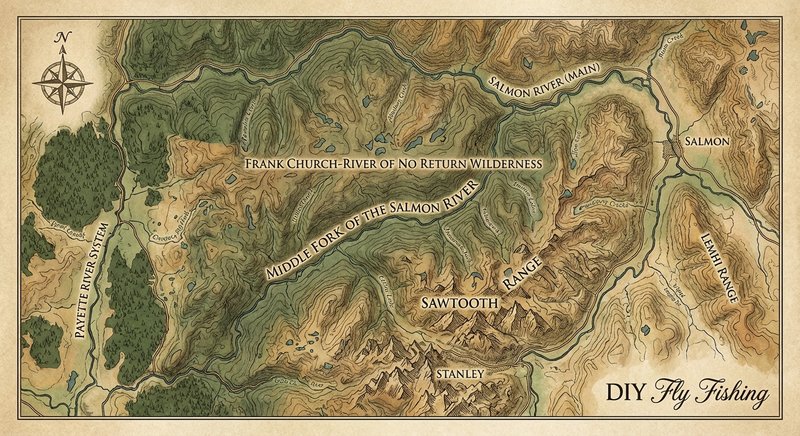
Middle Fork of the Salmon River
Fly fishing in Idaho · Advanced · Best seasons: Summer, Fall
Target Species
Cutthroat Trout, Rainbow Trout, Steelhead
About This Water
Wild and Scenic River through Frank Church Wilderness. World-class multi-day float trips for cutthroat and steelhead.
Fishing Recommendations
The Middle Fork of the Salmon River is widely considered the crown jewel of the American wilderness fishing experience. Flowing through the heart of the 2.3-million-acre Frank Church–River of No Return Wilderness in Idaho, it offers over 100 miles of free-flowing, crystal-clear water. This is not just a fishing trip; it is a pilgrimage into one of the most remote canyons in the Lower 48.
🎣 Location Overview
The Middle Fork is a high-gradient mountain river that drops nearly 3,000 feet over its 104-mile course. It is a "Wild and Scenic" river, meaning it remains undammed and retains its primordial character.
The river transitions from a tight, alpine forest environment at the put-in (Boundary Creek) to deep, dramatic granite gorges (the Impassable Canyon) near its confluence with the Main Salmon. The water is exceptionally clear, often allowing you to see trout holding 10 feet deep in emerald pools. Anglers love it because the fish are native, wild, and incredibly aggressive toward surface flies.
🐟 Target Species & Behavior
Westslope Cutthroat Trout
This is the star of the show. These are native, wild fish characterized by their brilliant orange "slash" under the jaw.
- Behavior: They are opportunistic feeders. Because the Middle Fork is nutrient-poor, these fish cannot afford to let a meal pass by. They are famous for rising to large dry flies even when no hatch is present.
- Holding Water: Look for "soft" water near fast currents—behind boulders, in foam lines, and in the "cushion" just in front of large rocks.
Rainbow Trout
While less common than Cutthroat, you will find wild Rainbows, particularly in the lower, warmer sections of the river. They tend to hold in slightly faster, more oxygenated riffles.
Steelhead
The Middle Fork is a critical spawning ground for B-run Steelhead.
- Behavior: These are "ghosts." They arrive in the Middle Fork in late fall and winter. Most trout anglers won't see them, but specialized fall trips can target them in the deep tail-outs and runs of the lower river.
📅 Best Times to Fish
Summer (July – August)
This is the prime window. Once the spring runoff subsides (usually by early July), the river clears and the dry fly fishing becomes legendary.
- Conditions: Warm days, cool nights. The fish are looking up.
- Prime Window: 10:00 AM to 6:00 PM. There is no need for "crack of dawn" starts here; the fish wake up as the sun hits the water.
Fall (September – October)
My personal favorite time. The crowds vanish, the canyon colors turn gold, and the larger fish become more aggressive before winter.
- Conditions: Lower water levels make the river more technical.
- Steelhead: Late October sees the first pulses of Steelhead moving into the lower sections.
🪰 Recommended Flies & Techniques
Top Fly Patterns
- Dries (The "Big & Ugly" approach):
- Chubby Chernobyl (Size 6-10) in Gold, Tan, or Purple.
- PMX (Parachute Madame X) in Royal or Olive.
- Stimulators (Size 8-12) in Orange or Yellow.
- Purple Haze (Size 12-16) for pickier fish in flat water.
- Nymphs:
- Pat’s Rubber Legs (Girdle Bug) in Coffee/Black.
- Prince Nymphs and Pheasant Tails (Size 12-14).
- Streamers:
- Olive or Black Wooly Buggers and Sculpzilla for the deep holes in the Impassable Canyon.
Techniques
- Hopper-Dropper: This is the standard Middle Fork rig. Use a buoyant Chubby Chernobyl on top with a 2-3 foot dropper to a weighted nymph.
- Pounding the Banks: If you are fishing from a raft, cast as close to the granite walls and boulders as possible. A fly landing 2 inches from the rock is 10x more effective than one 2 feet away.
- Skating Dries: Don't be afraid to give your dry fly a "twitch" or a short skate. Westslope Cutthroats love movement.
💡 Pro Tips & Local Knowledge
- The Velocity Transition: Look for where fast water meets slow water (seams). Middle Fork fish love to sit in the slow water and dart into the fast current to grab insects.
- Don't Overthink the Hatch: There are rarely massive, blanket hatches here. The fish are looking for "protein packages." If they aren't rising to a size 14 Adams, go bigger, not smaller.
- The "Attractor" Theory: Purple is a magic color on the Middle Fork. A Purple Chubby or a Purple Haze often outperforms natural colors.
- Wade with Caution: The rocks in the Middle Fork are famously slick and "greasy." Studded wading boots or felt (where legal) are highly recommended.
⚠️ Important Information
- Access: Access is primarily by boat. You must either win a permit through the Four Rivers Lottery System or book a trip with a licensed outfitter. Limited fly-in access is available via wilderness airstrips (like Indian Creek or Thomas Creek).
- Regulations: The Middle Fork is Catch and Release ONLY for all trout.
- Barbless Hooks: You must use single, barbless hooks. Pinch your barbs before you get on the water.
- Pack It Out: This is a pristine wilderness. All trash, including micro-trash (tippet ends), must be packed out.
- Safety: There is zero cell service. Carry a satellite communication device (InReach or Zoleo) and a robust first-aid kit.
The Middle Fork is a place where the fishing is often "too good to be true." Respect the resource, enjoy the silence of the canyon, and keep those native fish in the water!
Bug Hatches & Matching Flies
| Hatch | Type | Peak months | Time of day | Hook sizes | Matching flies |
|---|---|---|---|---|---|
| Salmonfly Pteronarcys californica | stonefly | June | All Day | #4-8 | Rogue Foam Stone #4-6, Sofa Pillow #6-8, Pteronarcys Nymph #4-8 |
| Golden Stonefly Hesperoperla pacifica | stonefly | June, July | Morning/Afternoon | #8-12 | Chubby Chernobyl (Golden) #8-12, Pat's Rubber Legs #8-12, Norm Wood Special #10-12 |
| Western Green Drake Drunella doddsii | mayfly | July | Afternoon | #10-12 | Hairwing Green Drake #10-12, Quigley Cripple #12, Green Drake Nymph #10-12 |
| Pale Morning Dun Ephemerella infrequens | mayfly | July, August | Late Morning/Early Afternoon | #14-18 | Parachute Adams #14-18, PMD Sparkle Dun #16-18, Pheasant Tail #14-18 |
| Spruce Moth Choristoneura occidentalis | terrestrial | August | All Day | #12-14 | Spruce Moth Dry #12-14, Elk Hair Caddis (Cream) #12-14 |
| Yellow Sally Isoperla sp. | stonefly | July, August | Afternoon/Evening | #14-16 | Yellow Stimulator #14-16, Little Yellow Sloan #16 |
| Grasshopper Acrididae family | terrestrial | August, September | Late Morning/Afternoon | #8-12 | Morrish Hopper #8-12, Dave's Hopper #10-12, Thunder Thighs Hopper #10 |
| October Caddis Dicosmoecus gilvipes | caddis | September, October | Afternoon | #8-12 | Orange Stimulator #8-10, Peeping Caddis #8-12 |
| Blue Winged Olive Baetis sp. | mayfly | April, May, September, October | Midday | #18-22 | BWO Parachute #18-20, RS2 #20-22, WD-40 #20 |