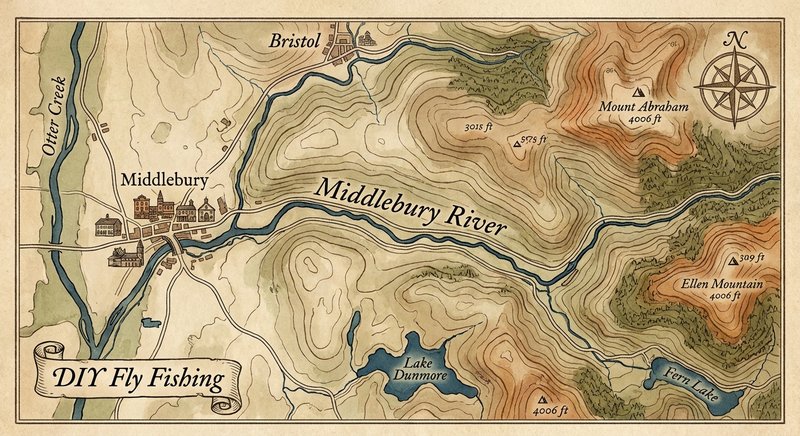
Middlebury River
Fly fishing in Vermont · Intermediate · Best seasons: Spring, Summer, Fall
Target Species
Brook Trout, Brown Trout
About This Water
Western Vermont stream flowing through Middlebury Gap. Native brook trout in upper reaches with browns below.
Fishing Recommendations
The Middlebury River is a quintessential Vermont freestone stream. It offers a dramatic transition from high-gradient mountain water to classic valley pocket water. Flowing out of the Green Mountain National Forest near Hancock and Ripton, it descends through the famous Middlebury Gorge before flattening out as it approaches its confluence with Otter Creek.
For the fly angler, it represents two distinct experiences: chasing feisty, wild brook trout in the headwaters and hunting larger, craftier brown trout in the lower reaches.
🎣 Location Overview
The Middlebury River is a "tale of two rivers." The Upper Middlebury (above the gorge) is a tumbling, high-elevation stream characterized by plunges, cold pools, and granite boulders. The Lower Middlebury (below the village) matures into a classic New England trout stream with long runs, riffles, and deep undercut banks.
What makes it special is its accessibility via Route 125 and its stunning scenery. You can fish under the canopy of the Green Mountains in the morning and be in a pastoral meadow by the afternoon. It is a freestone system, meaning its flow and temperature are dictated by snowmelt and rainfall, making it a dynamic and ever-changing fishery.
🐟 Target Species & Behavior
- Brook Trout: Found predominantly in the upper reaches near Ripton and the various feeder brooks. These are largely wild fish. They are opportunistic and aggressive but spook easily in the crystal-clear mountain water. They hold in the "cushion" in front of boulders and at the very head of plunge pools.
- Brown Trout: These dominate the water from the Middlebury Gorge down toward the Route 7 bridge. While there are wild browns, this section is also supplemented by state stocking. These fish are more selective and nocturnal. They hold in deeper "guts" of pools during the day and move into the riffles to feed at dusk.
📅 Best Times to Fish
- Spring (Late May – June): This is the "Golden Window." Once the spring runoff (mud season) subsides and the water hits 50°F, the insect activity explodes. Late May brings the legendary Hendrickson hatch.
- Summer (July – August): Focus on the Upper River. The lower sections can get too warm for trout health (above 68°F). In the mountains, however, the water stays cold. This is prime "dry-dropper" season.
- Fall (September – October): A spectacular time to be on the water. Brown trout become aggressive ahead of the spawn. Streamer fishing is most effective now, especially after a light rain.
- Time of Day: In the heat of summer, fish the first three hours of light. In the spring and fall, wait for the sun to warm the water slightly; the 11:00 AM to 3:00 PM window is usually best.
🪰 Recommended Flies & Techniques
Top Fly Patterns
- Dry Flies:
- Elk Hair Caddis (Tan/Olive, size 14-18) – The bread and butter of Vermont.
- Royal Wulff (size 12-16) – High visibility for the fast water of the upper river.
- Stimulator (Orange/Yellow, size 10-14) – Great for imitating golden stoneflies or grasshoppers.
- Nymphs:
- Pheasant Tail (size 14-18) – Mimics almost any mayfly nymph.
- Pat’s Rubber Legs (Black/Brown, size 8-12) – Essential for the stoneflies found in the Gorge.
- Zebra Midge (Red/Black, size 18-22) – For when the fish get picky in slower pools.
- Streamers:
- Wooly Bugger (Black or Olive, size 6-10) – The universal "meat" fly for big browns.
Techniques
- Pocket Water Nymphing: In the high-gradient sections, use a "Tight-Line" or Euro-nymphing style. High-sticking your rod allows you to navigate the complex currents between boulders.
- Dry-Dropper: This is the most effective way to cover the Middlebury. Use a buoyant Stimulator or Foam Hopper as your "bobber" and hang a small beaded Pheasant Tail 18 inches below it.
- Stealth Approach: Because the water is often very clear, stay low and wade slowly. Cast upstream and stay behind the fish's field of vision.
💡 Pro Tips & Local Knowledge
- The Route 125 Corridor: Much of the river is easily accessed from Route 125. However, the most successful anglers are those willing to hike 15 minutes away from the pull-offs. The fish near the bridges see a lot of flies; the fish half a mile upstream do not.
- The "Gorge" Safety: The Middlebury Gorge is beautiful but dangerous. The rocks are incredibly slippery, and the walls are steep. If you fish here, wear studded wading boots and consider a wading staff.
- The Otter Creek Confluence: Where the Middlebury River meets Otter Creek, the water slows down significantly. This area can hold surprisingly large "trophy" browns that move up from the main river to find cooler water or to feed on baitfish.
- Check the Gauges: The Middlebury River can rise rapidly after a thunderstorm. Check the USGS gauge for "Otter Creek at Middlebury" or nearby stations to ensure the water isn't "blown out" (chocolate milk color).
⚠️ Important Information
- Regulations: Vermont trout season generally runs from the second Saturday in April to October 31st. However, catch-and-release seasons may apply to certain sections. Always check the current Vermont Fish & Wildlife Law Digest.
- Permits: A valid Vermont Fishing License is required for everyone 15 years and older. You can purchase these online or at local shops in Middlebury.
- Wading Safety: The Middlebury is a classic freestone with "bowling ball" rocks. Felt soles (where legal) or vibram soles with studs are highly recommended.
- Respect Private Land: While much of the upper river is in the National Forest, the lower sections pass through private meadows. Always look for "Posted" signs and stay within the high-water mark. If a landowner is nearby, a friendly wave and a request for permission go a long way.
Guide’s Final Word: The Middlebury River rewards the observant angler. Spend five minutes watching the water before you make your first cast. Look for the "seams" where fast and slow water meet—that is where the Middlebury's trout are waiting for their next meal.
Bug Hatches & Matching Flies
| Hatch | Type | Peak months | Time of day | Hook sizes | Matching flies |
|---|---|---|---|---|---|
| Hendrickson Ephemerella subvaria | mayfly | April, May | Afternoon | #12-14 | Red Quill #12-14, Hendrickson Emerger #12-14, Pheasant Tail #12-14 |
| Blue-Winged Olive Baetis | mayfly | April, May, September, October | Late Morning/Afternoon | #18-22 | BWO Sparkle Dun #18-22, RS2 #20-22, Baetis Nymph #18-20 |
| Grannom Caddis Brachycentrus | caddis | May | Morning/Evening | #14-16 | Elk Hair Caddis (Dark) #14-16, LaFontaine's Deep Sparkle Pupa #14-16, Peacock Caddis #16 |
| March Brown Maccaffertium vicarium | mayfly | May, June | Afternoon | #10-12 | March Brown American #10-12, Hare's Ear Nymph #10-12, March Brown Wet Fly #12 |
| Sulfur Ephemerella dorothea | mayfly | June, July | Evening | #14-18 | Sulfur Dun #16-18, Sulfur Parachute #14-16, CDC Sulfur Emerger #16-18 |
| Light Cahill Stenacron candadense | mayfly | June, July | Evening/Dusk | #12-14 | Light Cahill #12-14, Cream Variant #14, Gold Ribbed Hare's Ear #14 |
| Golden Stonefly Acroneuria | stonefly | June, July | Morning/Evening | #8-12 | Golden Stone Nymph #8-12, Stimulator (Yellow) #10-12, Pats Rubber Legs #8-12 |
| Terrestrials Formicidae / Coleoptera | terrestrial | July, August, September | All Day | #12-18 | Cinnamon Ant #16-18, Black Foam Beetle #14-16, Dave's Hopper #10-12 |
| Zebra Midge Chironomidae | midge | January, February, March, November, December | Mid-day | #18-24 | Zebra Midge #18-22, Griffith's Gnat #20-24, Mercury Midge #20 |