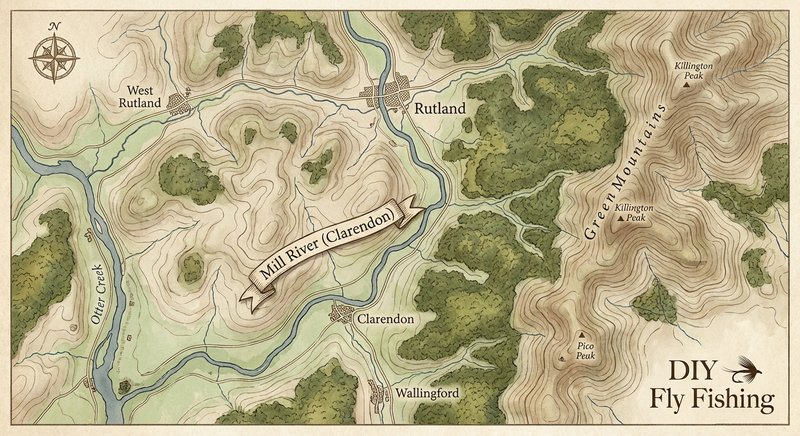
Mill River (Clarendon)
Fly fishing in Vermont · Beginner · Best seasons: Spring, Fall
Target Species
Brown Trout, Rainbow Trout
About This Water
Central Vermont stream with brown and rainbow trout. Good spring and fall fishing.
Fishing Recommendations
The Mill River in Clarendon, Vermont, is a hidden gem of the Green Mountain State. While often overshadowed by the larger Battenkill or the nearby Otter Creek, the Mill River offers some of the most diverse and scenic trout water in New England. As a tributary to the Otter Creek, it serves as a vital cold-water corridor and provides a "mountain stream" feel with "big river" potential.
🎣 Location Overview
The Mill River is a classic freestone stream that flows through Rutland County, characterized by its dramatic transition from rugged, tumbling mountain water to winding meadow stretches.
What makes this river special is the Clarendon Gorge. Here, the river has carved a deep limestone and schist chasm that creates massive, emerald-green pools and oxygen-rich pocket water. Anglers love the Mill because it offers a "choose your own adventure" experience: you can technical-nymph through the deep Gorge, cast dries in the riffles near the airport, or throw streamers in the lower reaches where it meets the Otter Creek.
🐟 Target Species & Behavior
The Mill River is managed by Vermont Fish & Wildlife as a cold-water fishery, seeing regular stockings supplemented by a healthy population of wild fish.
- Brown Trout: These are the kings of the Mill. You will find stocked browns throughout, but the Gorge and the deeper undercut banks in the lower sections hold wary, wild-born browns. They are opportunistic but cautious, often holding in the "cushion" in front of large boulders or deep in the shadows of the Gorge walls.
- Rainbow Trout: Generally more aggressive than the browns, the rainbows are heavily stocked near access points. They gravitate toward faster water, specifically the "tongue" of a pool or the bubbly "white water" where oxygen levels are highest.
- Brook Trout: While less common in the main stem in Clarendon, you will find wild brookies in the higher-elevation headwaters and cooler tributaries.
📅 Best Times to Fish
Optimal Seasons
- Spring (Late April – June): This is the "Golden Era" on the Mill. Once the spring runoff (snowmelt) subsides, the insect hatches are prolific.
- Fall (September – October): As temperatures drop, the brown trout become aggressive and mobile ahead of the spawn. The foliage makes this one of the most beautiful places on earth to cast a fly.
Best Times of Day
- Late Spring: 10:00 AM to 4:00 PM (Matching the heat of the day for hatches).
- Summer (If water temps allow): First light and last light are mandatory.
- Fall: Midday. As the water warms slightly in the afternoon sun, the fish become more active.
Prime Conditions
Look for a "falling barometer" or a slightly overcast day. The Mill River runs very clear; a little bit of "tannin" or cloudiness after a light rain provides the perfect cover for larger trout to move out of the deep holes.
🪰 Recommended Flies & Techniques
Top Fly Patterns
- Dry Flies:
- Hendrickson (Size 12-14): The quintessential Vermont spring hatch.
- Elk Hair Caddis (Size 14-18): Tan or Olive; works nearly all season.
- Royal Wulff / Stimulator: Excellent for the pocket water in the Gorge.
- Nymphs:
- Pheasant Tail (Size 14-18): Imitates various mayfly nymphs.
- Pat’s Rubber Legs (Size 8-12): In black or stone; essential for the turbulent water in the Gorge.
- Zebra Midge: Great for technical fishing in the slower pools.
- Streamers:
- Woolly Bugger (Black or Olive): The gold standard.
- Muddler Minnow: Works wonders during the grasshopper season or as a sculpin imitation.
Techniques
- High-Stick Nymphing: In the Gorge, long casts are your enemy. Use a weighted nymph under a high-visibility indicator and keep as much fly line off the water as possible to avoid the complex currents.
- The "Dry-Dropper": A Stimulator with a small Pheasant Tail dropped 18 inches below is the most effective way to cover the riffles in the Clarendon flats.
- Streamer Stripping: In the lower sections near Route 7, swing streamers through the deep bends to entice the larger holdover browns.
💡 Pro Tips & Local Knowledge
- The Gorge Entrance: Access the Clarendon Gorge via the Long Trail/Appalachian Trail parking area on Route 103. It’s a steep hike down, but the fishing pressure drops significantly once you get 500 yards away from the bridge.
- Stealth is Key: Because the water is often crystal clear, wear earth-toned clothing (greens and browns). Avoid "shiny" gear that might flash in the sun and spook the fish.
- Check the Temperature: During July and August, the Mill can get warm. If the water is over 68°F, give the fish a break and head further upstream or to higher-elevation tributaries where it’s cooler.
- The "Airport Flat": The stretch near the Rutland Southern Vermont Regional Airport offers easier wading and classic riffle-pool transitions that are perfect for beginners practicing their dry fly drift.
⚠️ Important Information
- Access: Much of the river runs through private land. Vermont has generous "unposted" access laws, but always look for signs. If a house is nearby, it is common courtesy to ask for permission.
- Wading Safety: Caution! The rocks in the Mill River, especially in the Gorge, are notoriously slippery. Felt-soled boots or studs are highly recommended. A wading staff is a lifesaver in the swifter sections.
- Regulations: Ensure you have a valid Vermont Fishing License. The Mill River generally follows General Trout Water regulations (open 2nd Saturday in April to Oct 31), but always check the current Vermont Fish & Wildlife Law Digest for any mid-season changes or specific length limits.
- Catch & Release: While some sections allow harvest, practicing catch and release (especially for wild fish) ensures the Mill remains a premier destination for years to come. Use barbless hooks for easier releases.
Bug Hatches & Matching Flies
| Hatch | Type | Peak months | Time of day | Hook sizes | Matching flies |
|---|---|---|---|---|---|
| Blue-Winged Olive Baetis spp. | mayfly | April, May, September, October | Midday | #18-22 | RS2 #18-22, BWO Sparkle Dun #18-20, Pheasant Tail Nymph #18-20 |
| Hendrickson Ephemerella subvaria | mayfly | May | Afternoon | #12-14 | Hendrickson Dark #12-14, Red Quill #14, Hendrickson Emerger #12-14 |
| Grannom Caddis Brachycentrus occidentalis | caddis | April, May | Morning/Afternoon | #14-16 | Grannom Pupa #14-16, Elk Hair Caddis (Olive/Black) #14-16, LaFontaine's Deep Pupa #14-16 |
| Sulphur Ephemerella invaria/dorothea | mayfly | June, July | Evening | #14-18 | Sulphur Parachute #14-18, Sulphur Cripple #16, Pheasant Tail #16-18 |
| Slate Drake Isonychia bicolor | mayfly | June, July, August, September | Afternoon/Evening | #10-12 | Iso Parachute #10-12, Zug Bug #10-12, Prince Nymph #10-14 |
| Light Cahill Stenacron interpunctatum | mayfly | June, July | Evening | #12-14 | Light Cahill #12-14, Gold Ribbed Hare's Ear #12-14 |
| Tan Caddis Hydropsyche spp. | caddis | June, July, August | Morning/Evening | #14-18 | Elk Hair Caddis (Tan) #14-18, Pulsating Emerger #16, Hydropsyche Larva #14-16 |
| Golden Stonefly Acroneuria spp. | stonefly | June, July | Morning/Evening | #8-12 | Pat's Rubber Leg #8-12, Golden Stimulator #10-12 |
| Ants and Beetles Formicidae / Coleoptera | terrestrial | July, August, September | All Day | #12-18 | Black Foam Ant #14-18, Chernobyl Ant #10-12, Flashback Beetle #14-16 |