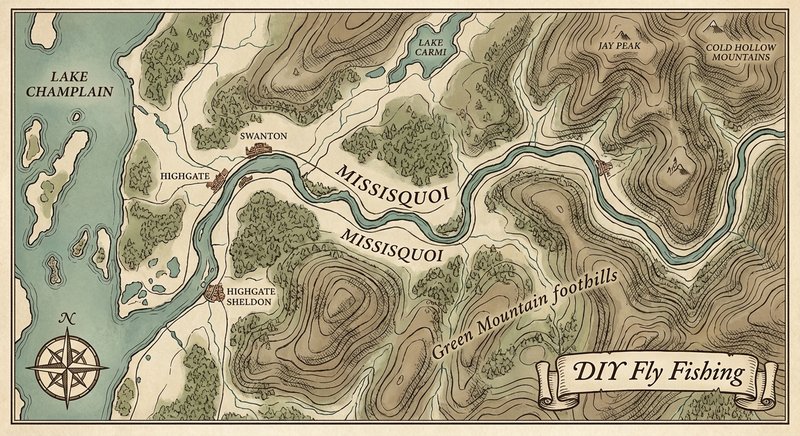
Missisquoi River
Fly fishing in Vermont · Intermediate · Best seasons: Spring, Summer, Fall
Target Species
Rainbow Trout, Brown Trout
About This Water
Northern Vermont river with excellent rainbow and brown trout fishing. Beautiful mountain scenery near Jay Peak.
Fishing Recommendations
The Missisquoi River is one of Vermont’s "hidden gems." While many anglers flock to the Winooski or the Battenkill, the Missisquoi offers a more rugged, less pressured experience in the quiet Northeast Kingdom and Franklin County. It is a "tale of two rivers": the upper sections are classic cold-water trout havens, while the lower sections transition into a warm-water fishery.
🎣 Location Overview
The Missisquoi River originates in Vermont, loops into Quebec, and returns to Vermont, eventually emptying into Lake Champlain. For the trout angler, the focus is primarily on the Upper Missisquoi—the stretch from the North Troy area down through Enosburg Falls.
What makes it special is its diversity. You’ll find classic freestone characteristics: brawling riffles, deep limestone-tinted pools, and long, glassy glides. Because it is further north and more remote than other major Vermont rivers, you will often have world-class water entirely to yourself. The scenery is quintessential Vermont—rolling farmland, covered bridges, and the backdrop of the Green Mountains.
🐟 Target Species & Behavior
- Brown Trout: The "kings" of the Missisquoi. The river holds a healthy population of wild browns and some very large holdovers. They are wary and light-sensitive. During the day, they tuck deep into undercut banks, submerged logs, and the dark shadows of boulders.
- Rainbow Trout: Often found in the faster, oxygenated water. Vermont Fish & Wildlife stocks several stretches (notably near Enosburg), but you will find "wild" acting holdovers in the swifter riffles.
- Feeding Behavior: These fish are opportunistic but can become highly selective during the massive Hendrickson or Caddis hatches. They are very "structure-oriented" due to the river's varied bottom.
📅 Best Times to Fish
- Spring (May – June): This is the peak. Once the spring runoff (snowmelt) subsides, the insect activity is explosive. Late May is prime for the legendary Hendrickson hatch.
- Summer (July – August): Water temperatures can rise. During this time, focus on the Upper River (North Troy to Jay) where the water stays cooler, or find the mouths of cold-water tributaries. Expert Tip: Only fish if water temps are below 68°F to ensure fish survival.
- Fall (September – October): A spectacular time to be on the water. Brown trout become aggressive as they prepare to spawn. Streamer fishing is highly effective now, and the Blue Winged Olive (BWO) hatches on overcast days can be prolific.
🪰 Recommended Flies & Techniques
Dry Flies
- Spring: Hendricksons (#12-14), Red Quills (#14), and Apple Bombers.
- Summer: Elk Hair Caddis (#14-18), Light Cahills (#14-16), and Terrestrials (Ants and Beetles are vital here).
- Fall: Blue Winged Olives (#18-22), Isonychia (#10-12).
Nymphs
- Golden Stoneflies: The Missisquoi has a lot of stonefly activity. Use size #8-12 Pat’s Rubber Legs.
- Classic Attractors: Pheasant Tails, Prince Nymphs, and Hare’s Ears (#14-18).
- Perdigons: For "Euro-nymphing" the fast riffles, fluorescent orange or green collars work well in the slightly tinted water.
Streamers
- Black Ghosts: A classic New England pattern that still slays here.
- Wooly Buggers: Black or Olive (#6-10).
- Articulated Streamers: For targeting trophy browns in the deep holes near Enosburg.
💡 Pro Tips & Local Knowledge
- The "Border Loop" Strategy: The stretch near North Troy where the river moves toward the Canadian border is some of the most consistent trout water. It stays cooler than the downstream sections and has excellent pocket water.
- Fish the "Broken Water": Many anglers focus on the big, easy-to-read pools. However, the biggest rainbows often sit in the "heavy" water—the bubbly, fast-moving sections that look too shallow or fast. High-stick nymphing these spots is a local secret.
- The "Evening Rise": In June and July, the river can look dead at 2:00 PM. Stick around until the last 45 minutes of light. The caddis activity on the Missisquoi can be frenetic right at dusk.
- Stealth Matters: Because the water can be clear in the summer, use long leaders (9-12 feet) and 5x or 6x fluorocarbon tippet when fishing dries.
⚠️ Important Information
- Access: Much of the river parallels Route 105. Look for VAST (Vermont Association of Snow Travelers) trails or bridge crossings. While Vermont has generous access laws, always respect "Posted" signs and ask permission if crossing private farmland.
- Regulations:
- The Missisquoi generally falls under General Trout Fishing rules, but always check the current Vermont Fish & Wildlife Law Digest.
- Note that some sections near the dams have specific "No Fishing" zones to protect spawning or migrating fish.
- Wading Safety: The Missisquoi has "slick" rocks. Felt soles (where legal) or studded boots are highly recommended. A wading staff is a life-saver in the heavier flows near Sheldon and Enosburg.
- Clean Your Gear: To prevent the spread of invasive species like Didymo (rock snot), always dry your waders completely or wash them with a mild bleach solution before moving to another watershed.
Bug Hatches & Matching Flies
| Hatch | Type | Peak months | Time of day | Hook sizes | Matching flies |
|---|---|---|---|---|---|
| Hendrickson Ephemerella subvaria | mayfly | April, May | Afternoon | #12-14 | Red Quill #12-14, Hendrickson Emerger #14, Pheasant Tail #12-14 |
| Blue-winged Olive Baetis / Drunella | mayfly | April, May, September, October | Late Morning/Afternoon | #18-22 | RS2 #18-22, Parachute BWO #18-22, WD-40 #20 |
| Grannom Caddis Brachycentrus | caddis | May | Morning/Evening | #14-16 | Grannom Pupa #14-16, Elk Hair Caddis (Olive/Black) #14-16, Peacock Caddis #16 |
| March Brown Maccaffertium vicarium | mayfly | May, June | Afternoon | #10-12 | March Brown American #10-12, Hare's Ear Nymph #10-12, March Brown Wet #12 |
| Golden Stonefly Acroneuria | stonefly | June, July | Evening | #6-10 | Golden Stone Nymph #6-10, Stimulator (Yellow) #8-12, Pats Rubber Legs #8-10 |
| Light Cahill Stenonema / Stenacron | mayfly | June, July | Late Evening | #12-16 | Light Cahill #12-16, Cream Usual #14, Gold Ribbed Hare's Ear #14 |
| Slate Drake Isonychia bicolor | mayfly | June, September | Afternoon/Evening | #10-12 | Isonychia Nymph #10-12, Parachute Iso #10-12, Zug Bug #12 |
| Spotted Sedge Hydropsyche | caddis | June, July, August | Evening | #14-18 | LaFontaine's Deep Sparkle Pupa #14-16, Elk Hair Caddis (Tan) #14-18, Soft Hackle Hare's Ear #16 |
| Trico Tricorythodes | mayfly | July, August, September | Early Morning | #20-24 | Trico Spinner #20-24, Trico Emerger #22, Griffith's Gnat #20-22 |