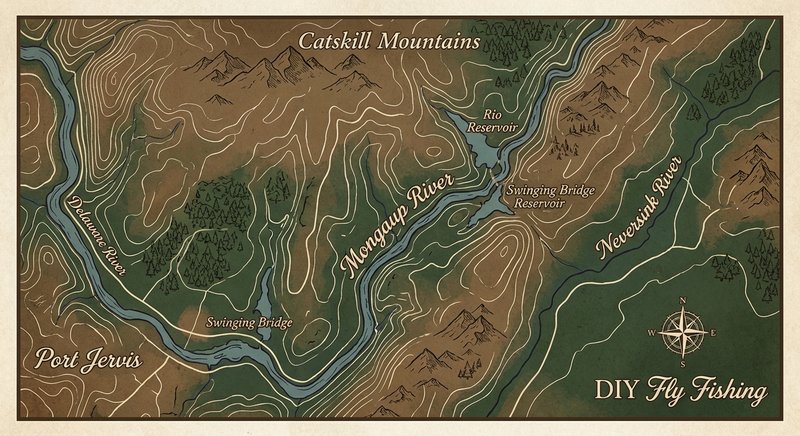
Mongaup River
Fly fishing in New York · Intermediate · Best seasons: Spring, Summer, Fall
Target Species
Brown Trout, Rainbow Trout
About This Water
Sullivan County tailwater with wild brown trout. Good dry fly fishing below dams.
Fishing Recommendations
Welcome to one of the hidden gems of the Catskill region. As your guide, I can tell you that the Mongaup River is a unique, rugged, and sometimes temperamental tailwater that offers a different experience than the nearby "Big Three" (the Beaverkill, Willowemoc, and Delaware).
Because the Mongaup is a hydroelectric river, it stays cold when other rivers are boiling, but it requires a high degree of situational awareness. Here is your comprehensive guide to fishing the Mongaup.
🎣 Location Overview
The Mongaup River flows through Sullivan and Orange Counties before emptying into the Main Stem of the Delaware River. It is characterized by its steep, forested banks, rocky pocket water, and significant elevation drops.
What makes it special is its role as a cold-water refuge. Because the water is released from the bottom of the Rio and Mongaup Falls reservoirs, it remains chilly even in the dog days of July and August. While the Upper Delaware might hit 70°F, the Mongaup often stays in the 50s. It feels more like a mountain stream in the Smokies or the Rockies than a typical New York river, featuring deep plunges, fast riffles, and massive boulders.
🐟 Target Species & Behavior
- Brown Trout: The primary resident. You’ll find a mix of stocked fish and hardy holdovers. In the lower sections near the confluence with the Delaware, you may encounter massive wild "run-up" Browns that enter the Mongaup to escape the heat or to spawn.
- Rainbow Trout: Found mostly in the swifter riffles and highly oxygenated "white water" sections. They are generally smaller than the Browns but exceptionally scrappy due to the heavy current they live in.
Behavior: These fish are "current-oriented." Because the flow can be heavy, they hold tight to the bottom and behind large "cushion" rocks. They aren't as selective as the Delaware fish, but they are very spooked by clumsy wading.
📅 Best Times to Fish
Optimal Seasons
- Spring (April – June): The prime window. Early spring brings heavy flows, but as things settle in May, the hatches are spectacular.
- Summer (July – August): While other NY rivers are too warm to fish safely, the Mongaup is the "emergency" backup. Fish early morning or late evening.
- Fall (September – October): Pre-spawn Browns become aggressive. This is the best time to throw large streamers for a trophy.
Best Times of Day
- Release Dependent: You must check the hydroelectric release schedule. If the turbines are spinning, the river can become unfishable and dangerous.
- Low Light: Early morning and the "magic hour" before dusk are best for dry fly activity.
🪰 Recommended Flies & Techniques
Top Fly Patterns
- Dry Flies:
- Early Season: Hendrickson (#12-14), Blue Winged Olives (#18-22).
- Summer: Sulphurs (#16-18), Light Cahills (#14), and big Terrestrials (Ants and Beetles are deadly here).
- The "Mongaup Special": Isonychia (#10-12). These large, purple/maroon dries work wonders in the broken water.
- Nymphs:
- Bead-head Pheasant Tails (#14-18), Hare’s Ear (#12-16), and Prince Nymphs.
- Perdigons in flashy colors work well in the deep, fast slots.
- Streamers:
- Wooly Buggers (Olive/Black), Black Ghosts, or small articulated patterns to mimic sculpins.
Presentation Tips
- High-Sticking/Euro Nymphing: Because the river is so rocky with complex currents, traditional indicator nymphing often leads to "drag." Using a long rod and a tight-line approach allows you to get the fly into the deep pockets behind boulders.
- Short Casts: Accuracy over distance. The terrain is tight; being able to "flick" a dry fly into a 1-foot pocket of calm water is the key to success.
💡 Pro Tips & Local Knowledge
- The Delaware Confluence: The last half-mile of the river before it hits the Delaware is legendary. During heat waves, "Big River" trout congregate here. Treat these fish with respect—they are stressed by the heat transition.
- The "Release" Factor: The Mongaup is a "peaking" power river. This means the water level can rise several feet in a matter of minutes. If you see the water start to get muddy or see sticks floating by, get out of the river immediately.
- Wading Safety: This river is notoriously slippery. Studded wading boots and a wading staff are not optional—they are mandatory. The "bowling ball" rocks are covered in slick algae.
- Stealth: Because the water is often crystal clear between releases, wear earthy tones (greens/browns) and avoid "lining" the fish.
⚠️ Important Information
- Access: Much of the river is accessible via Route 31 and Rio Dam Road. There is significant Public Fishing Rights (PFR) water, but pay close attention to "Posted" signs, as some sections are private.
- Regulations:
- Check the current NYSDEC Freshwater Fishing Regulations.
- The Mongaup has specific reach-based regulations; generally, it falls under the "Inland Trout" rules, but the section near the Delaware confluence may have different boundary rules.
- Permits: A valid New York State Fishing License is required.
- Cell Service: Spotty to non-existent in the gorge. Download your maps for offline use before you head out.
Guide’s Final Word: The Mongaup isn't for everyone. It’s physically demanding and requires constant attention to water levels. But if you want cold water in July and the chance at a wild Brown Trout in a stunning, deep-woods setting, there is nowhere better in the region. Tight lines!
Bug Hatches & Matching Flies
| Hatch | Type | Peak months | Time of day | Hook sizes | Matching flies |
|---|---|---|---|---|---|
| Blue-Winged Olive Baetis species | mayfly | April, May, September, October | Midday | #18-22 | RS2 #20-22, BWO Parachute #18-20, CDC Emerger #20-22 |
| Hendrickson Ephemerella subvaria | mayfly | April, May | Afternoon | #12-14 | Red Quill #12-14, Hendrickson Nymph #12-14, Snowshoe Rabbit Foot Emerger #14 |
| Grannom Caddis Brachycentrus | caddis | April, May | Morning/Afternoon | #14-16 | Peacock Caddis #14-16, Deep Sparkle Pupa #14-16, Elk Hair Caddis #14-16 |
| Sulphurs Ephemerella invaria / dorothea | mayfly | May, June | Evening | #14-18 | Sulphur Parachute #14-18, Pheasant Tail #14-18, Sulphur Cripple #16-18 |
| March Brown Maccaffertium vicarium | mayfly | May, June | Afternoon | #10-12 | March Brown American #10-12, Hare's Ear Nymph #10-12 |
| Isonychia (Slate Drake) Isonychia bicolor | mayfly | July, August, September | Late Afternoon/Evening | #10-12 | Iso Parachute #10-12, Prince Nymph #10-12, Zug Bug #10-12 |
| Light Cahill Stenonema ithaca | mayfly | June, July | Evening | #12-14 | Light Cahill Dry #12-14, Cream Usual #12-14 |
| Ants and Beetles Formicidae / Coleoptera | terrestrial | July, August, September | All Day | #14-18 | Black Foam Ant #16-18, Cinnamon Ant #14-16, Crowe Beetle #14-16 |
| Midges Chironomidae | midge | January, February, March, December | Late Morning | #20-24 | Zebra Midge #20-24, Griffith's Gnat #20-22 |