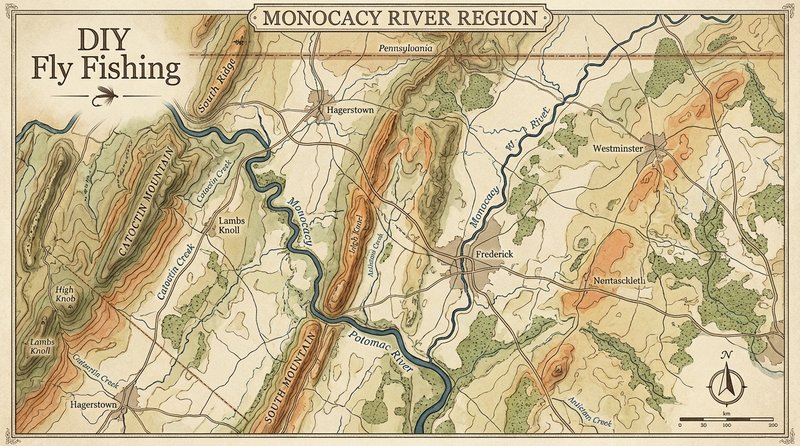
Monocacy River
Fly fishing in Maryland · Beginner · Best seasons: Spring, Summer, Fall
Target Species
Smallmouth Bass, Sunfish
About This Water
Central Maryland river with smallmouth bass. Good float fishing opportunities.
Fishing Recommendations
The Monocacy River is one of Maryland’s premier "warm water" fly fishing destinations. Flowing through the scenic rolling hills of Frederick County, it is a quintessential mid-Atlantic river characterized by slow-moving pools, limestone-influenced water, and an abundance of woody debris. While it is often overshadowed by the nearby Potomac, the Monocacy offers a more intimate experience, perfect for wading or kayaking.
🎣 Location Overview
The Monocacy is a "Scenic River" that winds approximately 58 miles through Maryland before emptying into the Potomac. What makes it special is its limestone influence; while not a true spring creek, it benefits from limestone springs in its drainage, which helps support a rich biomass of insects and crustaceans.
The river is generally shallow, with a bottom comprised of silt, cobble, and bedrock ledges. Because it drains a large agricultural area, the river is highly sensitive to rainfall. It can turn "chocolate milk" quickly and takes a few days to clear. When it’s "green" (slightly stained but visible), it is one of the most productive Smallmouth Bass fisheries in the region.
🐟 Target Species & Behavior
Smallmouth Bass (The "Bronze Back")
The star of the show. Monocacy Smallies are hardy and aggressive.
- Behavior: They are structure-oriented. Look for them in the "seams" where fast water meets slow water, behind large boulders, and especially around downed trees (blowdowns).
- Feeding: Their diet is heavy on crayfish and hellgrammites. They also forage on shiners, fallfish, and occasionally topwater terrestrial insects.
Sunfish (Bluegill, Redbreast, and Longear)
The Monocacy holds impressive numbers of Redbreast Sunfish, known for their vibrant orange bellies and feisty attitude.
- Behavior: They congregate in slower water near the banks and in the "slack" water behind bridge pilings.
- Feeding: They are opportunistic, eating anything from small nymphs to tiny poppers and foam beetles.
📅 Best Times to Fish
- Spring (Late April – Early June): This is the "trophy" window. As water temperatures hit 55–60°F, Smallmouth move into the shallows for the pre-spawn. They are aggressive and heavy.
- Summer (July – August): The best time for topwater action. Low water levels make wading easy. Fish early in the morning (dawn to 10 AM) or late in the evening to avoid the midday heat.
- Fall (September – October): As the water cools, bass go on a "feeding frenzy" to bulk up for winter. This is the best time for large streamers.
- Prime Conditions: Look for a stable or dropping river gauge (between 2.5 and 3.5 feet at the Frederick gauge is ideal for wading).
🪰 Recommended Flies & Techniques
Top Fly Patterns
- Streamers:
- Clouser Minnow: (Chartreuse/White or Olive/White) – The gold standard for the Monocacy.
- Murray’s Madtom: Designed specifically for these types of rivers.
- Woolly Bugger: (Size 4-8, Black or Olive) – Mimics leeches or hellgrammites.
- Nymphs/Subsurface:
- Hellgrammite Patterns: (Like the Pat’s Rubber Legs) – Fish these deep under an indicator or "high-sticked" through riffles.
- Crayfish Patterns: (Near-Nuff Crayfish) – Must be fished right on the bottom.
- Topwater:
- BoogleBugs: Highly durable foam poppers.
- Sneaky Petes: A slider-style fly that mimics a wounded minnow.
Techniques & Presentation
- The "Crayfish Hop": Cast a weighted fly slightly upstream, let it sink to the bottom, and use short, erratic strips to mimic a fleeing crayfish.
- Swing the Riffles: Cast streamers 45 degrees downstream into riffles and let the current swing the fly across the face of the "tailout" (where the water starts to deepen at the end of a riffle).
- Topwater "Pop and Pause": When using poppers, the pause is more important than the pop. Twitch it, let the rings dissipate, then twitch it again. Bass often strike when the fly is stationary.
💡 Pro Tips & Local Knowledge
- Stealth Matters: Because the Monocacy is often shallow and clear in the summer, Smallmouth are easily spooked. Long casts and a quiet approach are essential. Wear natural colors (tan/green) to blend into the bank.
- Focus on Ledges: The river has many underwater bedrock ledges that run perpendicular to the flow. These are "Smallmouth Highways." Always fish the downstream side of these ledges.
- The "Pinecliff to Buckeystown" Stretch: This is a classic float or wade. The area around Monocacy National Battlefield offers great history and excellent fishing, but be sure to check specific park access points.
- Gear Selection: A 9ft 6-weight rod is the perfect "all-around" tool for the Monocacy. It has enough backbone to throw heavy streamers into the wind but is still fun for sunfish.
⚠️ Important Information
- Access:
- Pinecliff Park: Great for family access and wading.
- Buckeystown Station: A popular spot for launching kayaks or wading upstream.
- Monocacy Boulevard/Route 28: Good access points for the lower river.
- Regulations: A valid Maryland Non-Tidal Angler’s License is required for anyone 16 or older.
- Wading Safety: The Monocacy bottom can be very slippery and uneven. Felt-soled boots or studs are highly recommended. Beware of "drop-offs" near bedrock ledges.
- Water Levels: Check the USGS Gauge for Monocacy River at Frederick. If it’s over 4 feet, wading becomes dangerous and the water is likely too muddy for fly fishing.
Bug Hatches & Matching Flies
| Hatch | Type | Peak months | Time of day | Hook sizes | Matching flies |
|---|---|---|---|---|---|
| White Fly Ephoron leukon | mayfly | August, September | Evening/Dusk | #12-14 | White Wulff #12-14, Ephoron Spinner #12-14, Snowshoe Emerger #14 |
| Trico Tricorythodes | mayfly | July, August, September | Morning | #20-24 | Trico Spinner #20-24, Trico Drown Spinner #22, Zebra Midge #20-22 |
| Hellgrammite Corydalus cornutus | other | May, June, July | All Day | #4-8 | Murray's Hellgrammite #4-8, Black Wooly Bugger #6-10, Rubber Leg Stone #8 |
| White Miller Caddis Nectopsyche | caddis | June, July, August | Evening | #14-16 | White Elk Hair Caddis #14-16, White LaFontaine Sparkle Pupae #14-16, White Stimulator #14 |
| Damselfly Enallagma | other | June, July, August | Midday | #10-14 | Adult Damselfly #10-12, Marabou Damselfly Nymph #12-14, Braided Butt Damsel #12 |
| Light Cahill Stenacron interpunctatum | mayfly | May, June | Evening | #12-14 | Light Cahill Dry #12-14, Gold Ribbed Hare's Ear #12-14, Light Cahill Parachute #14 |
| Blue-Winged Olive Baetis | mayfly | March, April, October, November | Afternoon | #18-22 | BWO Parachute #18-20, RS2 #20-22, Pheasant Tail Nymph #18-20 |
| Terrestrials (Ants/Beetles) Formicidae / Coleoptera | terrestrial | July, August, September | All Day | #12-18 | Chernobyl Ant #8-12, Black Foam Beetle #14-16, Cinnamon Flying Ant #16-18 |