Moose River
Fly fishing in Maine · Intermediate · Best seasons: Summer, Fall
Target Species
Brook Trout, Landlocked Salmon
About This Water
Moosehead Lake region stream with brook trout. Scenic wilderness fishing.
Fishing Recommendations
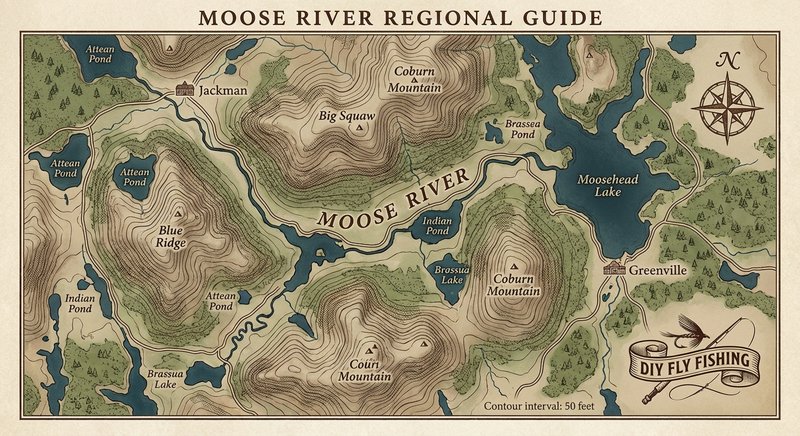
The Moose River in Northwestern Maine is one of the crown jewels of Northeast fly fishing. Connecting the waters between Jackman and Rockwood, specifically the stretch between Brassua Lake and Moosehead Lake (often called the "Lower Moose"), this river offers some of the finest opportunities in the country for trophy-sized wild Brook Trout and acrobatic Landlocked Salmon.
As your guide, here is the deep-dive intel you need to successfully fish the Moose.
🎣 Location Overview
The Moose River is a classic "pool and drop" Maine river. It is characterized by heavy, powerful runs, deep holding pools, and technical pocket water. What makes it special is its role as a migratory corridor. Large Landlocked Salmon and "Salter-sized" Brook Trout move out of the massive depths of Moosehead Lake and into the river to feed and eventually spawn.
The river has a "big water" feel compared to many small mountain streams in Maine. It requires careful wading and often rewards those who can make long, accurate casts across complex currents. The scenery is quintessential North Woods—thick evergreen forests, the occasional moose sighting, and crisp, clean air.
🐟 Target Species & Behavior
- Landlocked Salmon: These are the "silver bullets" of the Moose. They are known for high-speed runs and multiple jumps. In the summer, they hold in the fastest, most oxygenated water (the "heads" of pools). In the fall, they become aggressive and territorial as they prepare to spawn.
- Brook Trout: These are native, wild fish. Unlike the 6-inchers found in small brooks, the Moose River trout can reach 18–20+ inches. They are opportunistic feeders but become very selective during major hatches. They tend to hold in the "tail-outs" of pools or behind large boulders in the pocket water.
📅 Best Times to Fish
While spring is famous for the smelt run, you asked for Summer and Fall, which are arguably the most rewarding times for technical anglers.
- Summer (July – August):
- Focus: Early morning and late evening.
- Conditions: Water temperature is key. If the water hits 70°F, stop fishing to protect the trout. Look for "cold water refugia" where springs enter the river.
- The Draw: The Hexagenia (Hex) hatch in July. These massive mayflies bring the biggest fish in the river to the surface at dusk.
- Fall (September – September 30th):
- Focus: This is peak season. As temperatures drop, the big fish move up from Moosehead Lake.
- Conditions: Overcast, drizzly days are often better than bright sunshine.
- The Draw: Pre-spawn aggression. The fish turn beautiful shades of orange and red, and they are more willing to chase large streamers.
🪰 Recommended Flies & Techniques
Dry Flies
- Hexagenia Limbata (Size 6-8): Essential for July evenings.
- Caddis (Size 14-18): Elk Hair Caddis in tan or olive work throughout the summer.
- Stimulators (Size 8-12): Great for "searching" the pocket water in August.
- Blue Winged Olives (Size 18-22): Essential for cloudy fall days.
Nymphs
- Pheasant Tail & Hare’s Ear (Size 14-18): The standard.
- Prince Nymph (Size 12-14): Works well in the heavy flows of the Moose.
- Pupa Patterns: For when the caddis are active.
Streamers (The "Maine Way")
- Grey Ghost or Black Ghost (Size 6-10): Classic Maine patterns that mimic smelt.
- Muddler Minnow: Versatile; can be fished as a baitfish or a hopper.
- Wooly Buggers (Olive/Black): Especially effective in the fall when fish are aggressive.
Techniques
- The "Swing": Traditional Maine streamer fishing involves casting across and slightly downstream, letting the fly swing through the current, and adding small twitches.
- Nymphing: Use plenty of weight (split shot) to get down in the deep pools. A high-stick nymphing approach is effective in the pocket water.
💡 Pro Tips & Local Knowledge
- The "Upper Dam" Area: The stretch immediately below the Brassua Dam is a hotspot. The oxygenated water keeps fish active even when other parts of the river are slow.
- The "Smelt" Factor: Even in the fall, Landlocked Salmon are hard-wired to look for smelt. If the bite is slow, switch to a long, sparse white streamer.
- Wading Safety: The Moose has "slippery bowling ball" rocks. Felt soles (where legal) or studs are highly recommended. A wading staff is not a luxury; it’s a necessity here.
- The "Drop-Off": In the fall, focus on the very tail-ends of the pools just before the water breaks into the next rapid. Salmon often congregate here before moving up.
⚠️ Important Information
- Access: The most popular access point is in Rockwood. There are several dirt roads off Route 15/6 that lead to the river. A short hike is often required to reach the best water.
- Regulations:
- The Moose River has specific "Fly Fishing Only" (FFO) sections.
- Catch and Release is highly encouraged for all wild Brook Trout.
- Check the Maine IF&W Open Water Regulations for current bag limits and length requirements, as they change frequently.
- Permits: A valid Maine Freshwater Fishing License is required. You can buy these online or at local general stores in Rockwood or Jackman.
- The Environment: This is "Beano" country (local term for black flies). In early summer, bring heavy-duty bug repellent or a head net.
Guide’s Final Word: The Moose River rewards patience. Don't just cast blindly; watch the water for ten minutes before stepping in. Look for the "seams" where fast and slow water meet—that is where the legends live. Tight lines!
Bug Hatches & Matching Flies
| Hatch | Type | Peak months | Time of day | Hook sizes | Matching flies |
|---|---|---|---|---|---|
| Hendrickson Ephemerella subvaria | mayfly | May, June | Afternoon | #12-14 | Red Quill #12-14, Hendrickson Nymph #12-14, Hendrickson Emerger #14 |
| Blue-Winged Olive Baetis | mayfly | May, September, October | Afternoon | #18-22 | BWO Parachute #18-20, RS2 #20-22, Pheasant Tail #18-22 |
| Grannom Caddis Brachycentrus | caddis | May | Morning/Afternoon | #14-16 | Elk Hair Caddis (Olive) #14-16, Deep Sparkle Pupa #14-16, Holy Grail #16 |
| Alderfly Sialis | terrestrial | June, July | All Day | #10-14 | Alder Fly #10-12, Humpy Black #12-14, Z-Lon Caddis #12 |
| Giant Black Stonefly Pteronarcys dorsata | stonefly | June, July | Evening | #4-8 | Pat's Rubber Leg #4-8, Black Stimulator #6-10, Kaufmann Stone #6-8 |
| March Brown Maccaffertium vicarium | mayfly | June | Afternoon/Evening | #10-12 | March Brown Western #10-12, Hare's Ear Nymph #10-12, March Brown Wet Fly #12 |
| Light Cahill Stenacron candadense | mayfly | June, July | Evening | #12-16 | Light Cahill #12-16, Cahill Emerger #14-16, Gold Ribbed Hare's Ear #14-16 |
| Slate Drake Isonychia bicolor | mayfly | August, September | Afternoon | #10-14 | Iso Parachute #12-14, Isonychia Nymph #10-12, Zug Bug #12-14 |