Moose River
Fly fishing in New York · Intermediate · Best seasons: Summer, Fall
Target Species
Brook Trout, Smallmouth Bass
About This Water
Adirondack river system with brook trout and smallmouth bass. Multiple branches to explore.
Fishing Recommendations
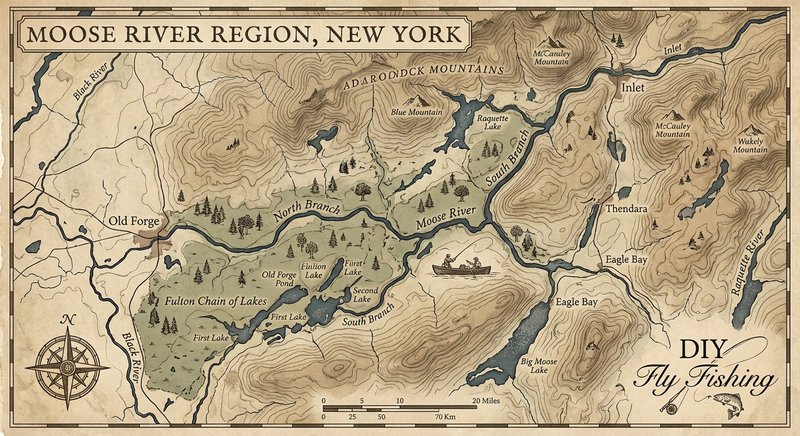
The Moose River is a crown jewel of the Adirondack Mountains. Spanning through Hamilton, Herkimer, and Lewis counties, it offers a diverse range of water—from high-altitude meadow streams to rugged, boulder-strewn canyons. Whether you are chasing wild "salters" (native brook trout) in the headwaters or bronze-back smallmouths in the lower reaches, the Moose provides a quintessential "North Country" experience.
🎣 Location Overview
The Moose River is characterized by its tea-colored, tannic water, a result of the surrounding hemlock and cedar forests. It is divided into three distinct branches:
- The North Branch: Generally smaller, cold, and famous for native Brook Trout.
- The Middle Branch: More accessible, featuring a mix of stocked and wild trout.
- The South Branch: The most remote and legendary section, flowing through the Moose River Plains. This area is a mix of slow-moving flat water and technical pocket water.
- The Main Stem: Below the confluence of the branches near McKeever, the river grows larger and warmer, transitioning from a trout fishery into one of the best Smallmouth Bass rivers in the region.
What makes it special is the solitude. Once you step away from the road access points, you are in true wilderness where the only other angler you might see is a black bear or a bald eagle.
🐟 Target Species & Behavior
Brook Trout
- Behavior: In the summer, Moose River Brookies are temperature-sensitive. They congregate near "cold water refugia"—spring seeps and the mouths of colder tributary streams. In the fall, they become aggressive and territorial as they prepare to spawn.
- Holding Spots: Look for them in deep undercut banks, behind large boulders in the "pocket water," and at the tail-outs of pools during evening hatches.
- Diet: Mayflies (Blue-Winged Olives, Isonychia), Caddis, and terrestrial insects (ants/beetles).
Smallmouth Bass
- Behavior: Found primarily in the lower sections (below Lyons Falls and toward the Black River). They are incredibly hard-fighting due to the river's current.
- Holding Spots: They love the "seams" where fast water meets slow water. In the summer, they sit in deep holes or under overhanging shaded banks. In the fall, they move to slower, deeper wintering holes but will crush large streamers to bulk up.
- Diet: Crayfish are the primary food source here, followed by sculpins and shiners.
📅 Best Times to Fish
Summer (July – August)
- Trout: Focus on the early morning (dawn till 10 AM) and the "witching hour" (sunset). Use a thermometer; if the water is over 68°F, stop trout fishing to protect the fish.
- Smallmouth: This is prime time. The warmer the water, the more active the bass. High noon is actually a great time for topwater bass action.
Fall (September – October)
- Trout: Late September is the peak for Brook Trout colors and activity. They move into shallower, gravelly runs. Note: Check local regulations as trout season typically ends Oct 15th on many sections.
- Smallmouth: October is "trophy season." As the water cools, the big females feed heavily. Look for "Indian Summer" days where a bit of sun warms the rocks.
🪰 Recommended Flies & Techniques
For Brook Trout
- Dry Flies: Ausable Wulff (a local legend), Royal Coachman, and Stimulators (Size 12-16). In late summer, use Black Ants and Cinnamon Flying Ants.
- Nymphs: Pheasant Tail (Size 14-18) and Gold-Ribbed Hare’s Ear.
- Technique: "High-sticking" through pocket water. Because the water is tannic, a fly with a bit of flash or a white wing (like the Wulff) helps you track it in the dark water.
For Smallmouth Bass
- Streamers: Woolly Buggers (Olive or Black), Sculpin patterns, and the Clouser Minnow (Chartreuse/White).
- Topwater: Sneaky Petes or small poppers in yellow or orange.
- Technique: The "Swing and Strip." Cast across the current, let the streamer swing, and provide erratic strips to mimic a wounded baitfish or a fleeing crayfish.
💡 Pro Tips & Local Knowledge
- The "Moose River Plains" Secret: If you have a high-clearance vehicle, drive into the Moose River Plains Wild Forest. The South Branch here is classic "creeking." It requires hiking, but the pressure is non-existent.
- Follow the Cold: In August, if the main river feels lukewarm, hike up any small tributary. Brook trout will stack up in these feeders where the water is 5-10 degrees cooler.
- Color Matters: In the dark, tannic water of the Moose, orange and yellow are high-visibility colors that triggers strikes. An orange-bodied Stimulator is a deadly "searcher" pattern here.
- The "Isonychia" Hatch: In late summer and early fall, the Isonychia (Slate Drake) hatch is prolific. These are large, dark mayflies. A size 10-12 dark dry fly can produce the biggest brook trout of your life during this hatch.
⚠️ Important Information
- Access: Much of the river is within the Adirondack Park (State Land), but there are private "clubs" and leases. Always look for yellow "State Land" markers. The McKeever area offers great public access for both trout (upstream) and bass (downstream).
- Regulations: New York State DEC regulations apply. Many sections are "Catch and Release" or have specific size limits. Always check the NYSDEC Freshwater Fishing Regulations before heading out.
- Safety: This is remote country. Cell service is spotty to non-existent. Always carry a map, a compass/GPS, and bear spray. The rocks in the Moose are notoriously slippery—studded wading boots and a wading staff are highly recommended.
- Bugs: In early summer, the black flies and "no-see-ums" are legendary. Bring heavy-duty repellent or a head net.
Bug Hatches & Matching Flies
| Hatch | Type | Peak months | Time of day | Hook sizes | Matching flies |
|---|---|---|---|---|---|
| Hendrickson Ephemerella subvaria | mayfly | May | Afternoon | #12-14 | Red Quill #12-14, Hendrickson Emerger #14, Pheasant Tail #12-14 |
| Quill Gordon Epeorus pleuralis | mayfly | April, May | Mid-day | #12-14 | Quill Gordon Dry #12-14, Hare's Ear #12-14 |
| Grannom Caddis Brachycentrus | caddis | May | Morning/Afternoon | #14-16 | Elk Hair Caddis (Olive) #14-16, LaFontaine's Deep Sparkle Pupa #14-16, Holy Grail #14-16 |
| March Brown Maccaffertium vicarium | mayfly | June | Afternoon/Evening | #10-12 | March Brown Dry #10-12, Gold Ribbed Hare's Ear #10-12 |
| Light Cahill Stenacron interpunctatum | mayfly | June, July | Evening | #12-14 | Light Cahill Dry #12-14, Cahill Emerger #14 |
| Isonychia (Slate Drake) Isonychia bicolor | mayfly | June, August, September | Late Afternoon | #10-12 | Zug Bug #10-12, Iso Parachute #10-12, Prince Nymph #10-14 |
| Golden Stonefly Acroneuria | stonefly | June, July | Evening/Night | #8-12 | Golden Stone Nymph #8-12, Stimulator (Yellow) #8-12 |
| Blue-Winged Olive Baetis | mayfly | May, September, October | Afternoon | #18-22 | BWO Sparkle Dun #18-22, RS2 #20-22 |
| Black Carpenter Ant Camponotus | terrestrial | July, August | All Day | #12-16 | Black Foam Ant #14-16, Chernobyl Ant #12 |