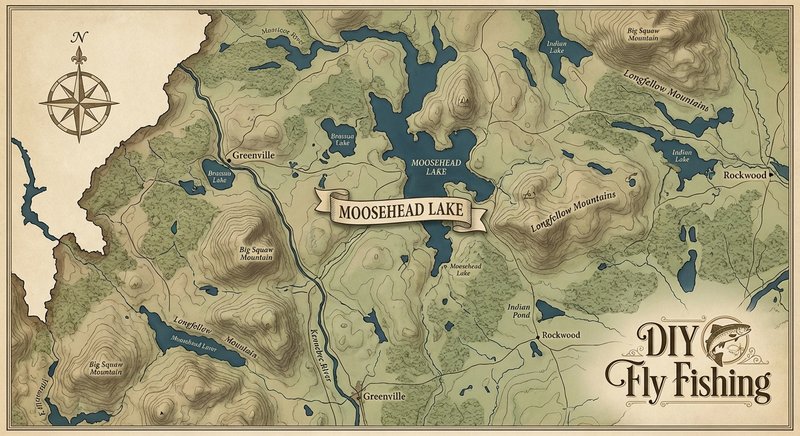
Moosehead Lake
Fly fishing in Maine · Intermediate · Best seasons: Spring, Summer, Fall
Target Species
Landlocked Salmon, Lake Trout, Brook Trout
About This Water
Maine's largest lake with landlocked salmon, lake trout, and brook trout. Wilderness fishing paradise.
Fishing Recommendations
Welcome to Moosehead Lake, the crown jewel of the Maine North Woods. At 40 miles long and covering nearly 75,000 acres, this is the largest mountain lake in the Eastern United States. As a guide, I consider this "big water" territory, but it offers some of the most technical and rewarding fly fishing for wild cold-water species in the country.
🎣 Location Overview
Moosehead is a deep, cold, oligotrophic lake surrounded by the rugged Longfellow Mountains. What makes it special is the sheer scale and the interconnectedness of its ecosystem. It is the headwaters for two of Maine’s legendary rivers: the Kennebec (East Outlet) and the Penobscot (West Outlet).
Anglers love Moosehead because it offers a "triple crown" of native and wild salmonids in a wilderness setting. The water is crystal clear and remains cold year-round in its depths, providing a refuge for prehistoric-sized Lake Trout and lightning-fast Landlocked Salmon.
🐟 Target Species & Behavior
Landlocked Salmon
These are the acrobats of the lake. They are descendants of Atlantic Salmon that became trapped inland after the last glacial retreat.
- Behavior: They are pelagic, following schools of Smelt (their primary food source).
- Holding: In early spring, they are found in the top 10 feet of the water column and near river mouths. As the water warms, they move deeper or congregate near oxygenated moving water.
Brook Trout (Squaretails)
Moosehead holds "trophy" class wild brookies, often reaching 3–5 pounds.
- Behavior: They are more structure-oriented than salmon. They hug rocky shorelines, sunken reefs (humps), and the mouths of the many tributary streams (like the Roach River).
- Feeding: They focus on smelt in the spring but switch to heavy insect hatches (Hexagenia limbata) in late June and July.
Lake Trout (Togue)
These are the giants of the deep.
- Behavior: They prefer water temperatures around 50°F. In the spring, they can be caught on a fly in the shallows. By summer, they drop to 60–100 feet.
- Feeding: Highly piscivorous; they eat smelt, sculpins, and even smaller trout.
📅 Best Times to Fish
Spring (Ice-Out to Mid-June) - Prime Window
- The Draw: This is the most famous time for fly anglers. As the ice clears (usually late April to early May), smelt move toward the shores and streams to spawn. The Salmon and Brookies follow them in a feeding frenzy.
- Conditions: Overcast, "fishy" days with a slight chop on the water are best.
Summer (July to August)
- The Draw: Evening hatches. While the lake fishing slows for Salmon, the East Outlet and West Outlet become world-class pocket water fisheries.
- Conditions: Focus on "The Hex" hatch in late June/early July. Large yellow mayflies bring the biggest trout to the surface at dusk.
Fall (September)
- The Draw: The spawning run. Salmon and Brookies begin staging at the mouths of the Kennebec and Roach Rivers.
- Conditions: Fish become aggressive and territorial. Their colors are spectacular this time of year.
🪰 Recommended Flies & Techniques
Streamer Fishing (The Maine Tradition)
The "Classic Maine Streamer" was invented for these waters. Trolling or casting these near shorelines is lethal.
- Top Patterns: Grey Ghost, Black Ghost, Mickey Finn, Herb Johnson’s Special, and the Governor Aiken.
- Modern Patterns: Thin Mints, Game Changers (white/silver), and Sculpin-Zilla.
- Technique: Use a fast-sink tip line. Cast toward rocky points or drop-offs, and use an erratic, "injured baitfish" strip.
Dry Flies
- Top Patterns: Hexagenia variants (Size 6-8), Royal Wulff, Stimulators, and Elk Hair Caddis.
- Technique: During the Hex hatch, "blind casting" near weed beds at dusk can result in heart-stopping surface takes.
Nymphing (In the Outlets)
- Top Patterns: Pheasant Tails, Prince Nymphs, and Golden Stoneflies.
- Technique: High-stick nymphing in the heavy riffles of the East Outlet.
💡 Pro Tips & Local Knowledge
- Follow the Wind: On a lake this size, the wind dictates where the food is. A "dead shore" (where the wind is blowing away from land) is usually quiet. Look for the "windward shore" where Smelt are pushed toward the rocks; the predators will be right behind them.
- The Roach River: If the lake is too rough to fish, head to the Roach River at Kokadjo. It’s a fly-fishing-only paradise that connects First Roach Pond to Moosehead.
- The "Smelt Run" Secret: If you find a small stream trickling into the lake in May, spend time there. Salmon will cruise the "apron" (the fan of silt where the stream meets the lake) waiting for smelt to drop back down.
- Structure is King: Use a GPS or depth map to find "The Humps." There are underwater mountains that rise from 100 feet to 20 feet. These are magnets for Lake Trout.
⚠️ Important Information
Access
- Greenville: The southern hub. Great for supplies and booking floatplanes.
- Rockwood: The central hub. This provides the best access to Mt. Kineo and the deeper central basins.
Regulations
- Fly Fishing Only (FFO): Many of the tributaries (like the Roach River and portions of the Outlets) are strictly FFO.
- Barbless Hooks: Highly recommended for catch and release, and required in certain sections.
- Boating Safety: Moosehead is dangerous. It can go from glass to 4-foot swells in 20 minutes. If you are in a canoe or small boat, stay close to shore and watch the horizon.
Permits
- A valid Maine Freshwater Fishing License is required. You can purchase these online via the Maine Department of Inland Fisheries & Wildlife (MDIFW) website.
Guide’s Final Word: Moosehead is a "thinking man's" fishery. You have to hunt for these fish, but when a 22-inch wild Landlocked Salmon hits your streamer and clears the water three times, you'll understand why this has been a pilgrimage site for fly anglers for over 150 years. Tight lines!
Bug Hatches & Matching Flies
| Hatch | Type | Peak months | Time of day | Hook sizes | Matching flies |
|---|---|---|---|---|---|
| Hexagenia (The Hex) Hexagenia limbata | mayfly | June, July | Dusk/Evening | #6-10 | Hexagenia Dry #6-8, Wiggle Nymph #8-10, Hex Emerger #8 |
| Green Drake Ephemera guttulata | mayfly | June | Afternoon/Evening | #8-12 | Green Drake Paradrake #10-12, Coffin Fly #8-10, Hare's Ear Nymph #10-12 |
| Hendrickson Ephemerella invaria | mayfly | May, June | Afternoon | #12-14 | Hendrickson Sparkle Dun #12-14, Red Quill #12-14, Pheasant Tail Nymph #12-14 |
| Grannom Caddis Brachycentrus | caddis | May | Morning/Afternoon | #14-16 | Elk Hair Caddis (Olive) #14-16, Deep Sparkle Pupa #14-16, LaFontaine Emerger #14-16 |
| Blue-Winged Olive (BWO) Baetis | mayfly | May, September, October | Afternoon | #18-22 | BWO Parachute #18-22, RS2 #20-22, Pheasant Tail #18-20 |
| Light Cahill Stenacron / Stenonema | mayfly | June, July | Evening | #12-16 | Light Cahill Dry #12-14, Cream Usual #14-16, Gold Ribbed Hare's Ear #14-16 |
| Flying Ants Formicidae | terrestrial | August, September | Afternoon | #16-20 | Black Flying Ant #16-18, Cinnamon Ant #16-20, Soft Hackle Ant #18 |
| Alderfly Sialis | caddis | June, July | Morning/Afternoon | #10-14 | Alder Fly #12, Black Zulu #10-14, Peacock Caddis #12-14 |