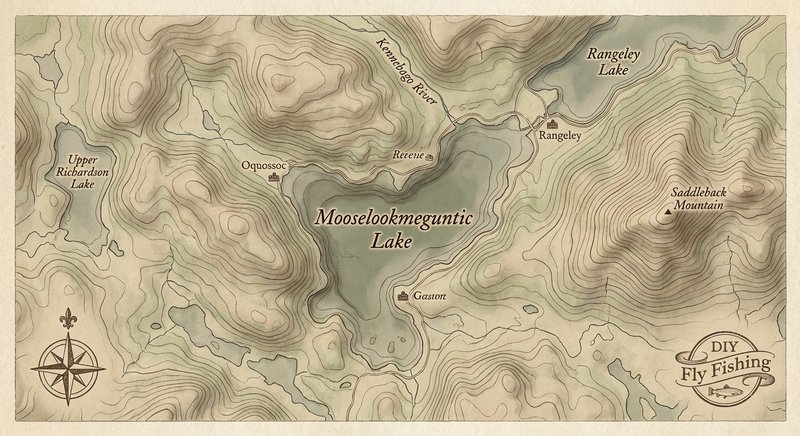
Mooselookmeguntic Lake
Fly fishing in Maine · Intermediate · Best seasons: Spring, Summer, Fall
Target Species
Landlocked Salmon, Brook Trout
About This Water
Rangeley region lake with landlocked salmon and brook trout. Scenic mountain setting.
Fishing Recommendations
Welcome to the "Big Lake." As your guide to the Rangeley Lakes region, I can tell you that Mooselookmeguntic Lake (often just called "Mooselook") is the crown jewel of Maine’s legendary fly fishing heritage. This is the birthplace of the Grey Ghost streamer and the stomping grounds of Carrie Stevens.
What makes Mooselook unique is that it is managed for wild fish. Unlike many other Maine lakes, the Brook Trout and Landlocked Salmon here are 100% wild, self-sustaining populations.
🎣 Location Overview
Mooselookmeguntic is the largest lake in the Rangeley chain, covering over 16,000 acres. It is a deep, cold, oligotrophic lake characterized by rocky shorelines, submerged reefs, and significant tributary inflows.
The lake is connected to Cupsuptic Lake to the north (they are essentially one body of water) and drains through the famous Upper Dam into Richardson Lake. Anglers love it because it offers a "big water" experience where you can catch a trophy Brook Trout of a lifetime (3–6 lbs) or a high-jumping Landlocked Salmon in a setting that looks exactly as it did 100 years ago.
🐟 Target Species & Behavior
Landlocked Salmon (Salmo salar)
- Behavior: These are aggressive, surface-oriented predators in the spring. They follow the Rainbow Smelt (their primary food source).
- Holding: In the spring, they are in the top 10 feet of the water column. In the heat of summer, they drop to the thermocline (30–50 feet).
- Feeding: Almost exclusively smelt, though they will rise for a massive Hexagenia hatch in late June.
Brook Trout (Salvelinus fontinalis)
- Behavior: Mooselook is famous for "cruising" brookies. They are more bottom-oriented than salmon but will move into the shallows when water temps are below 60°F.
- Holding: Look for rocky points, "humps" (underwater islands), and the mouths of tributaries like the Kennebago and Cupsuptic Rivers.
- Feeding: Smelt, caddis, stoneflies, and the legendary Hexagenia limbata (giant yellow mayflies).
📅 Best Times to Fish
Spring (Ice-out to Mid-June) – The Peak
- Window: As soon as the ice breaks (usually early to mid-May).
- Conditions: This is the best time for fly anglers. Salmon are near the surface and "smelt-hungry." Fishing near the shore and river mouths is highly productive.
Summer (July to August)
- Window: Early morning and late evening.
- Conditions: Water temperatures rise, and fish move deep. This is "sinking line" season. However, late June brings the Hex Hatch, which provides the best opportunity to catch a 5-pound Brook Trout on a dry fly at dusk.
Fall (September)
- Window: The entire month of September.
- Conditions: Fish begin staging near the mouths of rivers (Upper Dam, Kennebago, Cupsuptic) for their spawning runs. The Brook Trout take on brilliant orange spawning colors and become very aggressive.
🪰 Recommended Flies & Techniques
Streamer Fishing (The Classic Method)
This is the home of the "Rangeley Style" streamer—long, elegant flies tied on 3xl or 4xl hooks to mimic smelt.
- Top Patterns: Grey Ghost, Black Ghost, Herb Johnson Special, Mickey Finn, and the Governor Aiken.
- Technique: Trolling from a boat using a sinking tip or full sinking line. If casting, use a "strip-strip-pause" retrieve to mimic a wounded smelt.
Dry Fly Fishing
- Top Patterns: Hexagenia Limbata (Size 6-8), Elk Hair Caddis (Size 12-14), Stimulators, and Wulff patterns (Royal and Grey).
- Technique: Focus on the "slick" water near sunset during the Hex hatch. For salmon, "skittering" a dry fly across the surface can trigger a violent strike.
Nymphing
- Top Patterns: Pheasant Tail (Size 14-16), Prince Nymph, and large Golden Stonefly patterns.
- Technique: Best used near the mouths of the rivers or at Upper Dam. Use a strike indicator and fish the seams where the river current meets the lake stillwater.
💡 Pro Tips & Local Knowledge
- The "Upper Dam" Connection: The pool at Upper Dam (the outlet of Mooselook) is hallowed ground. If the lake is too windy, head here. It is Fly Fishing Only (FFO) and holds massive fish.
- Wind is Your Friend (To a Point): A "Rangeley Chop" on the water disguises your leader and stimulates the fish. If the water is glass-calm, salmon become very spooky.
- Follow the Smelt: If you see gulls diving or "boiling" water, get there immediately. Salmon push smelt to the surface, creating a feeding frenzy.
- The 55-Degree Rule: Landlocked salmon are most active when the water is exactly 55°F. Carry a thermometer; if you find that temp, you find the fish.
⚠️ Important Information
Access
- Haines Landing: Located at the end of Route 4 in Oquossoc. This is the primary boat launch and offers great access to the main body of the lake.
- Bug’s Cove/Toothaker Island: Great areas for those with motorized boats or sturdy canoes.
Regulations & Permits
- Wild Fish Policy: Mooselookmeguntic has specific length and bag limits to protect the wild population. Always check the current Maine Open Water Fishing Laws (Zone A).
- Barbless Hooks: While not always mandatory on the lake, it is highly recommended and often required in the connected "Fly Fishing Only" river sections.
- License: You must have a valid Maine Fishing License (available online at the MDIFW website).
Safety
- Weather: Mooselook is a massive body of water. It can kick up 3-to-4-foot swells in minutes. If you are in a canoe or small boat, stay close to the shoreline and watch the horizon for dark clouds moving in from the west.
Bug Hatches & Matching Flies
| Hatch | Type | Peak months | Time of day | Hook sizes | Matching flies |
|---|---|---|---|---|---|
| Hex (Giant Michigan Mayfly) Hexagenia limbata | mayfly | June, July | Late Evening/Dusk | #4-8 | Hexagenia Dry #6-8, Hex Nymph #4-8, Hex Emerger #6-8 |
| Grey Drake Siphlonurus rapidus | mayfly | June | Evening | #10-12 | Grey Drake Spinner #10-12, A.S.C. Grey Drake #12 |
| Flying Ants Formicidae | terrestrial | August, September | Afternoon | #16-22 | Black Flying Ant #16-20, Cinnamon Ant #18-22 |
| Cinnamon Caddis Hydropsyche | caddis | June, July | Evening | #14-18 | Elk Hair Caddis (Cinnamon) #14-16, LaFontaine's Deep Sparkle Pupa #16 |
| Blue-Winged Olive Baetis | mayfly | May, September, October | Afternoon | #18-22 | BWO Parachute #18-22, RS2 #20-22 |
| Early Brown Spinner Leptophlebia cupida | mayfly | May | Afternoon | #12-14 | Adams #12-14, Hare's Ear Nymph #12-14 |
| Green Drake Ephemera guttulata | mayfly | June | Evening | #8-12 | Green Drake Cripple #10, Coffin Fly #8-10 |
| Midges Chironomidae | midge | May, June, September | Morning/Evening | #20-28 | Zebra Midge #20-22, Griffith's Gnat #20-24 |
| Slate Drake Isonychia bicolor | mayfly | August, September | Afternoon | #10-14 | Isonychia Parachute #12, Zug Bug #10-12 |
| Grannom Caddis Brachycentrus | caddis | May | Morning/Afternoon | #14-16 | Grannom Pupa #14-16, Peacock Caddis #16 |