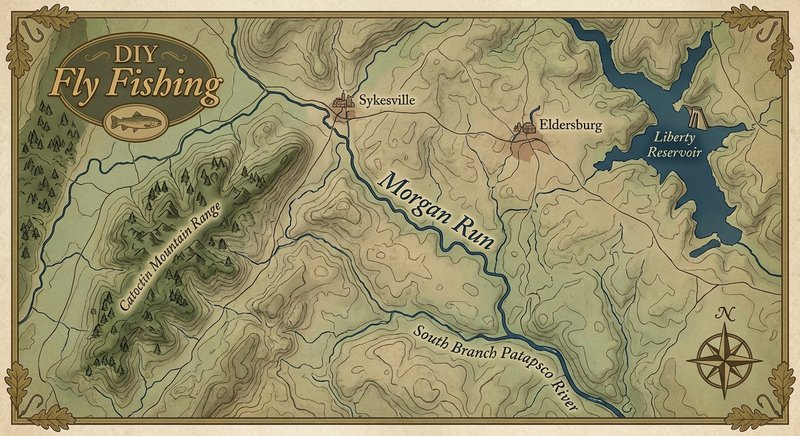
Morgan Run
Fly fishing in Maryland · Beginner · Best seasons: Spring, Fall
Target Species
Rainbow Trout, Brown Trout
About This Water
Carroll County stream with stocked trout. Easy access near Baltimore.
Fishing Recommendations
As an expert guide who has spent many seasons navigating the technical waters of the Mid-Atlantic, I can tell you that Morgan Run is one of Maryland’s most rewarding "chess match" streams. Located in Carroll County, just outside of Sykesville, it offers a serene escape from the Baltimore-DC sprawl.
Here is your comprehensive guide to fishing Morgan Run.
🎣 Location Overview
Morgan Run is a designated Catch and Release, Fly Fishing Only area managed by the Maryland DNR. What makes it special is its character: it is a classic freestone stream that feels much larger than it actually is. It features a mix of deep, slow-moving pools, undercut banks, and bubbly riffles.
Anglers love it because it demands technical proficiency. The canopy is tight, the water is often crystal clear, and the fish are notoriously "educated." It’s a place where stealth and presentation matter more than the price of your gear. Because of the special regulations, the trout stay in the system longer than in "put-and-take" waters, allowing them to acclimate and behave more like wild fish.
🐟 Target Species & Behavior
- Rainbow Trout: These are the primary residents, mostly stocked but often holding over for several seasons. They tend to hold in the faster oxygenated water at the heads of pools or in the "seams" where fast and slow water meet.
- Brown Trout: You’ll find fewer browns, but they are the prizes of Morgan Run. They are more secretive, usually hugging the undercut banks, submerged logs, or the darkest depths of the pools.
Behavior: Because this is a high-pressure, fly-only stream, the fish are sensitive to shadows and heavy wading. They feed primarily on small aquatic insects (Midges, Blue Winged Olives) but will aggressively chase terrestrial patterns in late summer and streamers during high-water events.
📅 Best Times to Fish
- Optimal Seasons:
- Spring (March – May): This is the prime window. Water temperatures are ideal (50–60°F), and the major hatches occur.
- Fall (October – November): The stream is restocked in the fall, and the cooling temperatures trigger the resident brown trout into pre-spawn aggression.
- Best Times of Day:
- Early Morning: Best for nymphing before the sun hits the water.
- Evening: Essential for dry fly action, especially during the "spinner falls."
- Prime Conditions: Overcast days are your best friend here. The low light masks your presence and encourages fish to move out from under cover.
🪰 Recommended Flies & Techniques
Top Fly Patterns
- Nymphs:
- Pheasant Tail (size 18-22): A staple for imitating small mayflies.
- Zebra Midge (size 20-24): Black or Red; effective year-round.
- Copper John (size 16-18): Good for deeper runs.
- Dry Flies:
- Adams/Parachute Adams (size 18-22): The ultimate generalist.
- Elk Hair Caddis (size 16-18): Great for the riffles.
- Blue Winged Olive (size 20-24): Essential for cloudy Spring/Fall days.
- Streamers/Terrestrials:
- Woolly Bugger (size 10-12): Olive or Black for high water.
- Dave’s Hopper or Foam Ants (size 14-16): Summer/Early Fall staples.
Techniques & Presentation
- The "High-Stick" Nymph: Because the current can be complex, use a tight-line or "Euro" style nymphing approach in the riffles to avoid drag.
- The Stealth Approach: Fish from the bank whenever possible. If you must wade, move like a heron. Waves from heavy wading will spook fish 30 feet upstream.
- Long Leaders: Use a 9-foot to 12-foot leader tapering down to 6X or 7X tippet. The thin diameter is necessary for the clear, slow pools.
💡 Pro Tips & Local Knowledge
- The "Klee Mill" Entrance: Most people park at the main lot on Klee Mill Road. If you want less pressure, be prepared to hike a half-mile downstream. The further you get from the bridge, the less "educated" the fish become.
- Focus on the Tail-outs: In the evening, fish move to the very back (tail-out) of the long pools to sip emerging insects. Cast your dry fly well above them and let it drift into the "slick."
- The "Ant" Trick: In the late summer and early fall, when the fishing seems dead, a tiny black ant pattern (size 20) dropped behind a dry fly often produces when nothing else works.
- Roll Casting is Key: The overhanging trees make back-casting difficult in the best spots. Practice your roll cast and side-arm casts before heading out.
⚠️ Important Information
- Access: The primary access point is the Morgan Run Natural Resources Management Area off Klee Mill Road. There is a designated parking lot and a well-maintained trail system.
- Regulations:
- Catch and Release Only.
- Fly Fishing Only (No bait, no spinning lures).
- Check the Maryland DNR website for any seasonal closures or special stocking announcements.
- Permits: A valid Maryland Non-Tidal Fishing License and a Trout Stamp are strictly required.
- Gear Recommendation: A 7.5ft to 9ft 3-weight or 4-weight rod is perfect. A 5-weight is okay but can feel "clunky" in the smaller sections of the run.
Guide’s Final Word: Morgan Run rewards the patient angler. Don't try to cover the whole river in one day. Find a good pool, stay low, and observe the water for 10 minutes before making your first cast. Tight lines!
Bug Hatches & Matching Flies
| Hatch | Type | Peak months | Time of day | Hook sizes | Matching flies |
|---|---|---|---|---|---|
| Blue Winged Olive Baetis tricaudatus | mayfly | March, April, October, November | Midday | #18-22 | RS2 #20-22, Parachute Adams #18-22, BWO Sparkle Dun #18-20 |
| Quill Gordon Epeorus pleuralis | mayfly | March, April | Afternoon | #12-14 | Quill Gordon Dry #12-14, Gold Ribbed Hare's Ear #12-14 |
| Hendrickson Ephemerella subvaria | mayfly | April | Afternoon | #12-14 | Hendrickson Dry #12-14, Red Quill Spinner #14, Pheasant Tail #12-14 |
| Tan Caddis Hydropsyche | caddis | April, May, June | Evening | #14-18 | Elk Hair Caddis #14-18, LaFontaine's Deep Sparkle Pupa #14-16, Holy Grail #16 |
| Sulfur Ephemerella invaria | mayfly | May, June | Late Afternoon/Evening | #14-18 | Sulfur Parachute #14-18, Sulfur Emerger #16-18, Pheasant Tail #16-18 |
| Trico Tricorythodes | mayfly | July, August, September | Early Morning | #22-26 | Trico Spinner #24-26, Griffith's Gnat #22-24 |
| Terrestrials Formicidae/Coleoptera | terrestrial | June, July, August, September | All Day | #12-18 | Black Foam Beetle #14-16, Cinnamon Ant #16-18, Dave's Hopper #12 |
| Zebra Midge Chironomidae | midge | January, February, March, December | Midday | #20-24 | Zebra Midge #20-24, WD-40 #20-22, Griffith's Gnat #20-22 |