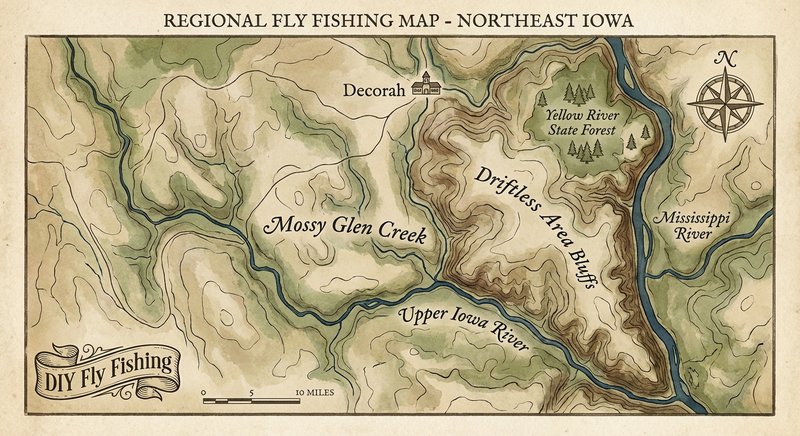
Mossy Glen Creek
Fly fishing in Iowa · advanced · Best seasons: spring, summer
Target Species
Brook Trout
About This Water
Clayton County stream with wild brook trout. Small stream through forested glen.
Fishing Recommendations
Welcome to the "Driftless Area" of Iowa. As your guide, I’m excited to walk you through one of the most scenic and rewarding small-stream experiences in the Midwest. Mossy Glen Creek is a hidden gem located in Clayton County, within the Mossy Glen State Preserve. It is rugged, intimate, and holds the ultimate prize for the Iowa angler: wild, self-sustaining Brook Trout.
🎣 Location Overview
Mossy Glen is not your typical Iowa pasture stream. Located near Strawberry Point, it flows through a deep, heavily timbered limestone canyon. The area is a State Preserve, meaning it is managed for its unique geological and botanical features as much as its fish.
The water is crystal clear, spring-fed, and remains cold even in the heat of July. The creek is characterized by a "stair-step" pool-and-riffle structure, with moss-covered limestone outcroppings and significant "deadfall" (downed trees) that provide excellent cover. It is a small, technical stream where a 20-foot cast is considered a long bomb.
🐟 Target Species & Behavior
Species: Wild Brook Trout (Salvelinus fontinalis). While you may occasionally find a stray Brown Trout, Mossy Glen is celebrated for its native-strain Brookies. These fish are not large—averaging 6 to 10 inches—but they are stunningly beautiful with vibrant halos and marbled "vermiculation" on their backs.
Behavior:
- Spooky: Because the water is so clear and the stream so small, these fish are extremely wary of overhead movement.
- Opportunistic: Due to the dense canopy, these fish rely heavily on "plop" snacks—insects falling from the trees.
- Holding Spots: Look for them at the very head of pools where the bubbles start to dissipate, or tightly tucked under limestone ledges and submerged logs.
📅 Best Times to Fish
Optimal Seasons
- Spring (Mid-April – May): This is the prime window. The water levels are stable, the stinging nettles haven't reached shoulder-height yet, and the first major insect hatches (Blue Winged Olives and Caddis) begin.
- Summer (June – August): Excellent fishing, but physically demanding. The canopy provides shade that keeps the water cold (usually below 65°F), which keeps the Brookies active when other streams get too warm.
Best Times of Day
- Morning: 7:00 AM to 11:00 AM.
- Evening: The last two hours of daylight are magical for dry fly action.
- Cloudy Days: On overcast days, the Brook Trout lose some of their inhibitions and will move further away from cover to feed.
🪰 Recommended Flies & Techniques
Top Fly Patterns
- Terrestrials (Summer Staple):
- Black Foam Ants (Size 16-18) – Absolutely essential.
- Japanese Beetles (Size 14-16).
- Dry Flies:
- Elk Hair Caddis (Tan or Olive, Size 16-18).
- Parachute Adams (Size 18-20) – Great for technical, flat water.
- Nymphs:
- Ray Charles or Scud patterns (Gray or Olive, Size 16-18) – The Driftless is "shrimp" country.
- Pheasant Tail (Size 18-20).
- Streamers:
- Small Black Wooly Bugger (Size 10-12) – Best used in the deeper holes during higher water.
Effective Techniques
- The Bow-and-Arrow Cast: You will use this more than a traditional overhead cast. The brush is thick; being able to "ping" a fly into a tight pocket is a required skill here.
- Stealth Approach: Fish from downstream to upstream. Stay low—literally crawl on your knees if you have to. If you see the fish, they have likely already seen you.
- Dry-Dropper: Use a buoyant foam ant as your indicator with a tiny unweighted pheasant tail nymph 12 inches below it.
💡 Pro Tips & Local Knowledge
- Gear Up Small: Leave the 9-foot 5-weight at home. A 7-foot to 7.5-foot 3-weight rod is the perfect tool for Mossy Glen. It handles the tight quarters and makes a 7-inch Brookie feel like a monster.
- The "One-Cast" Rule: In these small pools, your first cast is your only high-percentage shot. If you splash the line or snag a branch, move to the next pool. Brookies in small water have a high "alert" state.
- Mind the Vegetation: In mid-summer, the stinging nettles and wild parsnip can be brutal. Wear lightweight pants and long sleeves even if it's hot.
- Focus on the Preserve: The most productive water is within the State Preserve boundaries where the gradient is steeper and the water is colder.
⚠️ Important Information
- Access: Access is via a small parking area on the edge of the Mossy Glen State Preserve. Be prepared for a hike. The terrain is steep and can be slippery after rain.
- Regulations:
- Artificial Lures Only: In many of these sensitive Iowa Brook Trout streams, you are restricted to artificial flies and lures.
- Catch and Release: While some Iowa streams allow harvest, I strongly recommend 100% catch and release for Brook Trout in Mossy Glen to protect this fragile, wild population.
- License: You need a valid Iowa Fishing License and a Trout Fee (Trout Stamp).
- Respect the Land: As a State Preserve, it is "carry-in, carry-out." Do not disturb the rare flora found on the talus slopes (the rocky debris at the base of the cliffs).
Tight lines, and enjoy the quiet beauty of the Glen!
Bug Hatches & Matching Flies
| Hatch | Type | Peak months | Time of day | Hook sizes | Matching flies |
|---|---|---|---|---|---|
| Blue-Winged Olive (BWO) Baetis tricaudatus | mayfly | April, May, September, October | Late Morning/Afternoon | #18-22 | RS2 #18-22, Parachute Adams #18-22, Pheasant Tail #18-20 |
| Grannom Caddis Brachycentrus occidentalis | caddis | April, May | Afternoon/Evening | #14-16 | Elk Hair Caddis (Olive) #14-16, Deep Sparkle Pupa #14-16, Holy Grail Caddis #14-16 |
| Sulphur Ephemerella invaria | mayfly | May, June | Evening | #14-16 | Sulphur Parachute #14-16, CDC Bubbleback Emerger #14-16, Split Case Sulphur #14-16 |
| Trico Tricorythodes spp. | mayfly | July, August, September | Morning | #20-24 | Trico Spinner #20-24, Trico Drown Spinner #22-24 |
| Cinnamon Caddis Hydropsyche spp. | caddis | June, July, August | Evening | #16-18 | X-Caddis (Tan) #16-18, LaFontaine's Emergent Pupa #16-18 |
| Light Cahill Stenacron canadense | mayfly | June, July | Evening | #12-14 | Light Cahill #12-14, Gold Ribbed Hare's Ear #12-14 |
| Terrestrials (Grasshoppers/Ants) Orthoptera/Formicidae | terrestrial | July, August, September | All Day | #10-18 | Dave's Hopper #10-14, Black Foam Ant #16-18, Chernobyl Ant #12-14 |
| Scuds Gammarus lacustris | crustacean | January, February, March, April, May, June, July, August, September, October, November, December | All Day | #14-18 | Ray Charles #14-18, Pink Scud #14-16, Sowbug #14-18 |
| Midges Chironomidae | midge | January, February, March | Midday | #20-24 | Zebra Midge #20-24, Griffith's Gnat #20-22 |