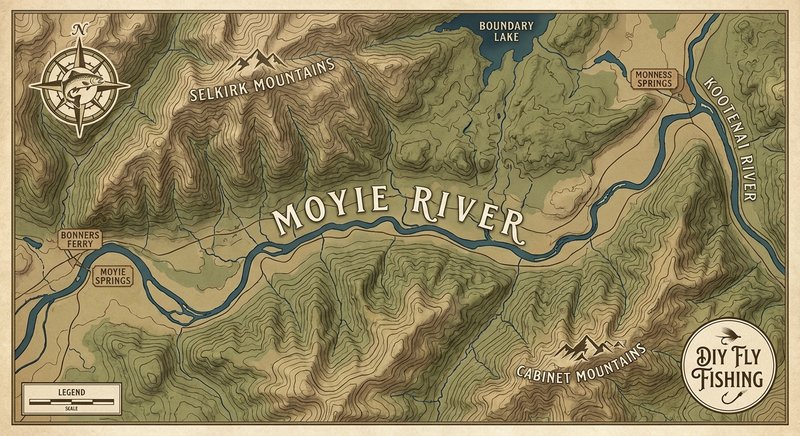
Moyie River
Fly fishing in Idaho · Intermediate · Best seasons: Summer, Fall
Target Species
Cutthroat Trout, Bull Trout
About This Water
Northern Panhandle stream near Canadian border. Native cutthroat and bull trout.
Fishing Recommendations
The Moyie River in the northern tip of the Idaho Panhandle is one of the state’s best-kept secrets. Flowing out of British Columbia and carving through a rugged canyon before joining the Kootenai River, the Moyie offers a true "off-the-beaten-path" experience. It is a classic freestone river characterized by crystal-clear water, steep canyon walls, and a relative lack of fishing pressure compared to the more famous rivers to the south.
🎣 Location Overview
The Moyie is a river of two personalities. The upper section (near the Canadian border) is smaller and more intimate, while the lower section below the Moyie Dam transitions into a dramatic, boulder-strewn canyon.
What makes the Moyie special is its remoteness and purity. It is a high-gradient river with rapid oxygenation, creating a paradise for native trout. Anglers love it because the fish are generally opportunistic and less "technical" than those in the Henry's Fork or Silver Creek. Here, you aren't just fishing; you are navigating a wilderness environment where you’re more likely to see a moose or a bear than another angler.
🐟 Target Species & Behavior
Westslope Cutthroat Trout
The star of the show. These fish are beautiful, featuring vibrant orange slashes and dark spotting near the tail.
- Behavior: They are highly surface-oriented. Even when there isn’t a visible hatch, they will often rise to an attractant pattern.
- Holding Water: Look for "soft" water. They sit in the foam lines, the tail-outs of pools, and right against the large granite boulders that break the current.
Bull Trout
The "apex predator" of the system. While Cutthroat provide the action, Bull Trout provide the adrenaline.
- Behavior: They are piscivorous (fish-eaters). They stay deep in the darkest, coldest holes and under undercut banks.
- Feeding: They often shadow schools of smaller whitefish or cutthroats. It is not uncommon for a Bull Trout to "bow wake" toward a 10-inch Cutthroat you are currently reeling in.
📅 Best Times to Fish
Summer (Late June – August)
This is the prime window. Once the spring runoff subsides (usually by late June), the river becomes wadeable.
- Peak Window: July is the month of the Golden Stonefly and the start of the terrestrial season.
- Time of Day: Morning and late evening are best, but because of the deep canyon shadows, you can often find a midday dry fly bite.
Fall (September – October)
The Moyie turns magical in the fall. The water drops and clears further, and the larch trees turn gold.
- Peak Window: September brings the Hecuba (Great Red Quill) and Mahogany Duns.
- Conditions: Cooler water temperatures trigger the Bull Trout to become more aggressive as they prepare for their spawning run.
🪰 Recommended Flies & Techniques
Dry Flies (The Moyie Staple)
- Attractors: Chubby Chernobyl (Size 8-12) in gold, olive, or purple.
- Mayflies: Parachute Adams (14-18), Purple Haze (14-16).
- Terrestrials: Morrish Hopper (10-12), Dave’s Hopper, and Black Ants (16-18) for the late summer "sneaky" bite.
Nymphing
- Patterns: Pat’s Rubber Legs (8-12) in coffee/black, Prince Nymphs (12-14), and Tactical Jighead Pheasant Tails.
- Technique: Use a "Dry-Dropper" rig. The Moyie isn't so deep that you need a heavy indicator rig; a Chubby Chernobyl with a bead-head nymph 2-3 feet below it covers 80% of the water.
Streamers (For Bullies and Large Cutthroats)
- Patterns: Sex Dungeon (White or Olive), Sparkle Minnow, or any large articulated streamer that mimics a whitefish or small trout.
- Technique: Swing the deep pools or "strip and pause" through the slower canyon runs.
💡 Pro Tips & Local Knowledge
- Pocket Water is King: Many anglers walk past the "riffly" water to get to the big deep pools. On the Moyie, the Cutthroat love the 2-to-3-foot deep pocket water behind mid-river boulders.
- The "Stealth" Approach: The water is exceptionally clear. Avoid wearing bright colors and try to stay low when approaching a pool. If you can see the fish, they’ve likely already seen you.
- Hike the Canyon: The areas furthest from the road bridge access points hold the largest unpressured fish. Be prepared for some light bushwhacking and rock scrambling.
- The "Bull Trout Tax": If you hook a Cutthroat and it suddenly feels like you snagged a log that started moving—hold on. That’s a Bull Trout trying to steal your catch.
⚠️ Important Information
Access
- Upper River: Access via Meadow Creek Road or various pull-offs along Highway 95.
- Lower River: Access is more difficult due to the canyon. Look for the Moyie River Road which follows the river for several miles.
Regulations & Permits
- Bull Trout: These are a protected species under the Endangered Species Act. In Idaho, you generally cannot intentionally target Bull Trout in the Moyie (check the latest Idaho Fishing Seasons and Rules for specific drainage closures). If you catch one incidentally, keep it in the water and release it immediately.
- Cutthroat: Barbless hooks are highly recommended to preserve the fishery.
- License: You will need a valid Idaho Fishing License.
Safety
- Wildlife: This is Grizzly Bear and Black Bear country. Carry Bear Spray and know how to use it.
- Wading: The rocks in the Moyie are notoriously slick and often "rolly." Felt soles (where legal) or studded boots and a wading staff are highly recommended.
- Cell Service: Virtually non-existent in the canyon. Tell someone where you are going and when you expect to return.
Bug Hatches & Matching Flies
| Hatch | Type | Peak months | Time of day | Hook sizes | Matching flies |
|---|---|---|---|---|---|
| March Brown Rhithrogena morrisoni | mayfly | April, May | Midday | #12-14 | Western March Brown #12-14, Hare's Ear #12-14, March Brown Emerger #14 |
| Salmonfly Pteronarcys californica | stonefly | June | All day | #4-8 | Rogue River Stone #4-8, Pat's Rubber Leg #6-10, Chubby Chernobyl #6-10 |
| Golden Stone Hesperoperla pacifica | stonefly | June, July | Afternoon/Evening | #8-12 | Golden Stimulator #8-12, Kaufmanns Stone #8-12, Norm Wood Special #10-12 |
| Pale Morning Dun Ephemerella excrucians | mayfly | June, July | Late Morning/Early Afternoon | #16-18 | PMD Sparkle Dun #16-18, Pheasant Tail #16-18, RS2 #18 |
| Western Green Drake Drunella doddsii | mayfly | June, July | Afternoon | #10-12 | Green Drake Hairwing #10-12, Quigley's Green Drake Stacklight #10-12, Mercer's Poxyback Drake #10-12 |
| Little Yellow Sally Isoperla spp. | stonefly | July, August | Evening | #14-16 | Yellow Sally Stimulator #14-16, Iron Sally #14-16, Sallie Emerger #16 |
| Spotted Sedge Hydropsyche | caddis | July, August, September | Evening | #14-18 | Elk Hair Caddis #14-18, LaFontaine's Deep Sparkle Pupa #14-16, Goddard Caddis #14-16 |
| Blue Winged Olive Baetis spp. | mayfly | March, April, September, October | Midday | #18-22 | BWO Parachute #18-22, JujuBaetis #20-22, Cdc BWO Emerger #18-20 |
| Terrestrials N/A | terrestrial | August, September | All day | #8-16 | Morrish Hopper #8-12, Black Foam Ant #14-16, Cinnamon Ant #14-16 |