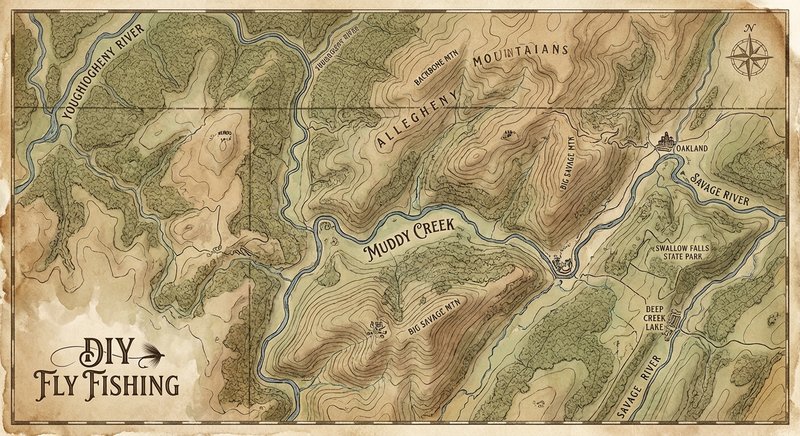
Muddy Creek
Fly fishing in Maryland · Intermediate · Best seasons: Spring, Summer, Fall
Target Species
Brook Trout
About This Water
Western Maryland brook trout stream in Garrett County. Native fish in pristine water.
Fishing Recommendations
Welcome to the "Wild West" of Maryland. Muddy Creek, located in the high plateau of Garrett County within the Appalachian Mountains, is one of the state's most storied and scenic native brook trout fisheries. Unlike the limestone spring creeks of central Maryland, Muddy Creek is a rugged, freestone environment that offers a true wilderness experience.
Here is your comprehensive guide to fly fishing Muddy Creek.
🎣 Location Overview
Muddy Creek flows through the Garrett State Forest and Swallow Falls State Park. What makes this water special is its character: it is a high-gradient, tannic-stained (tea-colored) stream hemmed in by ancient hemlocks and dense rhododendron thickets.
The water is slightly acidic due to the surrounding forest and peat, which gives it that classic "mountain branch" look. Anglers love it because it represents Maryland’s best effort at preserving the Native Eastern Brook Trout. This isn't a place for trophy-sized fish; it is a place for purists who value solitude, technical casting, and the vibrant, incomparable colors of a wild trout.
🐟 Target Species & Behavior
The star of the show here is the Native Brook Trout (Salvelinus fontinalis).
- Behavior: These fish are highly opportunistic but extremely "spooky." In the crystal-clear (though dark-tinted) water, they can see an angler from a distance. They are the masters of the "micro-lie"—they will hold in pockets of water no larger than a dinner plate.
- Where they hold: Look for "slack water" behind large boulders, undercut banks shaded by rhododendrons, and the head of deep pools where oxygen levels are highest.
- Feeding: Because of the lower nutrient levels in freestone streams, they aren't picky eaters, but they are fast. You have a split second to set the hook before they realize your fly isn't real.
📅 Best Times to Fish
Optimal Seasons
- Spring (April – June): This is the prime window. Water levels are usually stable, and the first major insect hatches occur. The forest is blooming, and the fish are hungry after the lean winter.
- Summer (July – August): Unlike many Maryland streams, Muddy Creek stays relatively cool due to its high elevation and heavy canopy. However, water levels can get very low. This is "terrestrial season."
- Fall (September – October): A magical time. The Brookies are in their spawning colors (fiery oranges and deep reds). Fishing is excellent, but please avoid stepping on redds (spawning beds) in late October.
Best Times of Day
- Late Morning to Mid-Afternoon: In the spring, the water needs to warm up a few degrees to trigger insect activity.
- Early Morning/Dusk: In the heat of summer, stick to the edges of the day to find the most active fish.
🪰 Recommended Flies & Techniques
Top Fly Patterns
- Dry Flies:
- Royal Wulff (Size 14-16): High visibility and floats well in turbulent water.
- Elk Hair Caddis (Size 16-18): A staple for Garrett County.
- Adams (Size 16-20): Perfect for matching various Mayfly hatches.
- Terrestrials (Summer Must-Haves):
- Black Foam Ants (Size 18-22): Often the only thing they will hit in August.
- Cricket patterns or small Beetles.
- Nymphs:
- Pheasant Tail (Size 18-20): Slim profile for technical drifts.
- Gold-Ribbed Hare's Ear (Size 16-18): Great for the deeper pools near the falls.
Techniques & Presentation
- The "Bow-and-Arrow" Cast: The canopy is tight. You will rarely have room for a traditional backcast. Mastering the bow-and-arrow cast is essential to get your fly under overhanging branches.
- Short Line Nymphing: Forget long casts. Most of your fishing will be done within 10–15 feet of your rod tip.
- Stealth: Wear drab colors (greens and browns) to blend into the forest. Kneel when approaching a pool. If you can see the fish, they have likely already seen you.
💡 Pro Tips & Local Knowledge
- The Tannic Tint: The water looks darker than it is. Don't be afraid to use flies with a bit of flash (like a Flashback Pheasant Tail) to help the fish spot the fly in the tea-colored depths.
- Think Small: While these fish are opportunistic, they live in a "small food" environment. A size 14 fly is "big" here. If you're getting strikes but no hookups, downsize to a size 20.
- The "Blue Line" Strategy: Don't just fish near the parking lots in Swallow Falls State Park. Hike upstream into the Garrett State Forest sections. The further you walk, the more aggressive (and less pressured) the fish become.
- Gear Selection: Use a 2-weight or 3-weight rod, ideally 6 to 7.5 feet in length. A long rod is a liability in the thick brush of Muddy Creek.
⚠️ Important Information
- Access: Access is best via Swallow Falls State Park (entry fee required) or through various forest service roads in Garrett State Forest. Be prepared for some rugged hiking.
- Regulations: Much of Muddy Creek is designated as a Wild Trout Management Area.
- Catch and Release Only.
- Artificial Lures/Flies Only (No bait).
- Check the current Maryland DNR Freshwater Fishing Guide for seasonal updates.
- Safety:
- Slippery Rocks: The rocks in Muddy Creek are notoriously slick. Felt soles or studs are highly recommended.
- Cell Service: Expect zero bars. Download your maps for offline use before heading into the forest.
- Bears: This is black bear country. Keep your snacks sealed and be aware of your surroundings.
Guide’s Final Word: Muddy Creek is a jewel of the Mid-Atlantic. Respect the native Brookies—keep them in the water, use barbless hooks, and enjoy the silence of the Garrett County woods. Tight lines!
Bug Hatches & Matching Flies
| Hatch | Type | Peak months | Time of day | Hook sizes | Matching flies |
|---|---|---|---|---|---|
| Blue-Winged Olive (BWO) Baetis / Pseudocloeon | mayfly | April, May, September, October | Late Morning/Afternoon | #18-24 | RS2 #20-22, Parachute Adams #18-22, Pheasant Tail Nymph #18-20 |
| Sulphur Ephemerella invaria / dorothea | mayfly | May, June | Evening | #14-18 | Sulphur Parachute #14-16, Sparkle Dun #16-18, Sulphur Nymph #14-16 |
| Tan Caddis Hydropsyche / Cheumatopsyche | caddis | May, June, July | Morning/Evening | #14-18 | Elk Hair Caddis #14-16, LaFontaine's Deep Sparkle Pupa #14-18, Holy Grail Caddis #16 |
| Hendrickson Ephemerella subvaria | mayfly | April | Afternoon | #12-14 | Hendrickson Dark #12-14, Red Quill #14, Hare's Ear Nymph #12-14 |
| Trico Tricorythodes | mayfly | July, August, September | Early Morning | #20-26 | Trico Spinner #22-24, Griffith's Gnat #20-24 |
| Cinnamon Caddis Ceratopsyche | caddis | June, July, August | Evening | #16-20 | X-Caddis #16-18, Iris Pupa #16-20 |
| Giant Black Stonefly Pteronarcys dorsata | stonefly | April, May | All Day | #6-10 | Pat's Rubber Legs #6-10, Black Kaufmann Stone #8-10 |
| Terrestrials (Ants and Beetles) Formicidae / Coleoptera | terrestrial | July, August, September | All Day | #12-18 | Black Foam Beetle #14-16, Cinnamon Ant #16-18, Chernobyl Ant #10-14 |
| Zebra Midge Chironomidae | midge | January, February, March, December | All Day | #18-24 | Zebra Midge #18-22, Black Gnat #20-22, Mercury Midge #20-24 |