Mulchatna River
Fly fishing in Alaska · Advanced · Best seasons: Summer, Fall
Target Species
King Salmon, Rainbow Trout, Arctic Grayling
About This Water
Bristol Bay tributary with king salmon and rainbow trout. Remote float trip destination.
Fishing Recommendations
The Mulchatna River is one of Southwest Alaska’s most legendary flows. A major tributary of the Nushagak River within the Bristol Bay watershed, the Mulchatna offers a quintessentially Alaskan wilderness experience. It is a remote, braided, and incredibly productive river system that serves as a vital artery for all five species of Pacific Salmon and the resident trophies that follow them.
🎣 Location Overview
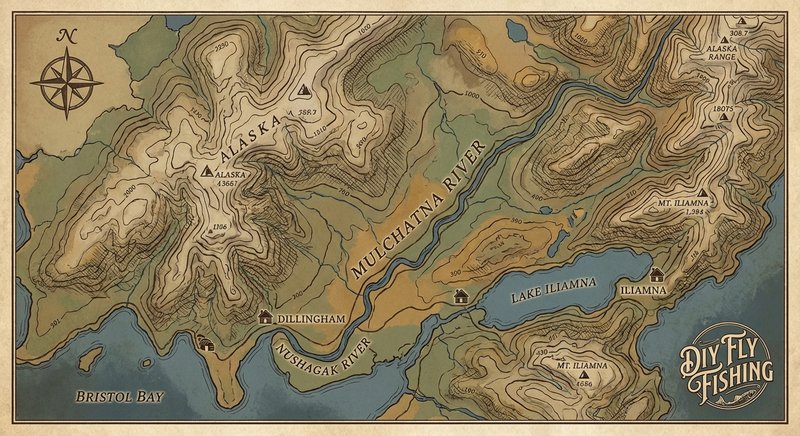
The Mulchatna is a "wild and scenic" river that flows through the heart of the Togiak National Wildlife Refuge and the foothills of the Alaska Range. What makes it special is its diversity of water. The upper reaches feature swift, clear water and rocky gardens, while the middle and lower sections become a complex network of braids, logjams, and sweeping gravel bars.
Anglers love the Mulchatna because it provides a "triple threat" experience: world-class King Salmon runs, "Leopard" Rainbow Trout that grow to massive proportions, and some of the most consistent Arctic Grayling fishing on the planet. Unlike the more crowded Kenai or Russian rivers, the Mulchatna offers solitude—you are more likely to see a Brown Bear or a Moose than another fishing party.
🐟 Target Species & Behavior
King (Chinook) Salmon
The Mulchatna Kings are chrome-bright and powerful, fresh from the Bering Sea.
- Behavior: They hold in the "guts" of deep runs and the soft water behind large submerged structures. They don't feed once they enter fresh water, but they are highly territorial and will strike out of pure aggression.
- Holding Water: Deep, walking-speed current (3–6 feet deep) and the transition zones where a shallow riffle drops into a deep pool.
Rainbow Trout
These are "Leopard" rainbows, known for their dense spotting and thick shoulders.
- Behavior: Their behavior shifts with the salmon cycle. Early in the season, they hunt out-migrating salmon smolt. Once the salmon begin to spawn, they become "egg-eating machines," positioning themselves directly behind spawning beds (redds).
- Feeding: Eggs, salmon flesh (late season), sculpins, and occasionally voles/shrews (mice).
Arctic Grayling
The "Lady of the Stream," known for their massive dorsal fins.
- Behavior: They are opportunistic and far less shy than trout. They prefer the slower edges of the main current and the eddies behind rocks.
- Feeding: They are surface-oriented and will rise for dries even when no hatch is visible.
📅 Best Times to Fish
- Late June – Mid-July: Prime King Salmon Season. The water is higher, and the first pushes of big Chinooks are moving into the system.
- Late July – August: The "Big Meal." Sockeye and Chum salmon begin spawning. This is the peak window for Rainbow Trout and Grayling as they gorge on eggs.
- September: Flesh & Silver Season. As salmon die off, "Flesh Flies" become the ticket. This is also when Silver (Coho) Salmon enter the system, providing explosive topwater and streamer action.
- Time of Day: In the land of the midnight sun, "time of day" is less critical than water temperature and light. Overcast days are often the most productive for big trout.
🪰 Recommended Flies & Techniques
For King Salmon
- Patterns: Large Intruders (Pink, Orange, Chartreuse), Bunny Leeches, and the Alaskabou.
- Technique: The Swing. Use a 9-weight or 10-weight Spey or single-hand rod with heavy sink tips (T-11 to T-14). Cast 45 degrees downstream, mend deep, and let the fly swing through the holding water.
For Rainbow Trout
- Patterns:
- Beads: 6mm and 8mm plastic beads (mottled orange, apricot, peach) to mimic salmon eggs.
- Streamers: Sculpin patterns and Black/White Bunny Leeches.
- Topwater: Mr. Hankey or Morrish Mouse (Mouse patterns).
- Technique: Nymphing beads under an indicator is the most effective. However, "skating" a mouse pattern toward the bank can trigger heart-stopping surface strikes from the largest trout in the river.
For Arctic Grayling
- Patterns: Elk Hair Caddis, Parachute Adams, and Royal Wulff.
- Technique: Standard dry fly presentation. A 4-weight or 5-weight rod makes these spirited fighters feel like giants.
💡 Pro Tips & Local Knowledge
- Find the "Redds," but Respect them: When looking for big Rainbows, find the spawning Sockeye or Chum Salmon. Look for the white, cleaned gravel. Fish behind the salmon, but do not walk on the nests (redds) to avoid crushing eggs.
- The "Mulchatna Mouse": While beads catch the most fish, the Mulchatna is famous for its mouse bite. Focus on the "cut banks" (the deep water against a grassy shore) and "skate" your mouse pattern with a rhythmic twitch.
- The Braid Rule: If the river splits into multiple channels, the smaller, "secondary" channels often hold the best trout and grayling because the current is more manageable and the food is more concentrated.
- Bear Safety: This is grizzly country. Always carry bear spray on your person (not in your pack) and make noise while walking through thick brush. Keep your catch-and-release handling quick.
⚠️ Important Information
- Access: The Mulchatna is strictly fly-in only. Most anglers access the river via floatplanes from Iliamna or Dillingham. Float trips (multi-day camping) are the best way to see the river.
- Regulations: Alaska Department of Fish & Game (ADFG) regulations are strict. The Mulchatna is often Catch & Release only for Rainbow Trout. Check the current "Southwest Alaska Sport Fishing Regulations" for King Salmon limits, as they can change mid-season based on escapement numbers.
- Gear Prep: Bring high-quality Gore-Tex waders and a solid wading staff. The gravel bars can be "loose," and the current is stronger than it looks.
- Remote Factor: There is zero cell service. An InReach or satellite phone is mandatory for safety.
Guide’s Final Word: The Mulchatna is Alaskana at its finest. If you want the thrill of a 30lb King Salmon followed by the beauty of a 24-inch Leopard Rainbow, there is no better place on earth. Tight lines!
Bug Hatches & Matching Flies
| Hatch | Type | Peak months | Time of day | Hook sizes | Matching flies |
|---|---|---|---|---|---|
| Giant Salmonfly Pteronarcys dorsata | stonefly | June, July | All day | #4-8 | Chubby Chernobyl (Orange) #6-8, Pats Rubber Legs #4-8 |
| Blue-Winged Olive Baetis tricaudatus | mayfly | June, August, September | Afternoon | #18-22 | RS2 (Olive) #20-22, Parachute Adams #18-20 |
| Golden Stonefly Hesperoperla pacifica | stonefly | July, August | Morning/Evening | #8-12 | Golden Rogue Foam Stone #8-10, 20 Incher Stone #10-12 |
| Grannom Caddis Brachycentrus occidentalis | caddis | May, June | Afternoon/Evening | #12-16 | Elk Hair Caddis (Olive) #14-16, Peacock Caddis Larva #12-14 |
| Pale Morning Dun Ephemerella excrucians | mayfly | July | Late Morning | #14-18 | PMD Sparkle Dun #16-18, Pheasant Tail Nymph #14-16 |
| Spotted Sedge Hydropsyche | caddis | July, August | Evening | #12-16 | LaFontaine's Deep Sparkle Pupa #14-16, Goddard Caddis #12-14 |
| Black Midge Chironomidae | midge | May, September | All day | #20-24 | Zebra Midge #20-22, Griffith's Gnat #20-24 |
| Meadow Ant Formicidae | terrestrial | August | Afternoon | #14-18 | Black Foam Ant #14-16, Cinnamon Ant #16-18 |