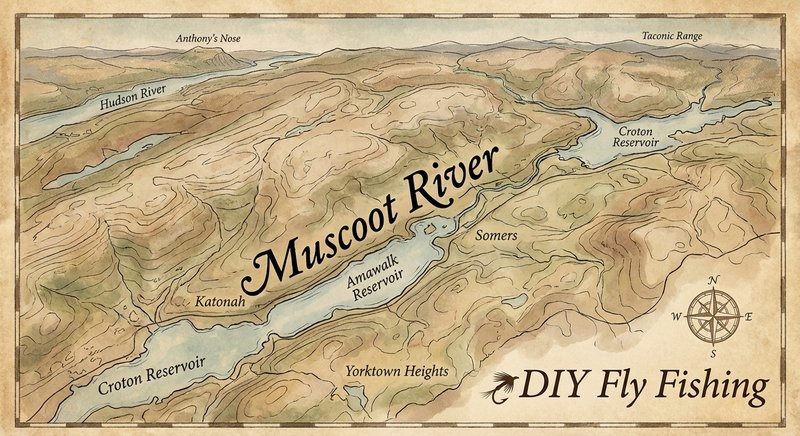
Muscoot River
Fly fishing in New York · Intermediate · Best seasons: Spring, Summer, Fall
Target Species
Brown Trout
About This Water
Westchester County stream with wild brown trout. Technical fishing close to NYC.
Fishing Recommendations
Tight lines! You’re looking at one of the finest "micro-tailwaters" in the Northeast. The Muscoot River (specifically the stretch below the Amawalk Reservoir, often called the Amawalk Outlet) is a technical, rewarding, and highly accessible piece of water for the discerning angler.
Here is your comprehensive guide to fly fishing the Muscoot River.
🎣 Location Overview
The Muscoot River is a classic Westchester County tailwater, flowing from the Amawalk Reservoir dam down into the Muscoot Reservoir. Because it is bottom-fed from the dam, the water remains significantly cooler in the summer and warmer in the winter than nearby freestone streams.
What makes it special is its intimacy. This is not a river for long, hero-casts; it is a small, technical stream (often only 20–40 feet wide) characterized by deep pocket water, tight overhead canopy, and wary wild and holdover Brown Trout. Anglers love it because it offers a "mountain stream" feel just an hour north of New York City, providing consistent water temperatures even during the heat of July.
🐟 Target Species & Behavior
The primary prize here is the Brown Trout. While the state does stock this water, there is a significant population of holdover fish and some wild reproduction.
- Behavior: These fish are highly "educated" due to consistent fishing pressure. They are notorious for being leader-shy.
- Holding Zones: Look for them in the "seams" between fast and slow water. Because the river is small, the trout often hold in tight spots—under overhanging branches, behind large boulders, or in the deep, slow pools near the dam.
- Feeding: They are opportunistic but selective. They feed heavily on midges year-round, but will key in on specific hatches (BWOs and Hendricksons) during the spring.
📅 Best Times to Fish
Spring (April – June)
The most productive window. As the water warms slightly, the insect activity picks up.
- Hatches: Blue Winged Olives (BWOs) on overcast days; Hendricksons in late April/May.
Summer (July – August)
While other NY rivers become too warm to fish safely, the Muscoot stays cool.
- Time of Day: Early morning or late evening.
- Note: Always check water temperatures; if it hits 68°F, give the fish a break.
Fall (September – November)
The Brown Trout become aggressive as they prepare for the spawn.
- The Run: Large lake-run Browns sometimes move up from the Muscoot Reservoir into the lower sections of the river.
- Caution: Watch your step to avoid walking on spawning beds (redds) in late October and November.
🪰 Recommended Flies & Techniques
Nymphing (The Bread and Butter)
Nymphing is the most consistent way to catch fish here.
- Patterns: Zebra Midges (#18–22) in black or red, Pheasant Tails (#16–20), Scuds (#16–18) in olive or orange, and Walt’s Worms.
- Technique: High-sticking or Euro-nymphing is incredibly effective in the pocket water. If using an indicator, use the smallest, most subtle one possible (like a New Zealand wool indicator).
Dry Fly
When the hatch is on, the Muscoot offers challenging "match the hatch" fishing.
- Patterns: Parachute Adams (#18–22), Elk Hair Caddis (#16–18), and CDC BWO (#18–22). In late summer, terrestrials like Ant and Beetle patterns (#16–18) are deadly.
- Technique: Focus on "micro-drifts." Even a few inches of drag will spook these fish.
Streamers
Best used in the deeper pools or during higher water flows.
- Patterns: Small Wooly Buggers (#8–12) in Black or Olive.
- Technique: "Dead-drift" the streamer through deep holes, followed by a slow, rhythmic twitch.
💡 Pro Tips & Local Knowledge
- Stealth is Mandatory: The Muscoot is clear and shallow. Wear drab clothing (camo or earth tones). Before you cast, stand back from the bank and observe for five minutes. If you can see the fish, they can definitely see you.
- The "Kneeling" Approach: Experienced Muscoot anglers often fish from their knees to keep a low profile.
- Tippet Size: You will rarely get away with anything heavier than 6X tippet. On bright days with low water, don't be afraid to drop to 7X fluorocarbon.
- Check the Flow: The "Amawalk Outlet" flow is controlled by the NYC DEP. If the gates are wide open, the river becomes difficult and dangerous to wade. Check online flow gauges before heading out.
⚠️ Important Information
- NYC DEP Access Permit: This is crucial. The Muscoot River flows through NYC Watershed land. You must have a valid (and free) NYC DEP Access Permit in addition to your NY State Fishing License. You can get this online instantly.
- Regulations: Most of the river is Catch and Release Only and restricted to Artificial Lures/Flies Only. Always double-check the current NYSDEC freshwater fishing regulations for "Westchester County" before your trip.
- Parking: Parking is limited. There are small pull-offs near the Amawalk Dam and further downstream near Route 100. Be respectful of traffic and do not block gates.
- Wading: The rocks here are notoriously slippery (the "Amawalk Grease"). Studded wading boots and a wading staff are highly recommended.
Enjoy the Muscoot—it’s a demanding little river, but landing a wild, butter-colored Brown Trout on 7X tippet in those tight quarters is a feeling you won't soon forget!
Bug Hatches & Matching Flies
| Hatch | Type | Peak months | Time of day | Hook sizes | Matching flies |
|---|---|---|---|---|---|
| Blue Winged Olive Baetis / Pseudocloeon | mayfly | April, May, September, October | Mid-day | #18-22 | BWO Sparkle Dun #18-20, Pheasant Tail #18-22, RS2 #20-22 |
| Sulfur Ephemerella invaria / rotunda | mayfly | May, June | Evening | #14-18 | Sulfur Parachute #14-16, Sulfur Emerger #16-18, Hare's Ear #14-16 |
| Tan Caddis Hydropsyche | caddis | May, June, July | Evening | #14-18 | Elk Hair Caddis #14-16, LaFontaine's Deep Sparkle Pupa #14-18, Iris Caddis #16-18 |
| Midges Chironomidae | midge | January, February, March, December | Late Morning | #20-26 | Griffith's Gnat #20-24, Zebra Midge #20-26, Top Secret Midge #22-24 |
| Little Black Stonefly Taeniopteryx | stonefly | February, March | Mid-day | #14-18 | Early Black Stone #16-18, Prince Nymph #14-18 |
| Light Cahill Stenacron / Stenonema | mayfly | June, July | Evening | #12-14 | Light Cahill #12-14, Gold Ribbed Hare's Ear #12-14 |
| Trico Tricorythodes | mayfly | July, August, September | Morning | #22-26 | Trico Spinner #22-26, Trico Parachute #22-24 |
| Slate Drake Isonychia bicolor | mayfly | June, September | Afternoon | #10-12 | Isonychia Parachute #10-12, Zug Bug #10-12, Isonychia Nymph #10-12 |
| Terrestrials Formicidae / Coleoptera | terrestrial | July, August, September | All Day | #12-20 | Black Foam Ant #16-20, Crowe Beetle #14-18 |