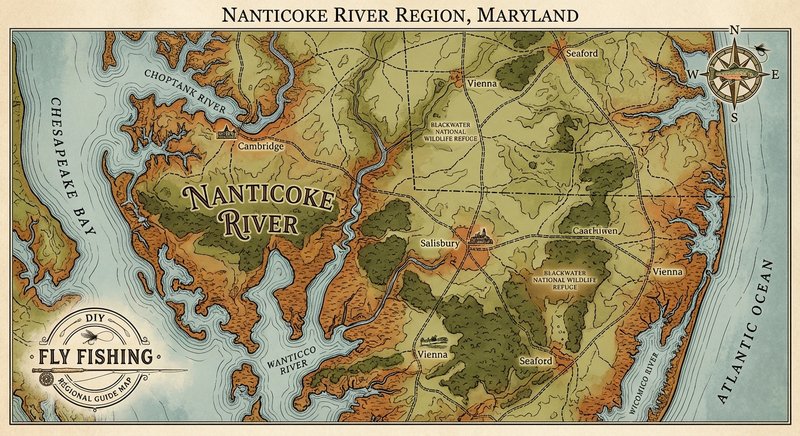
Nanticoke River
Fly fishing in Maryland · Beginner · Best seasons: Spring, Summer, Fall
Target Species
Largemouth Bass, White Perch, Blue Catfish
About This Water
Eastern Shore river with diverse fishing. Bass, perch, and catfish.
Fishing Recommendations
The Nanticoke River is one of the most pristine and scenic tidal rivers on the Chesapeake Bay’s Eastern Shore. Flowing from Delaware through Maryland and into the Tangier Sound, it offers a "blackwater" experience characterized by tea-colored tannic water, sprawling marshes, and ancient cypress knees.
As a fly fishing guide, I consider the Nanticoke a "thinking angler’s" river. It isn't just about the cast; it’s about understanding the rhythmic pulse of the tides.
🎣 Location Overview
The Nanticoke is a classic Coastal Plain river. Unlike the rocky rivers of Western Maryland, the Nanticoke is defined by mud, sand, wood, and vegetation. The water is brackish—fresh enough for Largemouth Bass in the upper reaches (near Sharptown and Vienna) and salty enough for Striped Bass and White Perch further downstream.
What makes it special is the lack of development. Much of the shoreline is protected, offering a wilderness feel where you're more likely to see a Bald Eagle or an Osprey than another boat. The river is deep in the channel but features vast, shallow "flats" and spatterdock (yellow water lily) fields that are prime territory for fly rodders.
🐟 Target Species & Behavior
Largemouth Bass
These are "Tidal Bass." They are generally smaller than pond bass but significantly more aggressive and muscular because they spend their lives fighting currents.
- Behavior: They move with the tide. On high tide, they push deep into the flooded spatterdock and marshes. On low tide, they drop back to the first available ledge or "wood" (downed trees) in the main channel.
- Feed: Primarily mummichogs (killifish), juvenile river herring, blue crabs, and dragonflies.
White Perch
The "panfish of the Chesapeake." They are incredibly fun on a 3-weight or 4-weight rod.
- Behavior: They school heavily. In the spring, they migrate upriver to spawn. In summer/fall, they hold around dock pilings, fallen timber, and shaded shorelines.
- Feed: Grass shrimp, small minnows, and aquatic insects.
Blue Catfish
An invasive species that has exploded in population. While often bottom feeders, they are highly predatory and will absolutely crush a fly.
- Behavior: They prefer deeper holes during the day but move onto the flats to hunt in low light.
- Feed: Anything they can fit in their mouths, especially oily baitfish like menhaden or gizzard shad.
📅 Best Times to Fish
Seasons
- Spring (March – May): Prime time for the White Perch run (March/April) and pre-spawn Largemouth Bass. The fish are hungry and shallow.
- Summer (June – August): Best for topwater Bass action at dawn and dusk. Mid-day can be tough as fish seek deeper, cooler water.
- Fall (September – November): This is the "Golden Era." As the water cools, Bass and Perch feed heavily on migrating baitfish. The Blue Catfish become very active in the shallower reaches.
The "Tidal Window"
In tidal fly fishing, the tide is more important than the time of day.
- The Best Window: The last two hours of the falling tide and the first hour of the rising tide.
- Why: A falling tide flushes baitfish and shrimp out of the safety of the marsh grass and into the open, creating a "conveyor belt" of food for predators waiting at the edges.
🪰 Recommended Flies & Techniques
For Largemouth Bass
- Topwater: BoogleBugs (size 4) or frogs with weed guards. The weed guard is non-negotiable because you’ll be throwing into thick lilies.
- Subsurface: Gamechangers (white/chartreuse) or Clouser Minnows.
- The "Nanticoke Special": A Black/Purple Wooly Bugger or Bunny Leech. In the dark, tannic water, dark silhouettes stand out better than bright colors.
For White Perch
- Patterns: Size 8-10 Clouser Minnows (white/pink or chartreuse/white).
- Technique: Use a sinking-tip line and a "twitch-twitch-pause" retrieve near bridge pilings or fallen trees.
For Blue Catfish
- Patterns: Large, heavy Half-and-Half streamers (size 1/0 or 2/0) in white or grey.
- Technique: You must get the fly deep. Use a heavy sink-tip (250-350 grain) and strip slowly along the bottom of channel breaks.
💡 Pro Tips & Local Knowledge
- Focus on the "Marshyhope": The Marshyhope Creek is a major tributary of the Nanticoke. It is narrower, easier to fish from a kayak, and holds some of the best Bass densities in the region.
- The Spatterdock Edge: Don’t just cast at the lily pads; cast into the small "pockets" within them. Use a heavy leader (16lb - 20lb fluorocarbon) to "horse" the bass out before they wrap you around a stem.
- Find the "Hard" Bottom: Much of the river is soft mud. If you find a point with gravel or sand (often found on the outside of bends), you’ve found a White Perch goldmine.
- Color Selection: If the water is particularly "black" (tannic), go with solid black or gold. If the water is muddy from rain, go with fluorescent chartreuse.
⚠️ Important Information
Access
- Vienna Waterfront Park: Excellent boat ramp and some shoreline access near the bridge.
- Cedar Hill Marina: Good for accessing the lower, more brackish sections.
- Sharptown Cherry Beach: Great kayak launch for the upper river.
Regulations
- License: You need a Maryland Tidal Sport Fishing License. If you cross the state line into Delaware (upriver), you will need a Delaware fishing license.
- Blue Catfish: There is no limit on Blue Catfish. In fact, the MD Department of Natural Resources encourages you to harvest them to protect the ecosystem.
- Striped Bass: Be aware of seasonal closures for "Rockfish" (Striped Bass), as regulations change annually to protect spawning stocks.
Safety
- Mud Flats: At low tide, the mud is "bottomless." Do not attempt to wade unless you are on a known sandy point.
- Vessel Traffic: The Nanticoke is a working river. Keep an eye out for tugboats and large barges; they have the right of way and cannot stop quickly.
Bug Hatches & Matching Flies
| Hatch | Type | Peak months | Time of day | Hook sizes | Matching flies |
|---|---|---|---|---|---|
| Midges Chironomidae | midge | March, April, October, November | All Day | #18-24 | Zebra Midge #18-22, Griffith's Gnat #20-22 |
| Great Western Leadwing Hexagenia limbata | mayfly | June, July | Evening/Night | #6-10 | Hexagenia Spinner #6-8, Hare's Ear Nymph #8-10 |
| Cinnamon Caddis Hydropsyche | caddis | May, June, September | Evening | #14-18 | Elk Hair Caddis #14-16, Pupa Emerger #16 |
| Damselfly Enallagma | terrestrial | June, July, August | Afternoon | #10-14 | Adult Damsel #12, Marabou Damsel Nymph #10-12 |
| Blue-Winged Olive Baetis | mayfly | April, October | Afternoon | #18-22 | BWO Sparkle Dun #18-20, Pheasant Tail #18-22 |
| White Curse Caenis | mayfly | July, August | Morning | #22-26 | Caenis Spinner #24, RS2 #22-24 |
| Japanese Beetle Popillia japonica | terrestrial | July, August | Afternoon | #10-14 | Foam Beetle #12-14, Coffee's Sparkle Beetle #12 |
| Dragonfly Anisoptera | terrestrial | June, July, August | Afternoon | #4-10 | Dragonfly Nymph #6-10, Adult Dragonfly #4-8 |