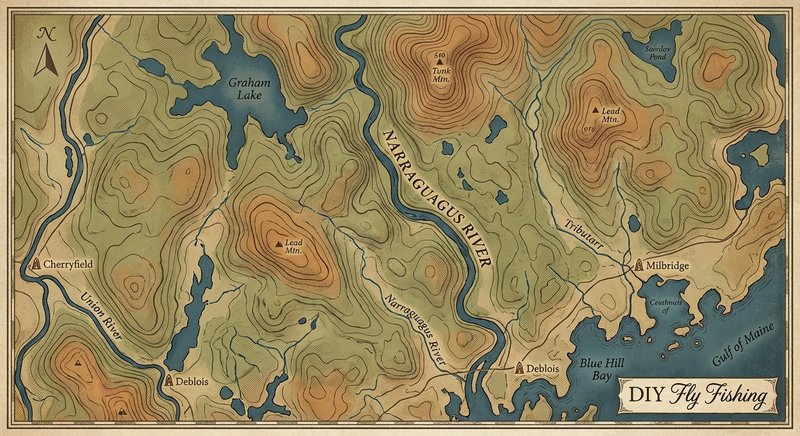
Narraguagus River
Fly fishing in Maine · Intermediate · Best seasons: Summer, Fall
Target Species
Atlantic Salmon, Brook Trout
About This Water
Downeast river with Atlantic salmon. One of Maine's eight salmon rivers.
Fishing Recommendations
The Narraguagus River, located in the rugged "Down East" region of Maine (Washington County), is a place of deep historical significance in the fly fishing world. Known as one of the legendary "Big Eight" Maine salmon rivers, it offers a quintessential Maine experience: dark, tannic water, dense pine forests, and a sense of solitude that is hard to find elsewhere.
Here is your comprehensive guide to fishing the Narraguagus.
🎣 Location Overview
The Narraguagus is a classic "blackwater" river. Its name, derived from the Abenaki word for "above the falls," hints at its structure. The river is characterized by its tea-colored, acidic water—a result of the surrounding cedar bogs and hemlock forests.
What makes it special is its intimacy. Unlike the sprawling Penobscot, the Narraguagus is manageable in size, featuring distinct pools, quick riffles, and long, glassy glides. It is a "wade-friendly" river in many stretches, though the rocks are notoriously slick. Anglers love it because it feels like a step back in history; the stone walls and old bridge abutments in Cherryfield whisper stories of the "Silver King" (Atlantic Salmon) that once filled these pools by the thousands.
🐟 Target Species & Behavior
Atlantic Salmon
Status Note: It is vital to understand that Atlantic Salmon in Maine are currently listed as Endangered. While the Narraguagus remains a primary recovery river, active fishing specifically for Atlantic Salmon is generally closed to protect the remaining wild population. However, knowing their behavior is key for the "accidental" hookup while trout fishing or for when experimental seasons are occasionally opened.
- Behavior: They do not feed once they enter the river from the ocean. They strike out of aggression, territoriality, or curiosity.
- Holding: They seek "seams" between fast and slow water, often resting at the "tail-out" of a pool before moving up to the next.
Brook Trout (The Primary Target)
- Behavior: These are wild, native fish. They are opportunistic but can be wary in the clear, shallow sections.
- Holding: Look for "refrigerated" water. In the summer, they congregate near the mouths of cold-water tributaries or in deep, shaded undercut banks.
- Feeding: They focus on aquatic insects (Mayflies, Caddis) but are known to be aggressive toward small baitfish and leeches in the darker water.
📅 Best Times to Fish
Summer (June - August)
- Early Summer: This is the prime window for Brook Trout. June brings the major hatches.
- The Heat: As water temperatures rise in late July and August, fishing should be restricted to the early morning and late evening to avoid stressing the fish. Focus on the upper reaches where the water remains cooler.
Fall (September - October)
- The "Push": Fall is spectacular Down East. Brook Trout begin their spawning colors (vibrant oranges and reds) and become more aggressive.
- Conditions: Look for the first major rains of September. This "freshenet" triggers fish to move and feed heavily before the winter.
- Time of Day: Mid-day becomes productive as the sun warms the water slightly.
🪰 Recommended Flies & Techniques
Techniques
- The "Wet Fly Swing": The traditional Maine method. Cast 45 degrees downstream, let the fly swing through the current, and give it slight twitches at the end of the swing.
- Dead Drifting: Essential for summer Brookies during a hatch. Use long, light leaders (9ft 5X) to avoid spooking fish in the glassy glides.
Top Fly Patterns
- Streamers:
- Black Ghost: A Maine classic.
- Muddler Minnow: Works as a baitfish or a grasshopper.
- Woolly Bugger (Black or Olive): Essential for the dark water.
- Dry Flies:
- Royal Wulff: High visibility in the dark water.
- Elk Hair Caddis: Perfect for the evening "blizzard" hatches.
- Blue Winged Olive (BWO): Crucial for overcast fall days.
- Traditional Salmon Patterns (For historical context/Wet fly trout fishing):
- Cosseboom (Yellow tail): Very effective in the Narraguagus.
- Green Highlander: High contrast for tannic water.
💡 Pro Tips & Local Knowledge
- The "Cherryfield" Rule: The lower river near Cherryfield is tidal. While the best trout fishing is further upstream (near Deblois), the lower pools are where the big "salters" (sea-run Brook Trout) can sometimes be found.
- Read the Bubbles: In the dark water, it's hard to see the bottom. Follow the bubble lines; they indicate the fastest current and where the food is being funneled.
- Stealth is Key: Because the river is small, your silhouette against the sky will spook fish. Stay low and wade quietly.
- Check the Temperature: Keep a thermometer on your zinger. If the water hits 70°F, stop fishing for trout. It's too hot for them to recover from a fight.
⚠️ Important Information
Regulations & Permits
- Salmon Restrictions: You must check the current Maine Department of Inland Fisheries & Wildlife (IFW) regulations. Currently, there is a zero-possession/no-targeting rule for Atlantic Salmon on the Narraguagus. If you hook one while trout fishing, keep it in the water and release it immediately.
- License: A valid Maine Freshwater Fishing License is required.
- Tackle: Much of the river is "Artificial Lures Only" or "Fly Fishing Only." Check the law book for the specific reach you are fishing.
Access
- Route 193: This road follows the river for a significant stretch between Cherryfield and Deblois, offering several pull-offs and bridge access points.
- The "Air Line" (Route 9): Provides access to the headwaters and the upper reaches where the water stays coolest.
Gear Recommendations
- Rod: A 9-foot 5-weight is the "Swiss Army Knife" for this river.
- Waders: Breathable waders with studded felt soles (where legal) or high-traction rubber. The rocks here are covered in a fine, slick silt.
- Safety: This is remote country. Cell service is spotty at best. Always tell someone where you are going and carry a basic first-aid kit and bear spray (black bears are common).
Bug Hatches & Matching Flies
| Hatch | Type | Peak months | Time of day | Hook sizes | Matching flies |
|---|---|---|---|---|---|
| Hendrickson Ephemerella subvaria | mayfly | May | Afternoon | #12-14 | Red Quill #12-14, Hendrickson Emerger #14, Pheasant Tail #12-16 |
| Blue-Winged Olive Baetis spp. | mayfly | May, September, October | Late Morning/Afternoon | #18-22 | RS2 #20-22, BWO Parachute #18-22, WD-40 #20 |
| Grannom Caddis Brachycentrus | caddis | May | Morning/Evening | #14-16 | Grannom Pupa #14-16, Elk Hair Caddis (Olive/Black) #14-16, Peacock Caddis #16 |
| March Brown Maccaffertium vicarium | mayfly | June | Afternoon | #10-12 | March Brown American #10-12, Gold Ribbed Hare's Ear #10-14, March Brown Wet #12 |
| Light Cahill Stenonema ithaca | mayfly | June, July | Evening | #12-16 | Light Cahill #12-16, Cream Usual #14-16, Cahill Wet #14 |
| Giant Stonefly Pteronarcys dorsata | stonefly | June | Evening/Night | #4-8 | Kaufmanns Stone #6-8, Pat's Rubber Leg #6-10, Stimulator (Orange) #8-10 |
| Cinnamon Caddis Hydropsyche | caddis | June, July, August | Evening | #14-18 | LaFontaine's Sparkling Pupa #16, Cinnamon Elk Hair Caddis #14-18, Soft Hackle Hare's Ear #14-16 |
| Black Ant Formicidae | terrestrial | July, August | All Day | #14-18 | Black Foam Ant #14-18, Chernobyl Ant #12-14, Fur Ant #16-18 |
| White Mayfly Ephoron leukon | mayfly | August | Late Evening | #12-14 | White Wulff #12, Ephoron Spinner #14, White Miller #12-14 |