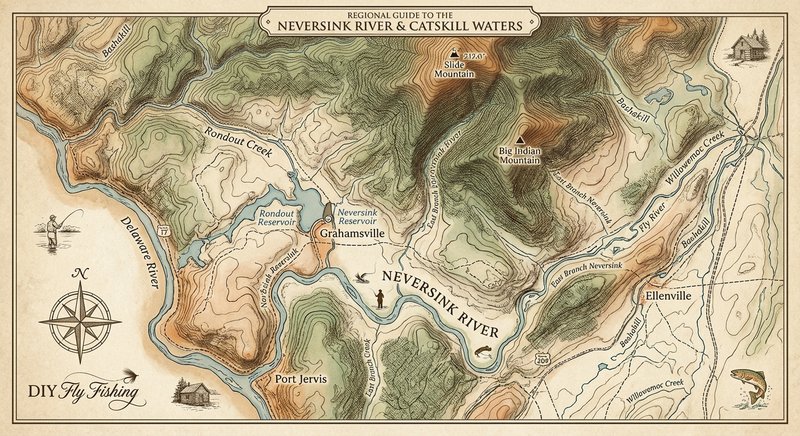
Neversink River
Fly fishing in New York · Intermediate · Best seasons: Spring, Summer, Fall
Target Species
Brown Trout, Brook Trout
About This Water
Historic Catskills stream with wild brown and brook trout. Technical fishing in beautiful pools.
Fishing Recommendations
The Neversink River is a legendary name in the annals of American angling history. Often cited as the birthplace of American dry fly fishing, this is the water where Theodore Gordon and Edward Hewitt refined the techniques that define the sport today. It remains one of the most beautiful and rewarding—yet challenging—rivers in the Catskill Mountains.
🎣 Location Overview
The Neversink River flows through the heart of the Catskills in New York. It is divided into two distinct sections: the Upper Freestone (above the Neversink Reservoir) and the Tailwater (below the reservoir).
The upper reaches near Claryville are classic high-gradient freestone waters, characterized by "pocket water," tumbling riffles, and deep, crystalline pools. The water is exceptionally clear—hence the name "Neversink"—and the bottom is composed of slick granite boulders and cobble. Below the dam, the river becomes a cold-water tailwater, providing a more stable environment for trout during the heat of the summer.
What makes the Neversink special is its wildness. Unlike some of its more crowded neighbors, the Neversink offers a sense of solitude and a population of truly wild, wary trout that require an angler’s "A-game."
🐟 Target Species & Behavior
- Brown Trout: The dominant species. In the Neversink, these fish are famous for being "PhD-educated." They hold in the shadows of undercut banks, behind large boulders, and at the tail-outs of pools during hatches.
- Brook Trout: Found primarily in the upper headwaters and the cold, shaded tributaries. They are smaller than the browns but are stunningly colored and represent the native heritage of the river.
Behavior: Because the water is so clear, these fish are exceptionally spooky. They have excellent vision and will bolt if they see a shadow, a heavy splash, or a thick leader. They are highly opportunistic during hatches but will retreat to deep "sanctuary" water during the bright midday sun.
📅 Best Times to Fish
- Spring (Mid-April – June): This is the "Golden Era" on the Neversink. The Hendrickson hatch in late April/early May is the stuff of legend. Water levels are usually good, and the fish are hungry after winter.
- Summer (July – August): Focus on the tailwater section below the dam for cold water, or the high-elevation headwaters for brookies. Early morning and the last two hours of daylight are critical.
- Fall (September – October): A fantastic time for the "Isonychia" hatch. Brown trout become aggressive and territorial as they prepare for the spawn. The fall foliage also makes this the most scenic time to be on the water.
🪰 Recommended Flies & Techniques
Top Fly Patterns
- Dry Flies:
- Quill Gordon (Sizes 12-14): The classic Catskill fly.
- Hendrickson (Size 14): Dark and Light versions for late spring.
- Blue Winged Olive (Sizes 18-22): Essential for overcast or drizzly days.
- Elk Hair Caddis (Sizes 14-18): A staple for the pocket water.
- Terrestrials: Ant and Beetle patterns are lethal in mid-summer.
- Nymphs:
- Pheasant Tail (Sizes 14-18): Mimics Mayfly nymphs.
- Hare’s Ear (Sizes 12-16): Great generalist pattern.
- Perdigons: Effective in the fast, deep runs of the tailwater.
- Streamers:
- Woolly Bugger (Olive or Black, Size 8-10): Best used after a rain when the water has a slight "tea" stain.
Techniques & Presentation
- The Stealth Approach: Kneel when approaching a pool. Avoid "lining" the fish (casting your fly line directly over their heads).
- Long Leaders: Use 9 to 12-foot leaders tapering to 5X or 6X fluorocarbon for nymphs and nylon for dries.
- High-Sticking: In the pocket water of the upper river, use a short line technique to keep your fly line off the conflicting currents, allowing the fly to drift naturally through small pockets.
💡 Pro Tips & Local Knowledge
- The "Unique Area": Explore the Neversink River Unique Area (located downstream of the dam). It requires some hiking to get into, which deters the "roadside" anglers. The fishing here is rugged and spectacular.
- The Hewitt "Skater": Edward Hewitt made the Neversink famous for "skating" large dry flies across the surface to induce violent strikes. If the water is flat and the fish seem dormant, try a large, bushy dry fly and give it a slight twitch or skate.
- Watch the Gauge: The Neversink is sensitive to rainfall. If the Grahamsville gauge shows a sharp spike, the water can become dangerously fast. Conversely, in low water, stay out of the river to avoid stressing the fish.
⚠️ Important Information
Access
- Public Access: There are several NY DEC parking areas along Route 42 (upper river) and within the Neversink Unique Area (lower river).
- NYC DEP Permit: Much of the land surrounding the reservoir and certain river stretches is owned by the NYC Department of Environmental Protection. You must obtain a free NYC DEP Access Permit online before stepping onto these lands.
Regulations
- New York State fishing regulations apply.
- Special Note: Check for specific "Catch and Release" or "Artificial Lures Only" sections, as these change periodically.
- Felt Soles: While not banned in NY, many anglers prefer studs or rubber soles with "slick" bars due to the incredibly greasy rocks on the Neversink.
Safety
- The rocks on the Neversink are notoriously slippery. A wading staff is not a luxury—it is a necessity.
- Cell service is spotty to non-existent in the deeper gorges; always let someone know where you are going.
Bug Hatches & Matching Flies
| Hatch | Type | Peak months | Time of day | Hook sizes | Matching flies |
|---|---|---|---|---|---|
| Blue-Winged Olive Baetis / Pseudocloeon | mayfly | April, May, September, October | Late Morning/Afternoon | #18-22 | BWO Sparkle Dun #18-22, Pheasant Tail #18-20, RS2 #20-22 |
| Hendrickson Ephemerella subvaria | mayfly | April, May | Afternoon | #12-14 | Hendrickson Dark #12-14, Red Quill #14, Hendrickson Wet Fly #12-14 |
| March Brown Maccaffertium vicarium | mayfly | May, June | Mid-day/Afternoon | #10-12 | March Brown Dry #10-12, Hare's Ear Nymph #10-12, March Brown Spider #12 |
| Green Drake Ephemera guttulata | mayfly | May, June | Evening | #8-10 | Green Drake Parachute #8-10, Coffin Fly #8-10, Green Drake Nymph #8-10 |
| Sulphur Ephemerella invaria / dorothea | mayfly | May, June, July | Late Afternoon/Evening | #14-18 | Sulphur Parachute #14-18, Sulphur Snowshoe Emerger #16-18, Pheasant Tail (Flashback) #16-18 |
| Slate Drake Isonychia bicolor | mayfly | June, July, August, September | Afternoon/Evening | #10-14 | Iso Parachute #10-12, Isonychia Nymph (Zug Bug variant) #10-12, Royal Wulff #12-14 |
| Grannom Caddis Brachycentrus | caddis | April, May | Morning/Afternoon | #14-16 | Elk Hair Caddis (Dark) #14-16, LaFontaine's Deep Sparkle Pupa #14-16, Grannom Larva #14 |
| Tan Caddis Hydropsyche | caddis | June, July, August | Evening | #14-18 | Tan Elk Hair Caddis #14-18, Pupa-Sella #16, Holy Grail #14-16 |
| Light Cahill Stenacron / Stenonema | mayfly | June, July | Evening | #12-14 | Light Cahill Dry #12-14, Light Cahill Wet Fly #14, Gold Ribbed Hare's Ear #12-14 |
| Cinnamon Ant Formicidae | terrestrial | July, August, September | All Day | #16-20 | Cinnamon Ant (Foam) #16-20, Black Beetle #14-16, Flying Ant #18 |