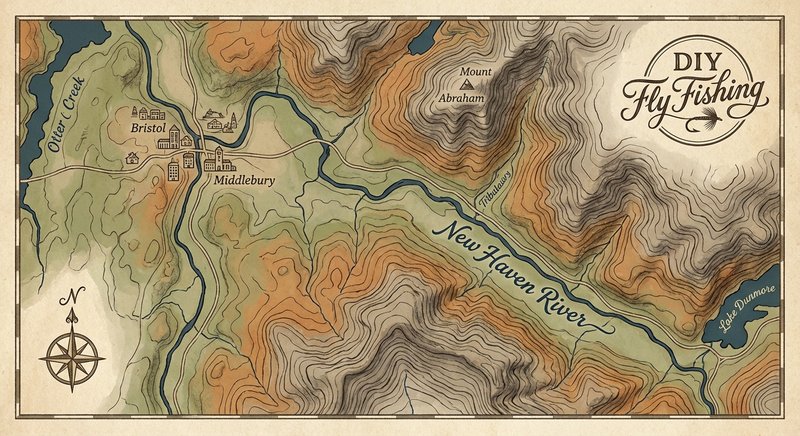
New Haven River
Fly fishing in Vermont · Intermediate · Best seasons: Spring, Summer, Fall
Target Species
Brook Trout, Brown Trout
About This Water
Beautiful freestone stream in the Green Mountain National Forest. Wild brook and brown trout in scenic gorges.
Fishing Recommendations
The New Haven River is one of Vermont’s true "hidden in plain sight" gems. Rising in the steep, rugged slopes of the Green Mountains near Ripton and Lincoln, it tumbles down through Bristol before mellowing out to join the Otter Creek. It is a classic New England freestone river that offers a "Jekyll and Hyde" personality: high-gradient pocket water in the mountains and classic pool-and-riffle water in the valley.
🎣 Location Overview
The New Haven is beloved by Vermont anglers because of its diversity. In its upper reaches, it is a quintessential mountain brook, cold and clear, surrounded by boulders and hemlocks. As it passes through the famous "Bartlett’s Falls" (Bristol Falls), it transforms into a medium-sized river.
What makes it special is its resilience and accessibility. Unlike some of the larger, slower rivers in the Champlain Valley, the New Haven stays relatively cool in its middle reaches due to the heavy canopy and mountain influence. It offers a "wild" feel even when you are only a hundred yards from Route 116. It is a freestone system, meaning its flow is dictated by snowmelt and rainfall, making it a dynamic environment that changes slightly every season.
🐟 Target Species & Behavior
Brook Trout (Salvelinus fontinalis)
- Location: Found predominantly from the village of Lincoln upstream and in the high-gradient tributaries.
- Behavior: These are mostly wild, native fish. They are opportunistic feeders due to the nutrient-poor mountain water. They hold in the "cushion" in front of boulders or in the soft bubbles of plunge pools.
- Feeding: They aren't picky but are wary. They will rise for small dries even in fast water.
Brown Trout (Salmo trutta)
- Location: Dominant from Bristol down to the confluence with Otter Creek.
- Behavior: You’ll find both wild and stocked browns here. The larger, "venerable" browns are notoriously nocturnal or low-light hunters. They hold in the deep undercut banks, under downed timber, and at the very head of deep pools where the oxygen is highest.
- Feeding: In the spring and fall, they are aggressive. In the heat of summer, they become "sulky" and require technical nymphing or late-night streamer stripping.
📅 Best Times to Fish
- Spring (Late April – June): This is the prime window. Once the spring runoff (mud season) subsides, the Hendrickson hatch (late April/early May) triggers the first major surface activity of the year.
- Summer (July – August): Best for the upper reaches where the water stays cold. In the lower sections, you must fish early morning (6 AM – 10 AM) or late evening. Check water temperatures: if it’s over 68°F, head to the higher elevations in Lincoln to avoid stressing the fish.
- Fall (September – October): My personal favorite. The Brown Trout become aggressive as they prepare to spawn. The Isonychia (Slate Drake) hatch occurs, and the foliage makes the New Haven one of the most beautiful places on earth to cast a fly.
🪰 Recommended Flies & Techniques
Dry Flies
- Attractors: Royal Wulff, Stimulators (Size 12-16), and the Hornberg (a Vermont classic that can be fished as a dry or a streamer).
- Match the Hatch: Hendrickson (12-14), Elk Hair Caddis (14-18), and Blue Winged Olives (18-22) for rainy days.
- Terrestrials: In August, a fat Foam Beetle or a Dave’s Hopper dropped tight against the banks is deadly.
Nymphs
- The Bread & Butter: Pheasant Tail (14-18), Gold-Ribbed Hare’s Ear (12-16), and Prince Nymphs.
- Modern Classics: Sexy Walt’s Worm and Perdigons (especially in the fast pocket water of the upper river).
Streamers
- Patterns: Black or Olive Woolly Buggers, Muddler Minnows, and the Grey Ghost.
- Technique: "Swing and strip." Cast toward the opposite bank, let it swing through the current, and give it short, erratic pulses.
💡 Pro Tips & Local Knowledge
- The "Dry-Dropper" Strategy: Because the New Haven is full of "pocket water" (small pockets of calm water behind rocks), a single dry fly often misses fish. Use a high-visibility Stimulator as your float and hang a weighted Pheasant Tail nymph 18-24 inches below it.
- Avoid the "Swimming Hole" Crowd: Bartlett’s Falls is a popular swimming spot. During summer afternoons, the middle section near the falls will be crowded. Walk a half-mile upstream or downstream from the main parking areas to find solitude and undisturbed fish.
- The Otter Creek Connection: In the fall, some very large "lake-run" style Browns move out of the Otter Creek and into the lower New Haven to spawn. Focus on the deep holes in the flats near Brooksville.
- Stealth Matters: The water is often crystal clear. Wear earthy tones (no white shirts/hats) and avoid "lining" the fish with a heavy fly line. Use long leaders (9-12 feet) for the slower pools.
⚠️ Important Information
- Access: Much of the river follows Route 116 and Route 17. There are several pull-offs with "Vermont Fish & Wildlife" access signs. Always respect "Posted" signs; Vermont landowners are generally generous, but asking permission goes a long way.
- Regulations: The New Haven is generally under General Trout Fishing Regulations, but always check the current Vermont Fish & Wildlife Law Digest. Usually, the season opens the second Saturday in April and closes October 31st.
- Safety: The rocks in the New Haven are notoriously slippery (covered in "didymo" or rock snot in some years). Studded wading boots and a wading staff are highly recommended, especially in the gorge sections.
- Catch & Release: While the state stocks parts of this river, please consider releasing all wild Brook Trout to preserve the genetics of these native mountain gems.
Bug Hatches & Matching Flies
| Hatch | Type | Peak months | Time of day | Hook sizes | Matching flies |
|---|---|---|---|---|---|
| Blue-Winged Olive Baetis / Pseudocloeon | mayfly | April, May, September, October | Afternoon | #18-22 | RS2 #18-20, Parachute BWO #18-22, Pheasant Tail #18-20 |
| Hendrickson Ephemerella subvaria | mayfly | May | Afternoon | #12-14 | Red Quill #12-14, Hendrickson Nymph #12-14, Hendrickson Emerger #12-14 |
| Grannom Caddis Brachycentrus | caddis | April, May | Morning/Afternoon | #14-16 | Elk Hair Caddis (Olive) #14-16, LaFontaine's Deep Sparkle Pupa #14-16, Peacock Caddis #14-16 |
| March Brown Maccaffertium vicarium | mayfly | May, June | Afternoon | #10-12 | March Brown Dry #10-12, Hare's Ear Nymph #10-14 |
| Sulphurs Ephemerella invaria / dorothea | mayfly | June, July | Evening | #14-18 | Parachute Sulphur #14-18, Sulphur Snowshoe Emerger #16-18, Pheasant Tail (Flashback) #16-18 |
| Isonychia Isonychia bicolor | mayfly | July, August, September | Late Afternoon | #10-12 | Iso Parachute #10-12, Zug Bug #10-12, Prince Nymph #10-14 |
| Golden Stonefly Acroneuria | stonefly | June, July | Evening/Night | #8-12 | Kaufmann's Stone (Golden) #8-12, Stimulator (Yellow) #10-12 |
| Light Cahill Stenonema ithaca | mayfly | June, July | Evening | #12-14 | Light Cahill Dry #12-14, Gold Ribbed Hare's Ear #12-14 |
| Terrestrials Formicidae / Coleoptera | terrestrial | July, August, September | All Day | #12-18 | Black Foam Ant #14-18, Chernobyl Ant #10-12, Crowe Beetle #14-16 |