New River
Fly fishing in Virginia · Intermediate · Best seasons: Spring, Summer, Fall
Target Species
Smallmouth Bass, Musky, Walleye
About This Water
One of the oldest rivers in the world with excellent smallmouth bass. World-class fishing.
Fishing Recommendations
Welcome to the New River, Virginia. As a guide, I can tell you that this is not just any river; it is widely considered one of the oldest rivers in the world (ironically named) and offers some of the finest warm-water fly fishing in the Eastern United States. Its ancient geology—characterized by vertical rock shelves and massive ledges—creates a unique "stair-step" habitat that produces trophy-sized fish.
🎣 Location Overview
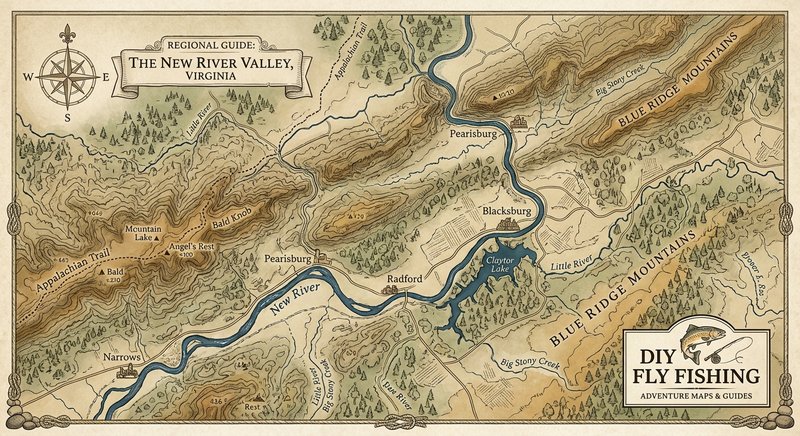
The New River in Virginia flows north from the North Carolina border through the Blue Ridge Mountains toward West Virginia. It is a powerful, high-volume river characterized by massive limestone and shale ledges, deep pools, and heavy riffles.
What makes it special is its productivity. The river is alkaline and rich in nutrients, supporting a massive biomass of crawfish, hellgrammites, and baitfish. For the fly angler, it offers a "big water" experience where you can hunt for 20-inch Smallmouth Bass and 50-inch Musky in the same afternoon. It is rugged, beautiful, and demands respect.
🐟 Target Species & Behavior
Smallmouth Bass (The Main Event)
The "New River Strain" of Smallmouth is legendary for its shoulders and fight.
- Behavior: They are opportunistic but wary in clear water.
- Holding Water: Look for "slack water" behind the massive rock ledges, the "seams" where fast water meets slow water, and deep eddies. In summer, they move into the faster "oxygen water" of the riffles.
- Diet: 70% of their diet is crawfish, supplemented by hellgrammites and various shiners/minnows.
Musky (The Fish of 10,000 Casts)
The New River is perhaps the best Musky river in the South.
- Behavior: Apex predators. They hold in deep timber, under cut banks, or at the tail-outs of long pools.
- Diet: They eat whatever they want—suckers, fallfish, and even small ducks.
Walleye
Often overlooked by fly anglers, but very present.
- Behavior: Light-sensitive. They hug the bottom in deep, dark holes during the day and move into shallower gravel bars at dusk to feed.
📅 Best Times to Fish
Spring (March – May)
- Conditions: High water, but the time for trophies.
- Target: Pre-spawn Smallmouth and Musky.
- Window: Late April is prime as water temps hit the 55–60°F mark.
Summer (June – August)
- Conditions: Lower, clearer water.
- Target: Peak Smallmouth season.
- Window: Early morning and late evening are essential for topwater action. This is the best time for wade fishing.
Fall (September – November)
- Conditions: Cooling water, beautiful foliage.
- Target: Smallmouth feeding heavily for winter; Musky activity spikes.
- Window: The "Feeding Frenzy" usually happens in October when the water drops below 60°F.
🪰 Recommended Flies & Techniques
Smallmouth Bass
- Topwater: BoogleBugs (Poppers) in Chartreuse or White. These are durable and create the right "chugging" sound.
- Sub-surface: Clouser Minnows (Chartreuse/White), Gamechangers, and Crayfish patterns (Near Nuff Craw).
- The "New River Special": Large Hellgrammite patterns (size 2-6) fished on a sink-tip line through the ledges.
Musky
- Flies: 8–12 inch articulated streamers. Think Bulkheads, T-Bones, and Double Deceivers.
- Colors: Black/Orange (dirty water) or White/Olive (clear water).
- Technique: You must master the "Figure-8" at the end of every single cast. New River Muskies are notorious followers.
Walleye
- Flies: Heavy Dredging Streamers or Bunny Leeches in Purple or Chartreuse.
- Technique: Use a heavy sink-tip (250–350 grain) to get the fly literally bouncing off the bottom rocks.
💡 Pro Tips & Local Knowledge
- Fish the Ledges Vertically: Unlike many rivers where you cast toward the bank, on the New, the fish are often in the middle of the river hugging the downstream side of the rock shelves. Work your fly parallel to the ledges.
- The "Drag and Drop": When using crawfish patterns, don't strip them fast. Let them tumble over a ledge, sit for a second, and then give a short hop. That’s when the Smallmouth strike.
- Specific Stretches:
- Radford to Whitethorne: Great for Smallmouth and Musky.
- Pembroke to Pearisburg: Incredible scenery with towering cliffs and massive Smallmouth.
- Fries to Byllesby: Known for higher numbers of fish.
- Gear Up: For Smallmouth, use a 6 or 7-weight rod. For Musky, do not bring anything less than a 10-weight with a wire tippet.
⚠️ Important Information
Access & Navigation
- Boating: The New River is a "pool and drop" river. It can be dangerous for drift boats due to the jagged ledges. A fishing raft with a frame is the preferred vessel for most guides.
- Wading: Wading is possible during summer low-flows (around 1,500 cfs or lower at the Radford gauge), but the bottom is incredibly slick and uneven. Felt soles and a wading staff are mandatory.
Regulations
- License: A valid Virginia Freshwater Fishing License is required.
- Special Regs: Certain stretches have "Slot Limits" (e.g., all bass between 14–22 inches must be released). Always check the DWR Virginia website before heading out.
Safety
The New River can rise rapidly after rain in North Carolina. Always check the USGS gauges (Galax, Radford, or Glen Lyn) before launching. If the water looks like chocolate milk, stay home; the Musky will shut down and the Smallmouth will be hard to find.
Tight lines, and watch those ledges!
Bug Hatches & Matching Flies
| Hatch | Type | Peak months | Time of day | Hook sizes | Matching flies |
|---|---|---|---|---|---|
| White Fly Ephoron leukon | mayfly | August, September | Evening | #12-14 | White Wulff #12-14, White Fly Para-Spinner #12-14, Snowshoe Emerger #14 |
| Slate Drake Isonychia bicolor | mayfly | June, September | Afternoon/Evening | #10-14 | Iso Parachute #12-14, Zug Bug #10-14, Isonychia Cripple #12 |
| Tan Caddis Hydropsyche | caddis | May, June, July | Evening/Night | #14-18 | Elk Hair Caddis (Tan) #14-16, Pupa-X #16, Hydropsyche Larva #14-18 |
| Golden Stonefly Acroneuria | stonefly | May, June, July | Morning/Evening | #6-10 | Kaufmann's Stone (Golden) #6-10, Golden Stimulator #8-12, Pat's Rubber Legs #8-12 |
| Trico Tricorythodes | mayfly | July, August, September | Morning | #20-24 | Trico Spinner #20-24, RS2 (Black) #20-22 |
| Periodical & Annual Cicada Magicicada / Neotibicen | terrestrial | July, August | All day | #4-8 | Project Cicada #6-8, Rainy's Cicada #6-10 |
| Blue Winged Olive Baetis | mayfly | March, April, October, November | Afternoon | #18-22 | BWO Parachute #18-22, Pheasant Tail #18-20, WD-40 #20 |
| Grasshopper Melanoplus | terrestrial | July, August, September | Late Morning/Afternoon | #6-12 | Dave's Hopper #8-12, Yum Yum Hopper #10-12, Morrish Hopper #8-10 |