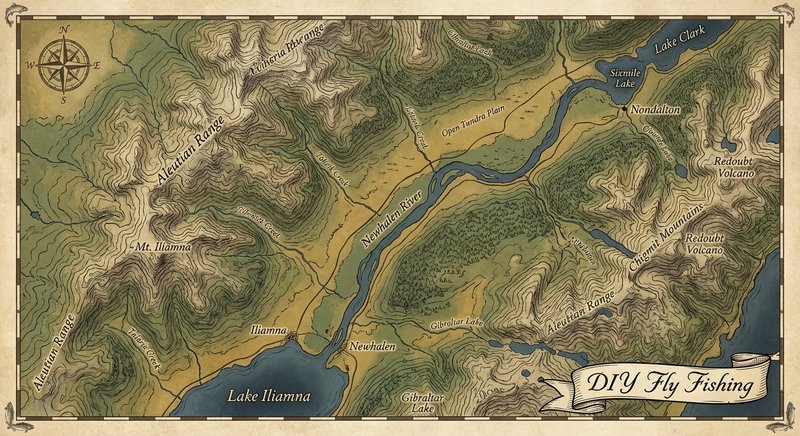
Newhalen River
Fly fishing in Alaska · Intermediate · Best seasons: Summer, Fall
Target Species
Rainbow Trout, Sockeye Salmon, Arctic Char
About This Water
Connects Iliamna and Sixmile Lakes. Trophy rainbow trout and salmon.
Fishing Recommendations
The Newhalen River is one of the crown jewels of the Bristol Bay watershed. Connecting Lake Clark to the massive Iliamna Lake, this river is a powerful, high-volume corridor that serves as a primary highway for millions of salmon and a playground for some of the largest wild Rainbow Trout on the planet.
As your guide, here is the comprehensive breakdown of how to fish this legendary Alaskan water.
🎣 Location Overview
The Newhalen is a short but mighty river, roughly 22 miles long. It is characterized by its immense volume and two distinct personalities:
- The Upper River: Deep, broad, and swift, moving massive amounts of water out of Lake Clark.
- The Lower River/Gorge: A rugged, boulder-strewn stretch featuring a dramatic gorge and waterfalls that act as a natural bottleneck for migrating fish.
What makes it special: Unlike the small, intimate creeks of the region, the Newhalen is "big water." It offers a sense of scale that is humbling. Anglers love it because it produces "leopard" rainbows and massive Arctic Char that thrive on the protein-rich conveyor belt of salmon eggs and flesh.
🐟 Target Species & Behavior
Rainbow Trout
These are wild, indigenous Alaskan rainbows. They are incredibly strong and behave more like steelhead than typical stream trout.
- Behavior: They follow the salmon. In early summer, they are opportunistic predators (smolt and sculpins). By late summer, they become stationary "vacuum cleaners" sitting behind spawning salmon.
- Hold: Look for "seams" where fast and slow water meet, and deep depressions behind active spawning beds (redds).
Sockeye Salmon
The Newhalen hosts one of the largest Sockeye runs in the world.
- Behavior: They are not traditional feeders once they enter the river. However, they are aggressive and defensive.
- Hold: They hug the banks to avoid the heaviest current. You’ll see them in "strings" moving upriver.
Arctic Char / Dolly Varden
These fish are the vibrant jewels of the river.
- Behavior: They are highly migratory, moving up from Lake Iliamna to feast on the salmon drop.
- Hold: They often sit in the softer water and tail-outs of pools, slightly behind the main concentration of Rainbows.
📅 Best Times to Fish
Summer (Late June – July)
- Focus: The Sockeye Run.
- Conditions: Early July is the peak for Sockeye. This is also a great time for "smolt" patterns as young salmon head to the lake, triggering explosive surface strikes from Rainbows.
- Window: Late evening light in Alaska lasts forever; 6:00 PM to 11:00 PM can be magical.
Fall (August – September)
- Focus: The "Egg Drop" and Flesh.
- Conditions: This is prime time for trophy Rainbows. As salmon begin to spawn and die, the river becomes an all-you-can-eat buffet of protein.
- Window: Late August through mid-September is the pinnacle. The water cools, and the fish "bulk up" for winter.
🪰 Recommended Flies & Techniques
For Rainbows & Char
- Beads (The Gold Standard): 6mm and 8mm plastic beads in "mottled orange," "peach," or "dead egg" colors. This is the most effective way to catch fish during the spawn.
- Flesh Flies: "Bunny Leeches" in white, ginger, and peach to mimic decaying salmon meat.
- Streamers: Sculpin patterns (black/olive) and "Dolly Llama" flies with heavy lead eyes to get deep in the current.
For Sockeye Salmon
- Patterns: The "Sockeye Special" or "Montana Red." These are sparse flies, usually just a hook with some crystal flash and a small wing.
- Technique: The "Kenai Flip" or "Flossing." It involves a short cast, a heavy sinker, and a drift that pulls the line through the fish’s mouth as they breathe.
Presentation Tips
- Indicators: Use large, buoyant indicators. The Newhalen's current is heavy, and you need to suspend your beads/nymphs at the exact depth of the fish.
- Weight: "Shot is your friend." If you aren't ticking the bottom occasionally, you aren't deep enough.
💡 Pro Tips & Local Knowledge
- The "Lower River" Hike: Most people fly into Iliamna or Newhalen. You can hike the trail along the lower river to access the falls. This is a grueling hike but provides access to some of the best Sockeye holding water.
- Watch the Salmon: Don't just cast blindly. Look for "active" salmon (fish turning over or digging redds). The biggest Rainbows will be 10–20 feet directly downstream of these fish.
- Heavy Gear: This is not the place for your 4-weight. Use a 7-weight or 8-weight rod. You need the backbone to turn a 10lb Rainbow in a 10mph current.
- The "Smolt Feed": If you are there in June/early July, look for gulls diving. This signals a smolt burst. Switch to a silver Minnow pattern and strip it fast near the surface.
⚠️ Important Information
Access
- Remote Location: The Newhalen is not on the road system. You must fly into the village of Iliamna via Anchorage (roughly a 1-hour flight).
- Transport: From the village, you can utilize local transporters or stay at one of the several high-end lodges (like Intricate Bay or Newhalen Lodge) that provide boat access.
Regulations & Permits
- License: You must have a valid Alaska Sport Fishing License.
- Barbless Hooks: Most of this drainage is strictly catch-and-release for Rainbow Trout, and barbless hooks are highly encouraged (often required by local lodge policy).
- Sockeye Limits: If you plan to keep Sockeye to eat, check the current ADF&G (Alaska Dept of Fish & Game) emergency orders, as limits change based on run strength.
Special Considerations
- Bears: This is high-density Brown Bear country. They are there for the salmon just like you. Always carry bear spray, stay vocal, and never leave your catch or backpack unattended on the bank.
- Wading Safety: The Newhalen is powerful and slippery. A wading staff and a belt are mandatory. Do not underestimate the "push" of this river.
Bug Hatches & Matching Flies
| Hatch | Type | Peak months | Time of day | Hook sizes | Matching flies |
|---|---|---|---|---|---|
| Chironomids Chironomidae | midge | May, June, September | All Day | #18-24 | Zebra Midge #18-22, Griffith's Gnat #20-22 |
| Blue-Winged Olive Baetis | mayfly | May, September | Afternoon | #16-20 | RS2 #18-20, Parachute Adams #16-20 |
| Golden Stonefly Hesperoperla pacifica | stonefly | June, July | Morning/Evening | #6-10 | Pat's Rubber Leg #8-10, Rogue River Stone #6-8 |
| Spotted Sedge Hydropsyche | caddis | July, August | Evening | #12-16 | Elk Hair Caddis #14-16, Hydropsyche Larva #12-14 |
| American Grannom Brachycentrus | caddis | June | Afternoon | #14-16 | Deep Sparkle Pupa #14-16, Peacock Caddis #14-16 |
| March Brown Rhithrogena morrisoni | mayfly | June, July | Afternoon | #12-14 | Gold Ribbed Hare's Ear #12-14, March Brown Western #12-14 |
| Yellow Sally Isoperla | stonefly | July, August | Evening | #14-16 | Yellow Sally #14-16, Little Yellow Stone #14-16 |
| Crane Fly Tipulidae | midge | August, September | Morning | #8-12 | Crane Fly Larva #10-12, Daddy Long Legs #8-10 |
| Green Sedge Rhyacophila | caddis | July, August | All Day | #10-14 | Green Weenie #12-14, Caddis Larva #10-12 |