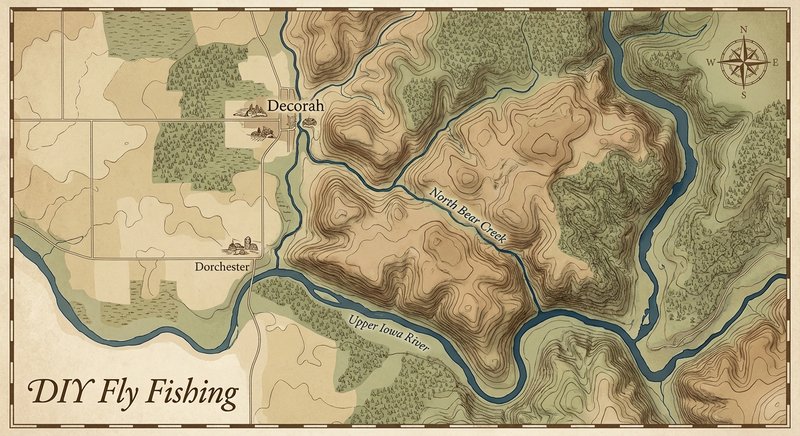
North Bear Creek
Fly fishing in Iowa · intermediate · Best seasons: spring, summer, fall
Target Species
Brown Trout, Brook Trout
About This Water
Winneshiek County stream with wild trout. Headwaters fishing in wooded valley.
Fishing Recommendations
Welcome to the Driftless Area of Northeast Iowa. As your guide, I can tell you that North Bear Creek is often cited as the "crown jewel" of Iowa’s trout streams. Located in Winneshiek County near the tiny settlement of Highlandville, North Bear offers a classic limestone spring-creek experience that rivals many of the famous waters out West.
Here is your comprehensive guide to fishing North Bear Creek.
🎣 Location Overview
North Bear Creek is a quintessential Driftless stream. Because this region escaped the flattening effects of the last glaciation, the landscape is defined by steep limestone bluffs, deep valleys, and cold, bubbling springs.
What makes it special: North Bear is one of the most consistent streams in the state. It is fed by massive limestone aquifers that keep the water a steady 48–52°F near the source year-round. It features a perfect mix of fast-running riffles, deep undercut banks, and long, glassy pools. Unlike some of its sister streams, North Bear has extensive public access through the North Bear Creek Wildlife Management Area, providing miles of fishable water.
🐟 Target Species & Behavior
The stream is managed for both Brown Trout and Brook Trout.
- Brown Trout: You’ll find both wild-reared and stocked Browns here. They are the "intellectuals" of the creek. Larger Browns (16"+) are nocturnal or crepuscular, hiding deep under limestone ledges and fallen timber during the day. They are highly opportunistic but easily spooked by heavy footsteps or poor shadows.
- Brook Trout: Iowa DNR stocks Brookies here regularly. They are typically found in the swifter, highly oxygenated water and are much more aggressive than Browns. They lack the wariness of the wild Browns and will often strike a well-presented dry fly even when no hatch is present.
- Feeding Patterns: These fish are "grazers." Because of the limestone-rich water, the biomass of scuds (freshwater shrimp) and sowbugs is immense. If you aren't seeing rising fish, they are almost certainly feeding on the bottom.
📅 Best Times to Fish
North Bear is a year-round fishery, but for the best experience, focus on these windows:
- Spring (April – early June): This is prime time. The water is high but clear, and the first major hatches occur. Look for Blue Winged Olives (BWOs) on cloudy days and the Grannom Caddis in late April.
- Summer (Late June – August): Focus on the early morning (sunrise to 10:00 AM) and the "Magic Hour" before dusk. This is Terrestrial Season. When the Iowa heat kicks in, the trout look to the banks for grasshoppers, ants, and beetles.
- Fall (September – October): My personal favorite. The Brown Trout become aggressive as they prepare for the spawn. The colors of the Brookies are breathtaking this time of year.
- Conditions: The best fishing usually occurs when the barometer is steady. If a heavy rain hits, the creek can "mud out," but because it's spring-fed, it usually clears within 24–48 hours.
🪰 Recommended Flies & Techniques
Top Fly Patterns
- Nymphs:
- The Pink Squirrel (Size 14-18): A Driftless legend. The pink head and flash tail are irresistible here.
- Scuds/Sowbugs (Size 16-20): Gray or Olive. Fish these deep under a strike indicator.
- Zebra Midge (Size 18-22): Essential for winter and early spring.
- Dry Flies:
- Elk Hair Caddis (Size 14-18): Tan or Olive.
- Hi-Vis Ant or Foam Beetle (Size 14-16): Vital for summer.
- Parachute Adams (Size 16-20): The best "searching" pattern when you see a rise but can't identify the bug.
- Streamers:
- Woolly Bugger (Size 8-12): Black or Olive. Swing these through deep holes for the "wall-hanger" Browns.
Techniques
- The "Driftless Stealth": The water is crystal clear. Keep a low profile. I often recommend my clients literally crawl on their knees to the bank to avoid "lining" the fish.
- Tight-Line Nymphing: Because the creek is narrow, "Euro-style" or tight-line nymphing is incredibly effective in the riffles.
- The Hopper-Dropper: In July and August, run a foam grasshopper on top with a small bead-head nymph (like a Pheasant Tail) tied 18 inches below it.
💡 Pro Tips & Local Knowledge
- Go Upstream: Most anglers park at the main bridge and fish within sight of their trucks. If you walk a half-mile upstream or downstream from the main access points, the fishing pressure drops significantly and the fish become much less "educated."
- Mind the Mud: The banks of North Bear can be "tucky"—deep, soft mud that can trap a boot. Stick to the gravel bars when wading.
- The "Highlandville Store": Stop at the general store in nearby Highlandville. It’s the unofficial headquarters of the area. They have local fly patterns, up-to-date reports, and great sandwiches.
- Light Tackle: Leave the 5-weight or 6-weight rods at home. A 7.5ft to 9ft 3-weight rod is the perfect tool for this water. It allows for delicate presentations and makes a 12-inch trout feel like a monster.
⚠️ Important Information
- Access: North Bear Creek is largely public through the WMA, but it is bordered by private farmland. Look for the green "Public Hunting/Fishing" signs. If you see a fence with no sign, ask for permission or stay in the stream bed.
- Regulations:
- A valid Iowa Fishing License AND a Trout Fee are required for all anglers.
- Check the current Iowa DNR Trout Regulations, as some sections may have specific lure restrictions or catch-and-release rules (though most of North Bear allows for harvest within daily limits).
- Safety: Cell service is almost non-existent in the valley. Download your maps for offline use or carry a physical map of Winneshiek County.
Tight lines, and enjoy one of the finest spring streams in the Midwest!
Bug Hatches & Matching Flies
| Hatch | Type | Peak months | Time of day | Hook sizes | Matching flies |
|---|---|---|---|---|---|
| Blue-Winged Olive Baetis | mayfly | April, May, September, October | Late Morning/Afternoon | #18-22 | RS2 #18-22, BWO Parachute #18-20, WD-40 #20-22 |
| Grannom Caddis Brachycentrus | caddis | April, May | Afternoon/Evening | #14-16 | Elk Hair Caddis (Olive/Tan) #14-16, LaFontaine's Deep Sparkle Pupa #14-16, Peacock Caddis #16 |
| Sulfur Ephemerella invaria | mayfly | May, June | Late Afternoon/Evening | #14-18 | Pheasant Tail #14-16, Sulfur Parachute #16-18, Sulfur Spinner #16-18 |
| Trico Tricorythodes | mayfly | July, August, September | Early Morning | #20-24 | Trico Spinner (Poly Wing) #20-24, Zebra Midge #20-22, Griffith's Gnat #20-22 |
| Light Cahill Stenacron interpunctatum | mayfly | June, July | Evening | #12-14 | Light Cahill #12-14, Gold Ribbed Hare's Ear #12-14 |
| Terrestrials (Grasshoppers/Ants) Formicidae/Acrididae | terrestrial | July, August, September | Afternoon | #10-18 | Dave's Hopper #10-12, Black Foam Ant #16-18, Chernobyl Ant #10-14 |
| Midges Chironomidae | midge | January, February, March, December | Late Morning | #18-24 | Zebra Midge (Red/Black) #18-22, Morgan's Midge #20-22, Palomino Midge #20-22 |
| Little Black Stonefly Capniidae | stonefly | February, March | Early Afternoon | #14-18 | Little Black Sloan #16-18, Early Brown Stone Nymph #14-16 |
| Crane Fly Tipulidae | other | August, September | Afternoon/Evening | #10-14 | Daddy Long Legs #10-12, Crane Fly Larva #10-14 |