North Branch Lamoille River
Fly fishing in Vermont · Beginner · Best seasons: Summer, Fall
Target Species
Brook Trout
About This Water
Northern Vermont stream near Eden Mills. Wild brook trout in secluded mountain waters.
Fishing Recommendations
The North Branch of the Lamoille River is one of Vermont’s hidden gems for the small-stream enthusiast. While the main stem of the Lamoille is famous for its broad sweeps and heavy rainbows, the North Branch is an intimate, rugged, and high-gradient freestone stream that offers some of the finest wild Brook Trout fishing in the Green Mountain State.
🎣 Location Overview
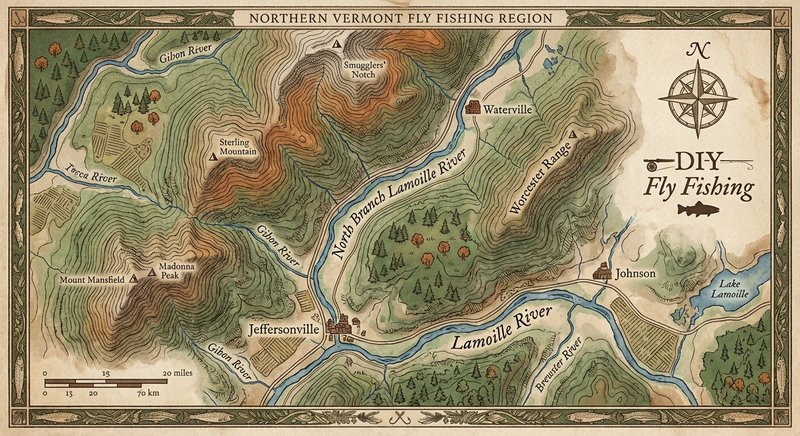
Flowing through the towns of Belvidere, Waterville, and into Johnson, the North Branch is characterized by "pocket water." Unlike the silty or sandy bottoms found in lower valley rivers, the North Branch is a classic boulder-strewn staircase.
What makes it special is its thermal stability. Because it is fed by high-elevation springs and shaded by dense forest canopy, the water stays significantly cooler than the main Lamoille during the heat of July and August. Anglers love it for the solitude—you are far more likely to see a moose or a blue heron than another fisherman—and for the sheer eagerness of its wild inhabitants.
🐟 Target Species & Behavior
The primary prize here is the Wild Brook Trout. While you may find an occasional wild Brown Trout near the confluence with the main river, the North Branch belongs to the brookies.
- Behavior: These are opportunistic feeders. Because the growing season is short and the water is nutrient-poor compared to limestone creeks, these fish cannot afford to be picky. However, they are incredibly "spooky." The water is crystal clear, and the fish are highly attuned to overhead shadows and vibrations.
- Holding Patterns: Look for "the bucket"—the soft water right behind a large boulder, or the "seam" where fast water meets slow water. In the summer, they hug the white water (highly oxygenated); in the fall, they move toward the tails of deeper pools for spawning preparation.
📅 Best Times to Fish
Optimal Seasons
- Summer (Late June – August): This is the prime window. When other Vermont rivers become too warm to fish safely (above 68°F), the North Branch remains a sanctuary.
- Fall (September – October): This is "magic hour" for Brook Trout. They don body paint of fiery oranges and deep reds for the spawn. Fishing is excellent, though anglers should be mindful to avoid stepping on "redds" (spawning nests in the gravel) late in the season.
Best Times of Day
- Summer: Mid-morning to late afternoon. Unlike tailwaters, the hatches here are often triggered by the sun hitting the water and warming the bugs.
- Fall: The warmest part of the day (11 AM to 3 PM) is most productive as insect activity peaks.
🪰 Recommended Flies & Techniques
Top Fly Patterns
Because the water is fast and turbulent, you need flies that float high and are easy for both you and the fish to see.
- Dry Flies:
- Royal Wulff (Size 12-16): The quintessential brook trout fly.
- Elk Hair Caddis (Size 14-18): Tan or Olive.
- Stimulators (Size 10-14): Great for imitating stoneflies or grasshoppers in late summer.
- Purple Haze: A variation of the Parachute Adams that works wonders in VT.
- Nymphs:
- Bead-head Pheasant Tail (Size 16-18)
- Prince Nymph (Size 14-16)
- Streamers:
- Black or Olive Woolly Bugger (Size 8-10): Best used in the deeper pools during the fall.
Effective Techniques
- Dry-Dropper: This is the most effective way to cover the North Branch. Use a high-vis Stimulator or Royal Wulff as your "indicator" and hang a small Pheasant Tail nymph about 18-24 inches below it.
- Dapping/Short Line: The brush is thick. Often, you won't be casting so much as "flicking" or "dapping" the fly over a log or rock.
- Upstream Approach: Always fish moving upstream. Because the water is clear and shallow, if you fish downstream, the trout will see you before you see them.
💡 Pro Tips & Local Knowledge
- The "Waterville Stretch": Focus on the area around Waterville. There are several bridges and pull-offs. The further you walk away from the road access points, the larger the average fish size becomes.
- Small Gear is Better: Leave the 9-foot 5-weight at home. A 7-foot to 8-foot 3-weight rod is the perfect tool for these tight quarters.
- Stealth is King: Wear natural colors (greens and browns). Kneel when approaching a pool. If you see a fish dart away, that pool is "blown" for at least 20 minutes—move on to the next one.
- The "Shadow" Rule: Never let your shadow fall across the pool you are fishing. In the mountain canyons of the North Branch, the sun angles can be tricky.
⚠️ Important Information
- Access: Much of the river runs through private land, but Vermont has a tradition of open access for fishing unless land is strictly "Posted." Always look for signs. The stretch along Route 109 provides several obvious pull-offs.
- Regulations:
- Check the current Vermont Fish & Wildlife Law Digest.
- Most of the North Branch falls under "General Fishing Regulations," but be aware of season closing dates (usually the last Sunday in October).
- Catch and Release is highly encouraged for these wild native Brookies to preserve the genetics of the stream.
- Safety: The rocks in the North Branch are notoriously "greasy" and slick. Felt-soled boots or studs are highly recommended. Cell service is spotty at best once you get into the Notch areas—let someone know where you are going.
Bug Hatches & Matching Flies
| Hatch | Type | Peak months | Time of day | Hook sizes | Matching flies |
|---|---|---|---|---|---|
| Blue-Winged Olive Baetis | mayfly | April, May, September, October | Midday | #18-22 | RS2 #18-22, Parachute Adams #18-22, Pheasant Tail #18-20 |
| Hendrickson Ephemerella subvaria | mayfly | May | Afternoon | #12-14 | Hendrickson Dark Dun #12-14, Red Quill #12-14, Hare's Ear Nymph #12-14 |
| Grannom Caddis Brachycentrus | caddis | May | Morning/Afternoon | #14-16 | Elk Hair Caddis (Olive) #14-16, LaFontaine's Deep Sparkle Pupa #14-16, Holy Grail #14-16 |
| March Brown Maccaffertium vicarium | mayfly | May, June | Afternoon | #10-14 | March Brown Dry #10-12, Gold Ribbed Hare's Ear #10-12 |
| Sulphur Ephemerella invaria | mayfly | June, July | Evening | #14-18 | Sulphur Parachute #14-18, CDC Sulphur Emerger #16-18 |
| Light Cahill Stenacron | mayfly | June, July, August | Evening | #12-16 | Light Cahill Dry #12-16, Cream Usual #14-16 |
| Yellow Sally Isoperla | stonefly | June, July | Afternoon/Evening | #14-16 | Yellow Sally Dry #14-16, Iron Lotus #16 |
| Trico Tricorythodes | mayfly | July, August, September | Morning | #22-26 | Trico Spinner #22-24, Griffith's Gnat #22-24 |
| Terrestrials Formicidae / Coleoptera | terrestrial | July, August, September | All Day | #12-18 | Black Foam Ant #16-18, Chernobyl Ant #12-14, Black Beetle #14-16 |