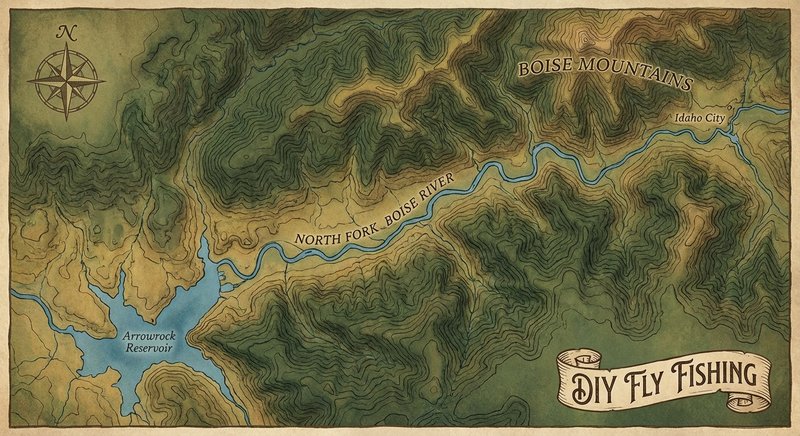
North Fork Boise River
Fly fishing in Idaho · Intermediate · Best seasons: Summer, Fall
Target Species
Rainbow Trout
About This Water
Boise National Forest stream with wild rainbow trout. Scenic mountain fishing near Idaho City.
Fishing Recommendations
The North Fork of the Boise River is one of Idaho’s premier "blue-ribbon" style freestone rivers that remains remarkably rugged despite its proximity to the state's capital. For the angler who loves crystal-clear pocket water, stunning granite canyons, and wild, feisty trout, the North Fork is a high-desert paradise.
🎣 Location Overview
The North Fork Boise River (NFBR) originates deep in the Sawtooth Wilderness and flows through the Boise National Forest before joining the Middle Fork. It is the quintessential Western freestone river: fast-moving, cold, and characterized by a classic "stair-step" gradient of plunge pools, riffles, and deep emerald runs.
What makes it special is the wildness. Unlike the main stem of the Boise River through town, the North Fork is home to wild, native Redband Rainbow Trout. The scenery is dramatic, featuring charred slopes from past wildfires (which have actually increased nutrient flow into the river) and massive granite boulders. It is a walk-and-wade fishery that rewards the adventurous angler who is willing to hike away from the road.
🐟 Target Species & Behavior
- Species: Primarily Interior Redband Trout (a hardy subspecies of Rainbow). You may also encounter Bull Trout (protected) and occasional Mountain Whitefish.
- Behavior: These are wild fish, not hatchery clones. They are opportunistic and aggressive. Because the North Fork is nutrient-poor compared to spring creeks, the fish can’t afford to be picky—they have to eat when food passes by.
- Holding Water: In the summer, look for them in oxygen-rich "pocket water" (the small slicks behind boulders) and at the heads of riffles. In the fall, as water cools, they move into the deeper, slower tail-outs and large pools.
📅 Best Times to Fish
- Optimal Months:
- July & August: This is prime time. The spring runoff usually subsides by late June. This is the window for epic dry-fly fishing.
- September & October: The "Golden Window." The crowds thin out, the Cottonwoods turn yellow, and the fish feed heavily on mahogany duns and terrestrials to bulk up for winter.
- Best Times of Day:
- Summer: Early morning (6 AM – 10 AM) and late evening (6 PM until dark) to avoid the midday heat.
- Fall: Mid-day (11 AM – 4 PM) as the sun warms the water and triggers insect activity.
- Prime Conditions: Look for flows to drop below 500 cfs at the NFBR gauge for the safest and most productive wading.
🪰 Recommended Flies & Techniques
Top Fly Patterns
- Dries:
- Chubby Chernobyl (Size 8-12, Gold or Royal) – The ultimate searcher pattern.
- Stimulator (Size 10-14, Orange or Yellow) – Mimics the large Golden Stones.
- Parachute Adams (Size 14-18) – For when they are sipping mayflies in the flats.
- Elk Hair Caddis (Size 14-16, Tan or Olive) – A staple for evening rises.
- Nymphs:
- Pat’s Rubber Legs (Size 8-12, Coffee/Black) – Essential for the North Fork.
- Pheasant Tail (Size 14-18) – Standard dropper.
- Perdigons (Size 14-16, Blue or Flashy) – To get deep in the fast chutes.
- Streamers:
- Woolly Buggers (Black or Olive) or Small Sparkle Minnows.
Effective Techniques
- Dry-Dropper: This is the "bread and butter" technique here. Use a buoyant Chubby Chernobyl as your "indicator" and hang a Pheasant Tail or a Copper John 24 inches below it.
- Short-Line Nymphing: In the heavy pocket water, skip the indicator. Use a heavy nymph and keep a tight line to feel the "tick-tick" of the bottom.
- The "Skate": In the evenings, skittering an Elk Hair Caddis across the surface of a riffle can trigger violent strikes.
💡 Pro Tips & Local Knowledge
- Don't Overlook the "Thin" Water: Many anglers walk right past 6-inch deep water to get to the big pools. Redbands often sit in very shallow, highly oxygenated water right against the bank or in front of rocks.
- Cover Water: These fish are spread out. If you haven’t had a hit in 15 minutes, move. The best anglers on the North Fork are the ones who walk the most miles.
- The "Rough Road" Factor: The road from Idaho City (FS 327/384) or the Middle Fork road can be brutal. Ensure you have a spare tire and preferably a high-clearance vehicle.
- Stealth Matters: Even though the water is turbulent, these fish are wary. Avoid wading right into the middle of a hole. Fish it from the bank first.
⚠️ Important Information
- Access: Much of the river is paralleled by Forest Service Road 327. There are numerous pull-offs and primitive campsites. The higher you go toward the headwaters, the smaller the water and the more "wild" it feels.
- Regulations:
- The North Fork is generally under General Stream Season (Saturday of Memorial Day weekend through November 30).
- Always check the current IDFG (Idaho Dept. of Fish and Game) regulations, as there are specific rules regarding bait and harvest limits (many sections are 2-fish limits, but catch-and-release is highly encouraged to protect the wild Redband genetics).
- Safety:
- No Cell Service: You will be out of range. Carry a satellite messenger (InReach/Zoleo) if traveling alone.
- Wildlife: This is Black Bear and Mountain Lion country. Carry bear spray.
- Rattlesnakes: Common in the rocky canyons during the summer—watch where you step when climbing over boulders.
- Wading: The rocks are incredibly slick. Felt soles or studded wading boots are highly recommended.
Tight lines on the North Fork! It’s a rugged piece of Idaho soul.
Bug Hatches & Matching Flies
| Hatch | Type | Peak months | Time of day | Hook sizes | Matching flies |
|---|---|---|---|---|---|
| Salmonfly Pteronarcys californica | stonefly | June, July | All Day | #4-8 | Rogue River Stone #4-6, Pat's Rubber Leg #6-8, Clark's Stone #6-8 |
| Golden Stonefly Hesperoperla pacifica | stonefly | July, August | Morning/Evening | #8-12 | Chubby Chernobyl (Gold) #8-12, Golden 20-Incher #10-12, Norm Wood Special #10-12 |
| Pale Morning Dun (PMD) Ephemerella excrucians | mayfly | July, August | Late Morning/Afternoon | #14-18 | Sparkle Dun #16-18, Pheasant Tail #14-18, PMD Quigley Cripple #16-18 |
| Spotted Sedge Hydropsyche | caddis | July, August, September | Evening | #14-18 | Elk Hair Caddis (Tan) #14-16, LaFontaine's Deep Sparkle Pupa #14-16, Godzilla Caddis #14-16 |
| Blue Winged Olive (BWO) Baetis | mayfly | April, May, September, October | Mid-day | #18-22 | Parachute Adams #18-22, RS2 #20-22, Baetis Barr Emerger #18-20 |
| Yellow Sally Isoperla | stonefly | July, August | Afternoon/Evening | #14-16 | Yellow Sally Foam Stone #14-16, Little Yellow Sloan #14-16, Stimulator (Yellow) #14-16 |
| Grasshopper Melanoplus | terrestrial | August, September | Mid-day/Afternoon | #8-12 | Morrish Hopper #8-12, Dave's Hopper #10-12, Parachute Hopper #10-12 |
| October Caddis Dicosmoecus gilvipes | caddis | September, October | Afternoon | #8-12 | Orange Stimulator #8-10, Peeping Caddis #8-12, October Sedge #8-10 |
| Western Green Drake Drunella doddsii | mayfly | July | Mid-day | #10-12 | Green Drake Hairwing #10-12, Hares Ear (Olive) #10-12, Green Drake Paradun #12 |
| Midge Chironomidae | midge | March, April, October, November | Mid-day | #18-24 | Zebra Midge #18-22, Griffith's Gnat #20-22, Top Secret Midge #20-24 |