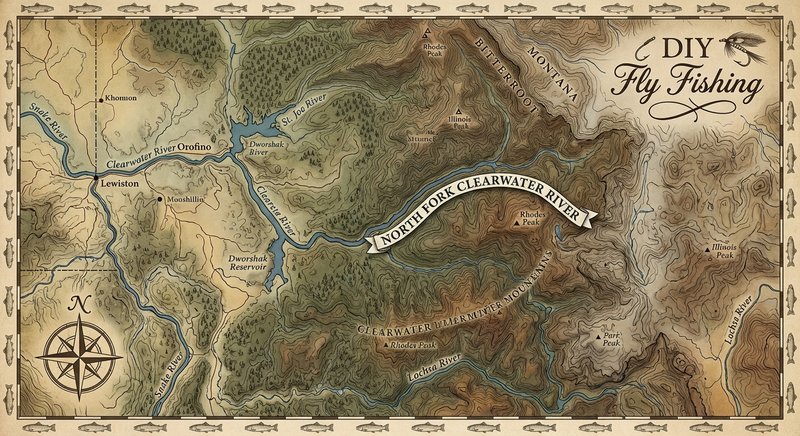
North Fork Clearwater River
Fly fishing in Idaho · Intermediate · Best seasons: Summer, Fall
Target Species
Cutthroat Trout, Bull Trout
About This Water
Remote Idaho Panhandle river with native cutthroat and bull trout. Pristine wilderness fishing.
Fishing Recommendations
The North Fork of the Clearwater River is, in my professional opinion, one of the crown jewels of the Inland Northwest. Tucked away in the rugged Clearwater National Forest of North-Central Idaho, this is a "bucket list" destination for anglers seeking true solitude and aggressive, wild trout.
Here is your comprehensive guide to fishing the North Fork.
🎣 Location Overview
The North Fork of the Clearwater is a high-gradient, cold-water system characterized by stunning scenery, gin-clear water, and massive boulders. Unlike the lower reaches of the Clearwater which are famous for Steelhead, the Upper North Fork (above Dworshak Reservoir) is a sanctuary for native Westslope Cutthroat and Bull Trout.
What makes it special is its wildness. This isn't a manicured tailwater; it’s a rugged, free-flowing river. The water is exceptionally clear, meaning you often see the fish before you cast. Anglers love it because the fish are notoriously "grabby"—they haven't been over-pressured by crowds, and they are eager to rise to large dry flies.
🐟 Target Species & Behavior
Westslope Cutthroat Trout
These are the stars of the show. They are beautiful, with bright orange slashes under their jaws and dark spots concentrated near the tail.
- Behavior: They are opportunistic surface feeders. Because the growing season is short, they cannot afford to be picky.
- Holding Water: Look for "foam lines" and the soft water behind large boulders. They love the "tailouts" of deep pools and the edges of fast current seams.
Bull Trout
The apex predator of the river. These are protected, migratory giants that can reach lengths over 30 inches.
- Behavior: They are piscivorous (eat other fish). They often shadow schools of Cutthroat or Mountain Whitefish.
- Holding Water: They prefer the deepest, darkest holes and the "buckets" at the base of waterfalls or heavy rapids. They are structure-oriented and stay deep during the day.
📅 Best Times to Fish
Summer (July – August)
- Conditions: The "Golden Era" on the North Fork. Once the spring runoff subsides (usually by early July), the river becomes wadeable.
- Windows: Mid-morning until dusk. There is rarely a need to be on the water at the crack of dawn, as the bug activity picks up as the water warms slightly.
Fall (September – October)
- Conditions: My personal favorite time. The nights get crisp, the larch trees turn gold, and the Cutthroats begin to congregate in deeper wintering holes.
- Windows: The warmest part of the day (11 AM to 4 PM) is the prime window for dry fly action.
🪰 Recommended Flies & Techniques
Dry Fly Fishing (The Primary Method)
Westslope Cutthroat love "attractor" patterns. They want something they can see in the bubbly water.
- Patterns:
- Chubby Chernobyl (Size 8-12) in Gold, Royal, or Purple.
- Purple Haze (Size 12-16).
- Turck’s Tarantula or Stimulators (Orange or Yellow).
- Technique: High-sticking through pocket water. Give the fly a slight "twitch" to imitate a struggling insect.
Streamer Fishing (For Bull Trout & Large Cutties)
If you want the giants, you have to go deep.
- Patterns:
- Sex Dungeon or Galloup’s Dungeon (White, Olive, or Black).
- Bunny Leeches (White is excellent to mimic whitefish).
- Technique: Use a sink-tip line. Cast quartering downstream into deep pools, let it sink, and use a slow, jerky strip.
Nymphing
Rarely necessary here because the dry fly fishing is so good, but if things are slow:
- Patterns: Pat’s Rubber Legs (Stonefly) or Bead-head Prince Nymphs.
💡 Pro Tips & Local Knowledge
- The "Kelly Creek" Factor: Kelly Creek is a major tributary of the North Fork and is world-famous. While it’s great, don't overlook the main stem of the North Fork itself between the Aquarius campground and the mouth of Kelly Creek for larger, albeit fewer, fish.
- The White Fly Secret: In late summer, keep an eye out for small white moths or mayflies. A size 14-16 White Wulff can be a "magic" fly when nothing else is working.
- Cover Water: Don't spend an hour in one hole. These fish are aggressive; if they are there and hungry, they will usually hit within the first five casts. If no luck, move to the next pocket.
- Bear Awareness: This is Grizzly and Black Bear country. Always carry bear spray and keep a clean camp.
⚠️ Important Information
Access
- FS Road 250: This is the primary artery following the river. It is a gravel road that can be rough. Ensure your vehicle has decent clearance and a full tank of gas—there are no gas stations once you head up-river from Pierce or Superior.
- Wading: The North Fork is "slick." The rocks are covered in a fine silt/algae. Felt-soled boots with studs are highly recommended.
Regulations & Permits
- Catch and Release: The North Fork and its tributaries are largely catch-and-release only for trout (check current Idaho Fish & Game yearlings for specific boundary lines).
- Barbless Hooks: Required for all fishing in this drainage.
- Bull Trout: It is illegal to target Bull Trout in certain sections, and they must be released immediately without being removed from the water. Even if you hook one incidentally, keep it in the water while unhooking.
- License: You need a valid Idaho Fishing License.
Gear Recommendations
- Rod: A 9-foot 5-weight is perfect for Cutthroat. If you are targeting Bull Trout, bring a 7 or 8-weight with a sink-tip.
- Leader: 9-foot 4X or 5X fluorocarbon. These fish aren't particularly leader-shy, but the water is very clear.
Bug Hatches & Matching Flies
| Hatch | Type | Peak months | Time of day | Hook sizes | Matching flies |
|---|---|---|---|---|---|
| Salmonfly Pteronarcys californica | stonefly | June, July | All Day | #4-8 | Chubby Chernobyl #6-8, Rogue Foam Stone #4-6, Pat's Rubber Leg #4-8 |
| Golden Stonefly Hesperoperla pacifica | stonefly | June, July | Morning/Afternoon | #8-12 | Clark's Stone #8-10, Golden Stimulator #10-12, 20 Incher Stone #8-12 |
| Green Drake Drunella doddsii | mayfly | July | Afternoon | #10-12 | Hairwing Green Drake #10-12, Quigley Cripple #12, Green Drake Nymph #10-12 |
| Pale Morning Dun (PMD) Ephemerella excrucians | mayfly | July, August | Late Morning/Afternoon | #14-18 | Sparkle Dun #16-18, PMD Parachute #14-16, Pheasant Tail #14-18 |
| October Caddis Dicosmoecus atripes | caddis | September, October | Afternoon/Evening | #8-12 | Orange Stimulator #8-10, October Caddis Pupa #10-12, Morrish October Caddis #8-10 |
| Yellow Sally Isoperla spp. | stonefly | July, August | Late Afternoon/Evening | #14-16 | Yellow Sally Foam #14-16, Elk Hair Caddis (Yellow) #14-16, Little Yellow Stone Nymph #14-16 |
| Blue Winged Olive (BWO) Baetis spp. | mayfly | April, May, September, October | Afternoon | #18-22 | Parachute Adams #18-22, BWO Sparkle Dun #20, RS2 #20-22 |
| Terrestrials (Grasshoppers/Ants) Formicidae / Orthoptera | terrestrial | August, September | Mid-Day/Afternoon | #10-16 | Morrish Hopper #10-12, Carpenter Ant #14-16, Black Beetle #14-16 |