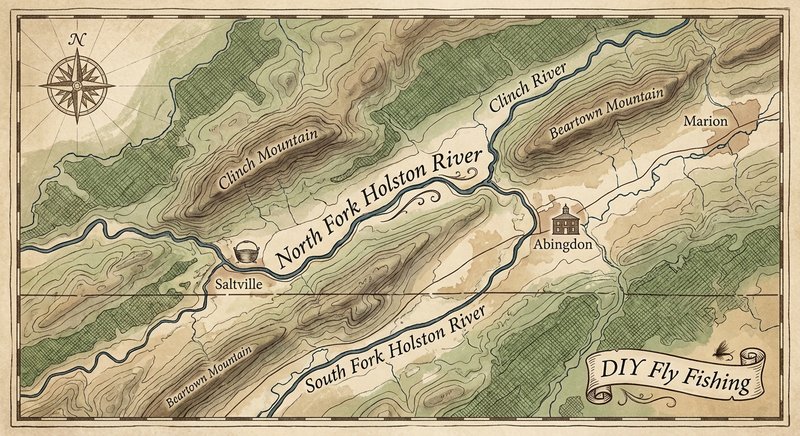
North Fork Holston River
Fly fishing in Virginia · Intermediate · Best seasons: Spring, Summer, Fall
Target Species
Rainbow Trout, Smallmouth Bass
About This Water
Southwest Virginia stream with trout and smallmouth. Scenic mountain river.
Fishing Recommendations
Welcome to the North Fork Holston River, one of Southwest Virginia’s most storied and productive river systems. As a guide, I consider the North Fork a "Jekyll and Hyde" river—it transitions from a cold-water trout sanctuary in its upper reaches to a world-class, limestone-influenced Smallmouth Bass factory as it moves downstream.
Here is your comprehensive guide to fly fishing the North Fork.
🎣 Location Overview
The North Fork Holston (NFH) flows through the rugged Appalachian ridges of Smyth, Washington, and Scott counties. What makes this river special is its limestone geology. Because the water passes through limestone, it has a higher pH and is incredibly rich in minerals, which leads to a massive biomass of aquatic insects and baitfish.
- Upper Section: Cold, spring-fed, and narrow; home to stocked and some wild trout.
- Middle/Lower Section: Wider, warmer, and characterized by ledges, deep pools, and "push water"; this is prime Smallmouth territory.
- The Draw: Anglers love the North Fork because it offers a "big fish" reputation. The Smallmouth here are famously aggressive and often larger on average than those in the nearby New or James Rivers.
🐟 Target Species & Behavior
Smallmouth Bass (The Main Attraction)
- Behavior: These are "river tigers." They are highly territorial and relate heavily to the river's rocky ledges.
- Holding Spots: Look for "seams" where fast water meets slow water, the shade of overhanging trees, and the eddies behind large limestone slabs.
- Feeding: They key in on crayfish and various minnow species (Shiners and Madtoms). During summer evenings, they will look up for massive White Miller or Hexagenia hatches.
Rainbow Trout
- Behavior: Found primarily in the upper reaches (above Saltville near Chatham Hill). They are opportunistic feeders but can become selective during specific hatches.
- Holding Spots: They prefer the "heads" of pools where oxygen levels are highest and deep undercut banks.
- Feeding: They feed on standard Appalachian freestone fare: Mayflies, Caddis, and terrestrial insects (ants/beetles) in late summer.
📅 Best Times to Fish
Spring (March - May)
- Target: Rainbow Trout and early Smallmouth.
- Conditions: High water is common. This is the best time for trophy trout as they shake off winter lethargy.
- Window: Mid-day when the sun warms the water slightly.
Summer (June - August)
- Target: Smallmouth Bass.
- Conditions: The "Golden Era" for the North Fork. Low, clear water makes for incredible sight fishing and topwater action.
- Window: Early morning and late evening are essential to beat the heat.
Fall (September - November)
- Target: Big Smallmouth and Trout.
- Conditions: As water cools, Smallmouth feed heavily to prepare for winter. The fall colors in the Holston Valley are spectacular.
- Window: Late morning through late afternoon.
🪰 Recommended Flies & Techniques
For Smallmouth Bass
- Topwater: Boogle Bugs (Poppers) in Blue/White or Chartreuse. Murphey’s Lost Cause for a more subtle presentation.
- Sub-surface: Gamechangers (White or Chartreuse), Clouser Minnows (Olive/White), and Near Nuff Crawfish.
- Technique: "Swing and Strip." Cast 45 degrees downstream toward the bank, let the fly swing into the current, and use erratic strips to mimic a wounded baitfish.
For Rainbow Trout
- Dries: Parachute Adams (14-16), Elk Hair Caddis (14-18), and Stimulators (10-12) for high water.
- Nymphs: Pheasant Tail (16-18), Pat’s Rubber Legs (Black/Brown), and Bead-head Prince Nymphs.
- Technique: Standard upstream dead-drift. In the North Fork’s pocket water, a high-sticking nymph technique is often more effective than using a strike indicator.
💡 Pro Tips & Local Knowledge
- The Ledge Logic: The North Fork is famous for its "stair-step" limestone ledges. Smallmouth often sit right on top of the ledge in very shallow water when feeding, or tucked tight against the downstream side of the ledge when resting. Never skip the shallow water.
- The "White Miller" Hatch: In July and August, look for a blizzard of white moths (White Millers) in the evening. The river will appear to "boil" with rising Smallmouth. Use a size 10-12 white fluttering caddis or a small white popper.
- Stealth is Key: Because the water is often crystal clear in summer, the North Fork fish are spooky. Long leaders (9-12 feet) and quiet wading are mandatory.
- Specific Spot: The stretch near Mendota, VA is legendary for Smallmouth numbers. For Trout, focus on the Chatham Hill area.
⚠️ Important Information
Mercury Advisory (CRITICAL)
The North Fork Holston has a long-standing Mercury health advisory due to historic industrial activity in Saltville.
- Regulations: It is generally a Catch and Release only mindset for most anglers here.
- Consumption: Check the Virginia Department of Health website for current consumption bans. Most guides strictly recommend not eating anything caught from this river.
Access & Logistics
- Public Access: There are several VDGIF (Virginia Department of Game and Inland Fisheries) ramps. Notable ones include Saltville, Allison Gap, and Holston.
- Wading vs. Floating: Much of the river is wadable during summer flows, but a kayak or a small raft is the best way to see the more remote, less-pressured stretches.
- Licensing: You need a standard Virginia Freshwater Fishing License. If fishing for trout in designated waters (Oct 1–June 15), you also need a Trout License.
Guide’s Final Word: The North Fork isn't always easy, but it is rewarding. Respect the private property bordering the river, watch your footing on the slippery limestone, and hold on tight when a North Fork Smallmouth decides to test your 6-weight!
Bug Hatches & Matching Flies
| Hatch | Type | Peak months | Time of day | Hook sizes | Matching flies |
|---|---|---|---|---|---|
| Blue Winged Olive Baetis | mayfly | March, April, October, November | Afternoon | #18-22 | RS2 #18-22, BWO Parachute #18-22, Pheasant Tail #18-20 |
| Quill Gordon Epeorus pleuralis | mayfly | March, April | Midday | #12-14 | Quill Gordon Dry #12-14, Hare's Ear Nymph #12-14 |
| March Brown Maccaffertium vicarium | mayfly | April, May | Afternoon | #10-14 | March Brown Emerger #12-14, Gold Ribbed Hare's Ear #10-12 |
| Sulphur Ephemerella invaria/dorothea | mayfly | May, June | Evening | #14-18 | Sulphur Parachute #14-18, CDC Sulphur Emerger #16-18 |
| Cinnamon Caddis Hydropsyche | caddis | May, June, July, August | Morning/Evening | #14-18 | Elk Hair Caddis (Tan) #14-18, Pupa (Amber/Tan) #14-16 |
| White Fly Ephoron leukon | mayfly | August, September | Late Evening | #12-14 | White Wulff #12-14, Snowshoe Mayfly #12-14 |
| Golden Stonefly Acronuria | stonefly | May, June, July | Morning/Afternoon | #6-10 | Pat's Rubber Legs #6-10, Stimulator (Yellow) #8-12 |
| Grasshoppers Orthoptera | terrestrial | July, August, September | Afternoon | #8-12 | Dave's Hopper #8-12, Morrish Hopper #10-12 |
| Ants/Beetles Formicidae/Coleoptera | terrestrial | June, July, August | All Day | #12-18 | Black Foam Beetle #12-16, Cinnamon Flying Ant #14-18 |