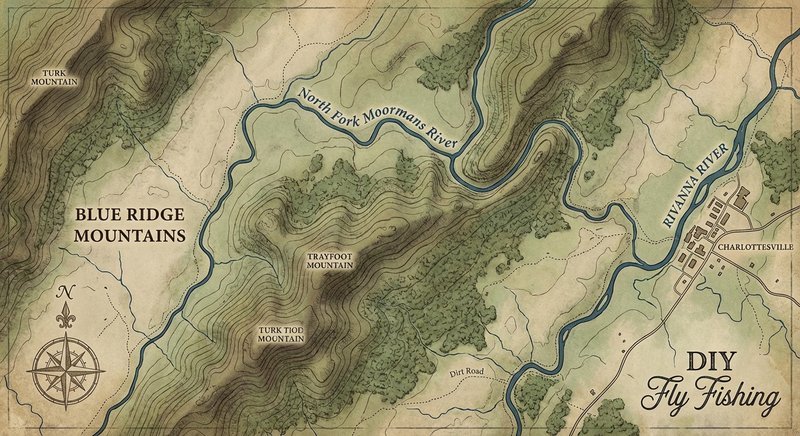
North Fork Moormans River
Fly fishing in Virginia · Intermediate · Best seasons: Spring, Summer, Fall
Target Species
Brook Trout
About This Water
Albemarle County stream with native brook trout. Sugar Hollow area.
Fishing Recommendations
As an expert guide who has spent years navigating the technical pocket waters of the Blue Ridge, I can tell you that the North Fork of the Moormans River is one of Virginia's crown jewels. Located within the Shenandoah National Park (SNP) near Charlottesville, it offers the quintessential "Blue Ridge Brookie" experience: rugged terrain, crystal clear water, and the vibrant, native Southern Appalachian Brook Trout.
Here is your comprehensive guide to fishing the North Fork.
🎣 Location Overview
The North Fork Moormans is a classic high-gradient freestone stream. What makes it special is its transition from the rolling foothills of Albemarle County into the steep, boulder-choked canyons of the Shenandoah National Park.
The water is remarkably clear and relatively nutrient-poor, which keeps the fish small but incredibly beautiful and aggressive. You’ll find a landscape dominated by massive granite boulders, deep plunge pools, and tight rhododendron tunnels. It feels far more remote than it actually is, offering a true wilderness experience just a short drive from civilization.
🐟 Target Species & Behavior
The primary (and arguably only) target here is the Native Brook Trout.
- Behavior: These are opportunistic feeders because food is scarce in mountain streams. However, they are incredibly "spooky." In this thin, clear water, they can see you long before you see them.
- Holding Patterns: Look for them in the "pocket water"—the small cushions of soft water behind or in front of large rocks. In the heat of summer, they move to the heads of pools where oxygen levels are higher. In the cooler months, you’ll find them in the slower tailouts soaking up the sun.
- Diet: Their diet consists mainly of small stoneflies, mayflies, and caddis. During the summer, terrestrials (ants, beetles, spiders) make up over 50% of their calorie intake.
📅 Best Times to Fish
- Spring (March – May): The Golden Window. This is when the best hatches occur (Quill Gordons and March Browns). Water levels are usually perfect.
- Summer (June – August): Fishing can be excellent but requires caution. The Moormans is sensitive to drought. If the water is too low and warm (above 68°F), give the fish a break. Focus on the early morning hours.
- Fall (September – October): A spectacular time to be on the water. The Brookies are in their spawning colors (vibrant oranges and reds) and become very aggressive.
- Prime Conditions: Fish 24–48 hours after a light rain. The extra "color" in the water hides your approach, and the rising levels wash food into the drift.
🪰 Recommended Flies & Techniques
You don't need a massive fly box here; you need a stealthy approach.
Top Fly Patterns
- Dry Flies:
- Royal Wulff or Royal Coachman (Size 14-16): High visibility and high buoyancy.
- Elk Hair Caddis (Size 14-18): The staple of the Blue Ridge.
- Parachute Adams (Size 16-20): For technical days when fish are rising to specific hatches.
- Terrestrials:
- Black Foam Ants (Size 18-22): If you aren't catching fish in July, put on an ant.
- Green Weenie: A local Shenandoah favorite (fishes like a nymph or a wet fly).
- Nymphs:
- Pheasant Tail (Size 16-18): Great for mimicking almost any small mayfly nymph.
- Bead-head Prince Nymph (Size 14-16): Good for deeper plunge pools.
Techniques
- Dry-Dropper: This is the most effective method. Run a buoyant dry fly (like a Stimulator) with a small Pheasant Tail nymph tied 12–18 inches below it.
- The "Bow and Arrow" Cast: The brush is thick. You will rarely have room for a full backcast. Master the bow-and-arrow cast to get your fly into tight pockets.
- Short Line Nymphing: You are rarely casting more than 15 feet. Keep as much fly line off the water as possible to avoid "drag."
💡 Pro Tips & Local Knowledge
- The "Hike-In" Rule: The Sugar Hollow Reservoir parking lot gets crowded. Most casual anglers fish the first half-mile. If you hike 2 miles upstream past the junction with the Big Branch Falls trail, the fishing pressure drops significantly and the fish become much less wary.
- Stealth is Everything: Wear drab colors (olive or tan). Approach pools from downstream and stay low—sometimes even kneeling on the rocks. If you see a fish dart away, that pool is "blown" for at least 20 minutes.
- Check the Gauge: The Moormans is notorious for "going dry" or becoming a trickle during late summer. Check the USGS gauge for the Rapidan River or nearby streams; if the Rapidan is below 10-15 cfs, the Moormans will be very skinny.
- Wait for the Shadow: On bright sunny days, fish the shaded banks. Brook trout hate being in direct midday sun where they are visible to ospreys and herons.
⚠️ Important Information
- Access: Park at the Sugar Hollow Reservoir parking area (end of Route 614). Follow the trail that leads around the north side of the reservoir to enter the Shenandoah National Park.
- Regulations:
- Single-hook, artificial lures only. No bait is permitted.
- A valid Virginia Freshwater Fishing License is required.
- Within the Park, most streams are "Catch and Release" or have very specific size limits (usually 9 inches for Brookies). However, most conservation-minded anglers practice 100% Catch and Release here to protect the native genetics.
- Safety: The rocks in the Moormans are incredibly slick (even when dry). Felt-soled boots or studs are highly recommended. Also, be "Bear Aware"—this is prime black bear habitat. Keep your snacks sealed!
Bug Hatches & Matching Flies
| Hatch | Type | Peak months | Time of day | Hook sizes | Matching flies |
|---|---|---|---|---|---|
| Quill Gordon Epeorus pleuralis | mayfly | March, April | Midday | #12-14 | Quill Gordon Dry #12-14, Gold Ribbed Hare's Ear #12-14 |
| Blue Quill Paraleptophlebia | mayfly | March, April | Late Morning/Afternoon | #16-18 | Blue Quill Dry #16-18, Pheasant Tail Nymph #16-18 |
| Hendrickson Ephemerella subvaria | mayfly | April, May | Afternoon | #12-14 | Red Quill #12-14, Hendrickson Emerger #14 |
| March Brown Maccaffertium vicarium | mayfly | May, June | Afternoon | #10-14 | March Brown Dry #10-12, American March Brown Nymph #10-12 |
| Sulfur Ephemerella invaria/dorothea | mayfly | May, June | Evening | #14-18 | Sulfur Parachute #16-18, Sulfur Emerger #16 |
| Yellow Sally Isoperla | stonefly | May, June, July | Late Afternoon/Evening | #14-16 | Yellow Sally Dry #14-16, Little Yellow Stone Nymph #14-16 |
| Light Cahill Stenacron canadense | mayfly | June, July | Evening | #12-14 | Light Cahill #12-14, Cream Variant #14 |
| Blue-Winged Olive Baetis | mayfly | March, October, November | Midday | #18-22 | BWO Parachute #18-22, RS2 #20-22 |
| Terrestrials (Ants and Beetles) Formicidae / Coleoptera | terrestrial | June, July, August, September | All Day | #14-18 | Black Foam Ant #16-18, Crowe Beetle #14-16 |