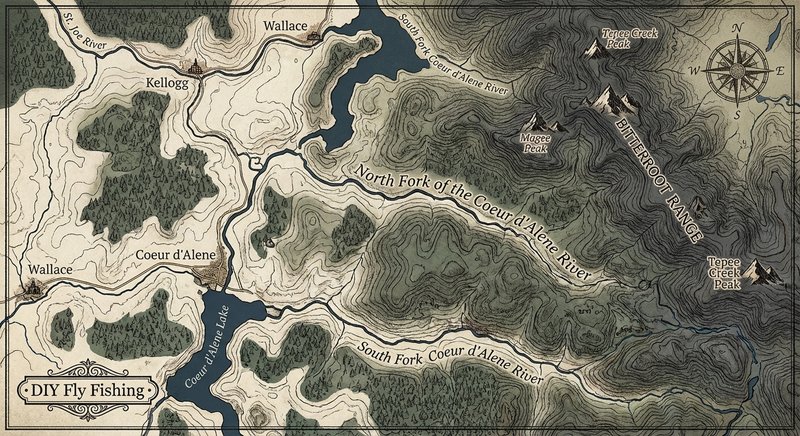
North Fork of the Coeur d'Alene River
Fly fishing in Idaho · Beginner · Best seasons: Summer, Fall
Target Species
Cutthroat Trout
About This Water
Crystal clear water with native cutthroat trout. Excellent hiking and fishing access in the Idaho Panhandle.
Fishing Recommendations
The North Fork of the Coeur d'Alene River (often simply called "The North Fork") is the crown jewel of North Idaho fly fishing. As an expert guide who has spent countless days on these waters, I can tell you that this is one of the premier Westslope Cutthroat fisheries in the lower 48. It is a classic freestone river that offers a quintessential "dry fly" experience in a stunning mountain setting.
🎣 Location Overview
The North Fork is a medium-sized freestone river flowing through the rugged Bitterroot Mountains. It is characterized by crystal-clear water, cobbled bottoms, and a diverse mix of deep "emerald" pools, bouldery pocket water, and long, glassy tailouts.
What makes it special is its accessibility and personality. Most of the river is closely paralleled by Forest Service Road 208, making it easy to hop from spot to spot. Despite the access, the river retains a wild feel. Anglers love it because the fish are famously "surface-oriented"—if there is a bug on the water, a Cutthroat will likely rise for it.
🐟 Target Species & Behavior
Primary Species: Westslope Cutthroat Trout (Native) Incidental Species: Rainbow Trout, Mountain Whitefish, and the occasional Bull Trout (which must not be targeted).
Behavior & Holding Patterns
- The "Look Up" Mentality: Unlike pressured tailwater fish, North Fork Cutthroats spend much of their time looking at the surface. They are opportunistic feeders due to the relatively nutrient-poor mountain water.
- Where They Hold:
- Seams and Foam Lines: Look for where fast water meets slow water. "If it holed bubbles, it holds fish."
- Tailouts: In the evening, fish move to the shallow tailouts of large pools to sip spinners or emergers.
- Wood Structure: Cutthroats love downed timber. Don't be afraid to cast tight to submerged logs.
- Boulders: In the upper reaches, look for the "cushion" of water just in front of or behind large boulders.
📅 Best Times to Fish
Optimal Seasons
- Summer (July - August): This is the prime window. Once the spring runoff subsides (usually by late June), the river becomes a dry fly paradise.
- Fall (September - October): Many guides consider this the best time. The crowds thin out, the water cools, and the fish become aggressive as they prepare for winter.
Best Times of Day
- Summer: Early morning (6 AM – 10 AM) and late evening (6 PM – Dark). During the heat of the day, fish deep in the faster, oxygenated riffles.
- Fall: The window shifts to the middle of the day (11 AM – 4 PM) as the sun warms the water and triggers hatches.
🪰 Recommended Flies & Techniques
Top Fly Patterns
- The "Purple Haze": If you only carry one fly here, make it this one (Size 14-18). For reasons unknown to science, North Idaho Cutthroats have a biological obsession with the color purple.
- Chubby Chernobyl: (Gold, Orange, or Purple, Size 8-12). Perfect as a high-visibility attractor or as the lead in a hopper-dropper rig.
- October Caddis: (Size 8-10). Essential for September and October.
- PMDs (Pale Morning Duns): (Size 16-18). Vital for the late July morning hatches.
- Perdigons/Pheasant Tails: (Size 16-20). If the dry fly action is slow, drop these 18-24 inches below a Chubby.
Effective Techniques
- Dry-Dropper: This is the "standard" North Fork rig. Use a buoyant terrestrial (like a Chubby) and hang a small unweighted or lightly weighted nymph behind it.
- Working the Pocket Water: Use a short line and high-stick your dry fly through the soft pockets behind rocks.
- Skating Caddis: In the evenings, don't be afraid to give your caddis pattern a little "twitch" or skate it across the surface to trigger a territorial strike.
💡 Pro Tips & Local Knowledge
- The "Upper" vs. "Lower": The river is generally divided at the confluence with the Little North Fork (Enaville). The Upper River (above Bumblebee) is more technical, skinnier water with higher densities of fish. The Lower River is broader and better for floating, holding fewer but often larger fish.
- Stealth Matters: Because the water is so clear, these fish can see you from a distance. Avoid "lining" the fish (casting your fly line directly over their heads). Approach pools from downstream and keep a low profile.
- The Twitch: While a "dead drift" is usually the goal, a subtle twitch of a terrestrial fly just as it enters a fish's window can often entice a strike from a wary Cutthroat.
- Look for "The Wood": If you see a pile of logs in a deep pool, there is almost certainly a 16-inch+ Cutthroat living underneath it.
⚠️ Important Information
Access
- Road Access: Forest Service Road 208 provides miles of public access. There are numerous pull-outs and campgrounds (Devil’s Elbow, Bumblebee, Kit Price).
- Floating: Common drifts include Prichard to Enaville. Note that the river can get very "bony" (shallow) in late August, making rafts or drift boats difficult in the upper sections.
Regulations & Permits
- Catch and Release: The North Fork is Catch and Release only for Cutthroat Trout.
- Hooks: Barbless hooks are highly recommended to protect the delicate mouths of the Cutthroat.
- License: You will need a valid Idaho Fishing License.
- Invasive Species: Ensure your boots and waders are clean and dry to prevent the spread of New Zealand Mud Snails or Didymo.
Special Considerations
- Wildlife: This is bear country (Black bears are common, Grizzlies are rare but present). Carry bear spray if you are hiking into the upper reaches.
- Cell Service: Expect zero cell service once you move a few miles past Kingston/Enaville. Download your maps for offline use.
Bug Hatches & Matching Flies
| Hatch | Type | Peak months | Time of day | Hook sizes | Matching flies |
|---|---|---|---|---|---|
| Skwala Stonefly Skwala americana | stonefly | March, April | Midday | #8-12 | Skwala Stone #10-12, Pat's Rubber Legs #8-12 |
| March Brown Rhithrogena morrisoni | mayfly | April, May | Afternoon | #12-14 | Western March Brown #12-14, Pheasant Tail #12-14 |
| Salmonfly Pteronarcys californica | stonefly | May, June | All Day | #4-8 | Rogue Foam Salmonfly #4-8, Pat's Rubber Legs (Black/Orange) #4-8 |
| Golden Stonefly Hesperoperla pacifica | stonefly | June, July | Morning/Evening | #8-12 | Chubby Chernobyl (Gold) #8-12, Golden Stone Nymph #10-12 |
| Green Drake Drunella doddsii | mayfly | June | Afternoon | #10-12 | Hair Wing Green Drake #10-12, Green Drake Cripple #12 |
| Pale Morning Dun (PMD) Ephemerella excrucians | mayfly | June, July, August | Late Morning/Afternoon | #14-18 | Sparkle Dun #14-18, PMD Emerger #16-18 |
| Tan Caddis Hydropsyche | caddis | July, August | Evening | #14-18 | Elk Hair Caddis (Tan) #14-18, LaFontaine's Deep Sparkle Pupa #14-16 |
| Terrestrials Formicidae / Acrididae | terrestrial | August, September | All Day | #10-16 | Morrish Hopper #10-14, Cinnamon Ant #14-16 |
| October Caddis Dicosmoecus gilvipes | caddis | September, October | Afternoon/Evening | #8-10 | Orange Stimulator #8-10, October Caddis Pupa #8-10 |
| Blue-Winged Olive (BWO) Baetis | mayfly | April, September, October | Midday | #18-22 | BWO Parachute #18-22, RS2 (Gray/Olive) #20-22 |