North Fork Shenandoah River
Fly fishing in Virginia · Beginner · Best seasons: Spring, Summer, Fall
Target Species
Smallmouth Bass, Sunfish
About This Water
Northern Shenandoah Valley river with excellent smallmouth bass. Scenic float fishing.
Fishing Recommendations
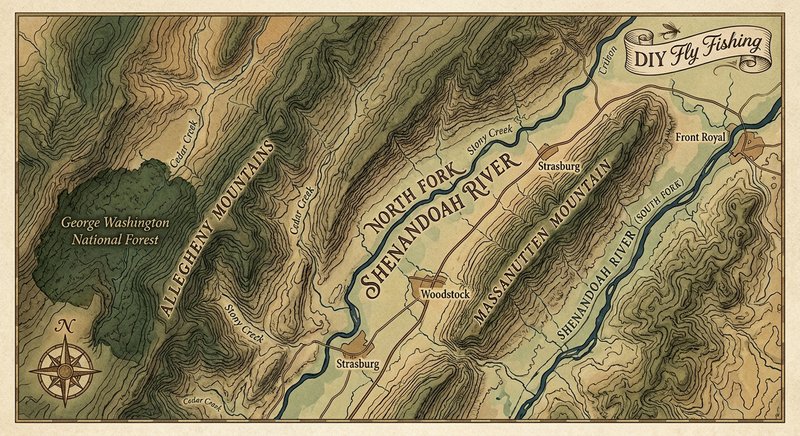
The North Fork of the Shenandoah River is a hidden gem of the Mid-Atlantic. While its sister, the South Fork, gets more publicity, the North Fork offers an intimate, technical, and incredibly rewarding fly fishing experience. Meandering through the valley beneath the shadow of Massanutten Mountain, this river is a limestone-influenced paradise for Smallmouth Bass enthusiasts.
🎣 Location Overview
The North Fork is characterized by its "ledge-and-pool" topography. Unlike many freestone rivers, the North Fork flows over tilted limestone shelves that create natural underwater "fences," deep troughs, and complex eddies.
What makes it special is its intimacy. It is smaller and shallower than the South Fork, making it much more approachable for the wading angler. The water is chemically rich (alkaline), which supports a massive biomass of hellgrammites, crayfish, and baitfish. It is a classic "small-water" Smallmouth fishery where you are more likely to find a 15-inch fish in two feet of water than in a deep hole.
🐟 Target Species & Behavior
Smallmouth Bass (The "Bronzeback")
- Behavior: On the North Fork, Smallmouth are opportunistic but wary. They are highly structure-oriented.
- Holding Spots: Look for the "seams" where fast water meets slow water, and specifically the downstream side of the limestone ledges. In summer, they move into the "oxygenated water"—the riffles and bubbly heads of pools.
- Feeding: They are aggressive predators. Their primary diet consists of Hellgrammites (dobsonfly larvae), Crayfish, and Madtom catfishes.
Sunfish (Bluegill, Redbreast, and Rock Bass)
- Behavior: These are the "willing participants." Redbreast Sunfish are particularly beautiful here, with deep orange bellies.
- Holding Spots: They congregate near woody debris (fallen logs) and in the slower "backwater" eddies near the banks.
- Feeding: They will rise to almost any small terrestrial or popper, making them perfect for beginners or for high-action afternoons.
📅 Best Times to Fish
Spring (Mid-April – June)
- Window: This is prime time for the biggest fish. As water temperatures hit 55°F, bass become active.
- Conditions: Look for the "post-spawn" period in late May/early June when fish are hungry and aggressive.
Summer (July – August)
- Window: This is Topwater Heaven.
- Time of Day: Early morning (dawn to 10:00 AM) and late evening (6:00 PM to dusk). During the heat of the day, fish deep ledges or shaded banks.
Fall (September – October)
- Window: As the water cools, bass go on a feeding binge to prepare for winter.
- Conditions: The "October Caddis" and falling leaves can make fishing tricky, but streamers moved slowly through deep pools can produce the largest fish of the year.
🪰 Recommended Flies & Techniques
Topwater (The most fun!)
- Murray’s Mini-Popper: (Size 6-10) In yellow or silver. Developed by local legend Harry Murray specifically for this river.
- BoogleBug: (Size 6) Extremely durable foam poppers.
- Sneaky Pete: A slider-style fly that mimics a wounded minnow without the loud "pop."
Sub-Surface (The most effective)
- Murray’s Hellgrammite: (Size 4-10) The "gold standard" for the Shenandoah. Fish it on a dead drift or with a slow crawl.
- CK Slider: A great baitfish imitation that darts side-to-side.
- Clouser Minnow: (Chartreuse/White or Olive/White). Essential for covering water.
- Near Nuff Crayfish: Fish this tight to the bottom near ledges.
Techniques
- The "Swim & Drop": Cast a weighted fly (like a Hellgrammite) upstream of a ledge. Let it tumble over the ledge and "drop" into the trough. This is where 90% of North Fork bass strike.
- Popper-Dropper: Tie a small popper on top and a 15-inch piece of tippet to a small nymph (like a Hare’s Ear) below. This catches bass and sunfish simultaneously.
💡 Pro Tips & Local Knowledge
- Read the "Ribs": The North Fork has visible rock ribs running across the river. Always fish the downstream side of these ribs. Bass sit in the soft water created by the rock, waiting for food to wash over the top.
- Long Leaders: Because the North Fork is often clearer and shallower than the South Fork, use a longer leader (9 to 11 feet) tapered to 10lb or 8lb test (3X or 4X). Stealth matters here more than you think.
- Wade Carefully: The limestone ledges are notoriously slick and uneven. Felt-soled boots and a wading staff are highly recommended.
- Target the "Shadow Line": In the summer, as the sun dips behind Massanutten Mountain, a shadow creeps across the river. Bass will move from the deep middle to the edges the moment that shadow hits the water.
⚠️ Important Information
Access Information
The North Fork is largely surrounded by private land. Use official VDWR (Virginia Department of Wildlife Resources) access points:
- Meems Bottom: Near the historic covered bridge.
- Mount Jackson: Good wading access near the bridge.
- Edinburg & Woodstock: Several low-water bridges offer "walk-in" potential, but be sure to park entirely off the roadway to avoid towing.
Regulations & Permits
- License: A valid Virginia Freshwater Fishing License is required for everyone 16 and older.
- Bass Rules: The Shenandoah has specific "Slot Limits" (e.g., all bass between 11–14 inches must be released). However, as a guide, I strongly recommend 100% Catch and Release for Smallmouth Bass to preserve the trophy quality of this fragile river.
Special Considerations
- Water Levels: The North Fork is prone to getting very low in late August. If the USGS gauge at Mount Jackson reads below 1.5 feet, canoeing becomes a "drag-fest." Wading is still possible, but fish will be spooky.
- Cattle Impact: Because this is an agricultural valley, please be mindful of water quality after heavy rains, which can cause temporary spikes in bacteria levels. Avoid fishing immediately after a massive flood.
Bug Hatches & Matching Flies
| Hatch | Type | Peak months | Time of day | Hook sizes | Matching flies |
|---|---|---|---|---|---|
| White Fly Ephoron leukon | mayfly | August, September | Evening | #12-14 | White Wulff #12-14, Ephoron Spinner #12-14, White Zonker #4-8 |
| Trico Tricorythodes | mayfly | July, August, September | Morning | #20-24 | Trico Spinner #20-24, RS2 #20-22 |
| Tan Caddis Hydropsyche | caddis | May, June | Evening | #14-16 | Elk Hair Caddis (Tan) #14-16, Pupa (Tan/Green) #14-16, Soft Hackle Hare's Ear #12-16 |
| Hellgrammite / Dobsonfly Corydalus cornutus | terrestrial | June, July | Night/Evening | #2-8 | Murray's Hellgrammite #4-8, Bitch Creek Nymph #4-10 |
| Ebony Jewelwing / Damselfly Calopteryx maculata | terrestrial | June, July, August | Afternoon | #10-14 | Braided Butt Damsel #10-12, Marabou Damsel Nymph #12-14 |
| Light Cahill Stenacron interpunctatum | mayfly | May, June | Evening | #12-14 | Light Cahill #12-14, Gold Ribbed Hare's Ear #12-14 |
| Japanese Beetle Popillia japonica | terrestrial | July, August | Afternoon | #10-14 | Foam Beetle #10-14, Coffee's Sparkle Beetle #12-14 |
| Grasshopper Melanoplus | terrestrial | July, August, September | Afternoon | #6-12 | Dave's Hopper #8-12, Morrish Hopper #6-10 |