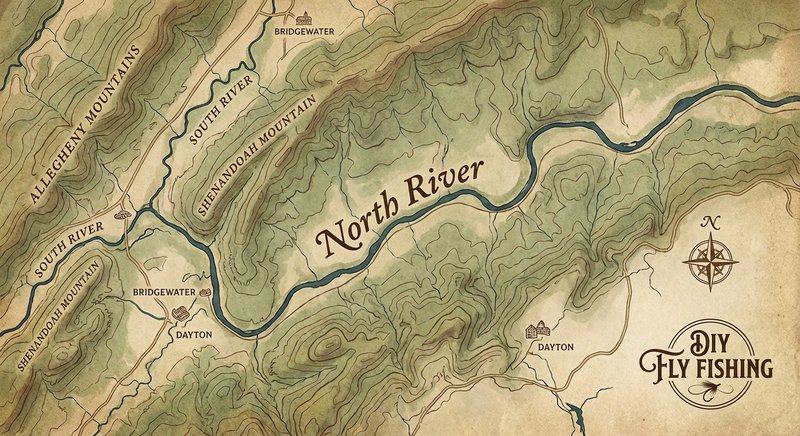
North River
Fly fishing in Virginia · Beginner · Best seasons: Spring, Summer, Fall
Target Species
Brown Trout, Rainbow Trout
About This Water
Rockingham County stream with wild trout. Good public access.
Fishing Recommendations
The North River, flowing through the rugged George Washington National Forest in Augusta County, is one of Virginia’s most storied fly fishing destinations. It offers a diverse experience, ranging from "Delayed Harvest" sections full of heavy hitters to high-gradient "Special Regulation" water that holds rare wild rainbows.
Here is your guide to mastering the North River.
🎣 Location Overview
The North River is a classic Appalachian freestone stream characterized by its dramatic scenery, steep gradients, and crystalline water. What makes it special is the variety of water it offers within a short drive.
The river is generally divided into three main areas of interest for trout anglers:
- The Gorge (Special Regulation Wild Trout Area): Located downstream of the Staunton Dam. This is a rugged, boulder-strewn section with deep plunge pools. It is one of the few places in Virginia where you can find a self-sustaining population of wild Rainbow Trout.
- The Delayed Harvest (DH) Section: This stretch (near the North River Campground) is heavily stocked in the spring and fall. It features classic pool-and-riffle water and is perfect for anglers looking for high catch rates.
- The Tailwater (Below Elkhorn Lake): A smaller, more intimate section that offers consistent temperatures.
The river bottom is largely sandstone and shale, creating technical pocket water that rewards accurate casting and stealthy wading.
🐟 Target Species & Behavior
- Rainbow Trout: In the DH sections, these are stocked fish that are often aggressive but can become "educated" quickly. In the Gorge, the wild Rainbows are smaller (7–12 inches) but incredibly vibrant, scrappy, and wary. They hold in the "bubble line" at the head of pools.
- Brown Trout: Found primarily in the DH section and the deeper holes of the Gorge. These fish are more light-sensitive and secretive. They tend to hold tight to undercut banks, submerged logs, or the very tail-outs of pools during low light.
- Behavior: Because the water is often gin-clear, these fish are "spooky." If they see your shadow or your fly line splash, the pool is finished. They feed heavily on macroinvertebrates (nymphs) but will rise readily to a well-presented dry fly during a hatch.
📅 Best Times to Fish
- Spring (March – May): Prime Time. This coincides with the heaviest hatches (Quill Gordons, March Browns) and the peak of the Delayed Harvest stocking. Water levels are usually optimal.
- Summer (June – August): Fishing becomes more technical. Focus on the Gorge or the headwaters where the water stays cooler. Early morning (dawn to 10:00 AM) is essential to avoid stressing the fish in warmer water.
- Fall (October – November): The DH section re-opens under catch-and-release rules. This is the best time to target large Browns as they become aggressive before spawning.
- Optimal Conditions: Look for a falling barometer or a "stained" water look after a light rain. Clear, low water requires 6x or 7x tippet.
🪰 Recommended Flies & Techniques
Top Fly Patterns
- Dry Flies:
- Parachute Adams (Size 14–18): The gold standard for the North.
- Elk Hair Caddis (Size 14–16): Great for the riffles.
- Stimulators (Size 10–12): Perfect for "dry-dropper" rigs in the Gorge.
- Nymphs:
- Pheasant Tail (Size 16–20): Mimics the many Mayfly species.
- Prince Nymph (Size 14–16): An excellent "attractor" for stocked fish.
- Frenchie/Perdigons: For European-style nymphing in deep pockets.
- Streamers:
- Woolly Bugger (Olive or Black, Size 8–10): Dead-drifted or swung through deep holes for big Browns.
Techniques
- Tight-Line (Euro) Nymphing: This is the most effective way to fish the North River Gorge. By eliminating the indicator, you can get nymphs deep into the small, pressurized pockets between boulders where the biggest fish hide.
- Dry-Dropper: In the summer, use a buoyant foam fly (like a Chubby Chernobyl) with a small Zebra Midge dropped 18 inches below.
- Stealth Approach: Wade slowly and upstream. In the clear water of the North, your approach is more important than your fly choice.
💡 Pro Tips & Local Knowledge
- Watch the Gauge: The North River is very sensitive to rainfall. Check the USGS gauge at Burketown. If it’s over 3.0 feet, it might be too turbid; if it's under 1.5 feet, it's very "bony" and requires extreme stealth.
- The "Gorge" Hike: Many anglers stick to the bridge access points. If you are willing to hike a mile into the Gorge away from the road, the fishing pressure drops significantly, and the wild trout become much less cynical.
- The Slate Rock Run Influence: Near the confluence with Slate Rock Run, the water temperature often drops a few degrees—this is a "hot spot" during the warmer months.
- Shadow Management: Because the canyon walls are steep, use the shadows to your advantage. Fish the shaded side of the river to stay invisible to the trout.
⚠️ Important Information
- Access: Most of the prime water is within the George Washington National Forest. Access is excellent via Forest Service Road 95.
- Regulations:
- Delayed Harvest: (Oct 1 – May 31) Catch and release only; no bait allowed. (June 1 – Sept 30) General regulations apply.
- Special Reg Area: Check the VDGIF (Virginia Department of Wildlife Resources) map for the exact boundaries of the wild trout sections, as these often require single-hook artificial lures only.
- Permits: You need a Virginia State Fishing License AND a National Forest Permit. If you are fishing for trout, a Trout License is also required.
- Safety: The rocks in the North River are notoriously slick (shale/silt). Felt soles or metal-studded wading boots are highly recommended. Cell service is virtually non-existent in the Gorge—tell someone where you are going.
Bug Hatches & Matching Flies
| Hatch | Type | Peak months | Time of day | Hook sizes | Matching flies |
|---|---|---|---|---|---|
| Blue Winged Olive Baetis / Pseudocloeon | mayfly | March, April, October, November | Midday/Afternoon | #18-22 | BWO Sparkle Dun #18-22, RS2 #20-22, Pheasant Tail #18-20 |
| Quill Gordon Epeorus pleuralis | mayfly | March, April | Midday | #12-14 | Quill Gordon Dry #12-14, Gold Ribbed Hare's Ear #12-14 |
| Hendrickson Ephemerella subvaria | mayfly | April | Afternoon | #12-14 | Red Quill #12-14, Hendrickson Emerger #14 |
| Sulphur Ephemerella dorothea | mayfly | May, June | Evening | #14-18 | Sulphur Parachute #16-18, Split Case Sulphur #16 |
| Green Sedge Rhyacophila | caddis | April, May, June | Morning/Evening | #12-16 | Green Weenie #12-16, Elk Hair Caddis #14-16, LaFontaine's Deep Sparkle Pupa #14-16 |
| Golden Stonefly Acroneuria | stonefly | June, July | Evening/Night | #8-12 | Pat's Rubber Legs #8-12, Stimulator #10-12 |
| Light Cahill Stenacron / Stenonema | mayfly | June, July | Evening | #12-16 | Light Cahill #12-16, Cream Usual #14-16 |
| Midge Chironomidae | midge | January, February, December | Anytime | #20-24 | Zebra Midge #20-22, Griffith's Gnat #20-24 |
| Ants and Beetles Formicidae / Coleoptera | terrestrial | July, August, September | Midday | #12-18 | Black Foam Beetle #14-16, Cinnamon Ant #16-18 |