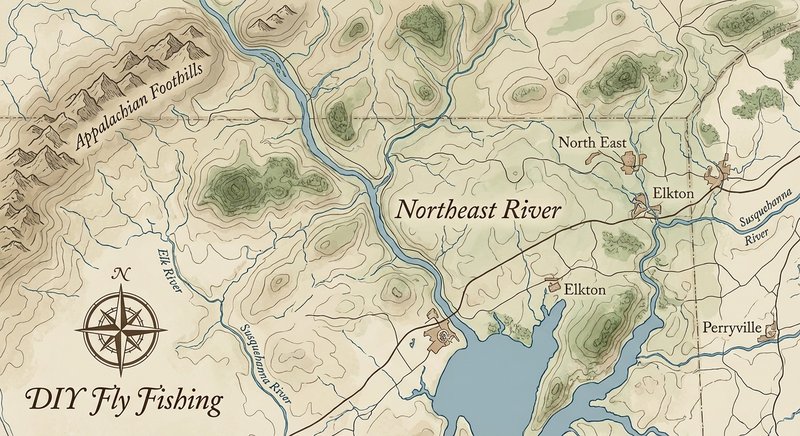
Northeast River
Fly fishing in Maryland · Beginner · Best seasons: Spring, Summer, Fall
Target Species
Largemouth Bass, White Perch, Catfish
About This Water
Cecil County river with bass and perch. Upper Chesapeake Bay tributary.
Fishing Recommendations
The Northeast River in Maryland is a hidden gem located at the extreme northern tip of the Chesapeake Bay. Unlike the fast-flowing trout streams of Western Maryland, the Northeast is a tidal fishery where the Atlantic tides dictate the rhythm of the day. It is a transition zone where freshwater meets the brackish influence of the Upper Bay, creating a rich, nutrient-dense environment that produces trophy-sized fish.
As your guide, I’ll help you navigate these tidal flats and marshes to target some of the hardest-hitting fish in the Mid-Atlantic.
🎣 Location Overview
The Northeast River is relatively short, stretching from the town of North East down to its mouth at the Susquehanna Flats. What makes it special is its diversity of structure. Within a three-mile stretch, you can fish lily pad fields, expansive grass beds (Vallisneria), steep riprap banks, and hundreds of residential boat docks.
The water is generally turbid (stained), which is actually an advantage for the fly angler—it allows you to use heavier tippets and get closer to the fish without spooking them. This is "power fly fishing" at its finest.
🐟 Target Species & Behavior
Largemouth Bass
The Upper Bay is world-renowned for its bass. These fish are "current-oriented" due to the tides.
- Behavior: They use structure to break the current and ambush prey.
- Holdings: Look for them on the down-current side of dock pilings or tucked deep into the "edges" of the grass beds.
- Diet: Primarily bluegill, gizzard shad, and the ubiquitous "mud shad."
White Perch
The "panfish of the Chesapeake." They are aggressive, travel in large schools, and provide non-stop action on light fly tackle.
- Behavior: They move with the tide, pushing up into the creeks on the flood tide and back to deeper channel edges on the ebb.
- Diet: Grass shrimp, minnows, and insect larvae.
Catfish (Blue and Channel)
The Northeast River has seen an explosion in the Blue Catfish population. While traditionally a bait fishery, they are increasingly targeted on flies.
- Behavior: They are more predatory than people realize. They will sit in deeper holes or patrol the edges of flats looking for injured shad.
- Diet: Anything meaty—dead or alive.
📅 Best Times to Fish
Seasons
- Spring (April – June): This is the prime window. Bass are moving into the shallows to spawn (pre-spawn is best). White perch make their massive spawning runs up into the North East Creek (the freshwater tributary).
- Summer (July – August): Best for early morning and late evening topwater. During the heat of the day, fish move to deeper dock pilings or the thickest grass.
- Fall (September – November): The "Second Spring." Bass become hyper-aggressive as they bulk up for winter, following baitfish schools into the shallows.
The Tidal Window (Critical!)
In this river, the tide matters more than the time of day.
- Best Window: The last two hours of the falling tide and the first hour of the rising tide.
- Why: Falling water forces baitfish out of the thick grass and off the shallow flats into the ambush zones where bass and perch are waiting.
🪰 Recommended Flies & Techniques
For Largemouth Bass
- Topwater: Large Frog Poppers or Deer Hair Bugs in chartreuse/white or black.
- Sub-surface: Gamechangers or clouser minnows (size 1/0 to 2/0).
- Technique: Use a 7-weight or 8-weight rod with a weight-forward floating line. When fishing docks, use a "snap-T" or sidearm cast to get the fly deep under the boards.
For White Perch
- Patterns: Ray’s Fly, Ckover’s Perch Fly, or small Glass Minnows (size 4–8).
- Technique: A 4-weight or 5-weight rod is perfect. Use a sinking poly-leader to get the fly down 3–5 feet. A "strip-strip-pause" retrieve mimics a fleeing shrimp.
For Catfish
- Patterns: Large, heavy Bunny Leeches or Dahlberg Divers (fished on a sink tip). Use dark colors like purple, black, or olive.
- Technique: You must get the fly to the bottom. Bounce it slowly along the channel breaks.
💡 Pro Tips & Local Knowledge
- The "Grass Edge" Rule: Don't just blind cast into the middle of the river. Find the edge where the submerged aquatic vegetation (SAV) ends and the deep water begins. Bass patrol this "wall" like a highway.
- Color Palette: Because the water is often stained, Chartreuse/White is the gold standard. If the water is very muddy after a rain, switch to Solid Black to provide a better silhouette.
- Dock Etiquette: Some of the best bass live under the private docks in the town of North East. You are legally allowed to fish there as long as you stay in your boat and do not touch the dock, but be respectful of homeowners.
- The "Pop and Sit": When fishing topwater for bass, after the fly hits the water, let the rings disappear before moving it. Often, the strike happens while the fly is motionless.
⚠️ Important Information
Access
- North East Community Park: Excellent for launching kayaks or wading the very upper reaches (North East Creek).
- Anchor Marina / McDaniel Yacht Basin: Good spots for boat launching if you are bringing a skiff or bass boat.
- Shore Access: Limited, but the Community Park offers some bank fishing for perch and catfish.
Regulations & Permits
- License: You need a Maryland Tidal Sport Fishing License. (Note: If you go far enough upstream into the creek, you may need a non-tidal license, but for the main river, tidal is the way to go).
- Invasive Species: If you catch a Blue Catfish or a Snakehead (which are also present), Maryland DNR encourages you to harvest them rather than release them, as they are invasive and damaging to the local ecosystem.
Safety
- Wind: The Northeast River is wide and shallow. A strong South wind can create "square waves" that make small boat navigation difficult. Check the wind forecast before heading out.
Bug Hatches & Matching Flies
| Hatch | Type | Peak months | Time of day | Hook sizes | Matching flies |
|---|---|---|---|---|---|
| White Mayfly Ephoron leukon | mayfly | August, September | Evening | #12-14 | Ephoron White Wulff #12-14, White Sparkle Dun #14, White Miller #12 |
| Midges Chironomidae | midge | March, April, October, November | All Day | #18-24 | Zebra Midge #18-22, Griffith's Gnat #20-22, Top Secret Midge #20 |
| Damselfly Enallagma | terrestrial | June, July, August | Afternoon | #10-14 | Marabou Damsel Nymph #10-12, Braided Butt Damsel #12, Adult Damsel #14 |
| Tricos Tricorythodes | mayfly | July, August, September | Morning | #20-24 | Trico Spinner #20-24, Trico Drown #22, RS2 #20-22 |
| Tan Caddis Hydropsyche | caddis | May, June | Evening | #14-16 | Elk Hair Caddis #14-16, LaFontaine's Deep Sparkle Pupa #14-16, Holy Grail Caddis #16 |
| Japanese Beetle Popillia japonica | terrestrial | July, August | Afternoon | #10-14 | Foam Beetle #12-14, Coffee's Sparkle Beetle #10-12, McGinty #14 |
| Blue-Winged Olive Baetis | mayfly | April, October | Afternoon | #18-22 | BWO Parachute #18-20, Pheasant Tail Nymph #18-22, BWO CDC Emerger #20 |
| Hex Hexagenia limbata | mayfly | June, July | Late Evening/Night | #6-10 | Hexagenia Spinner #6-8, Burrowing Mayfly Nymph #8-10, Hex Para-Wulff #8 |