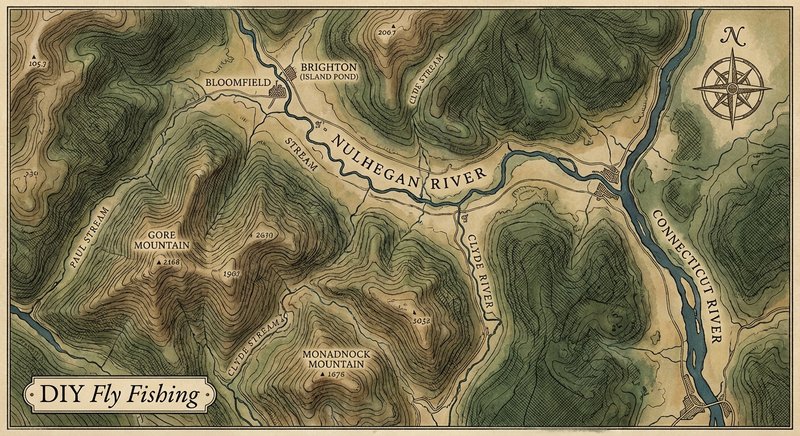
Nulhegan River
Fly fishing in Vermont · Intermediate · Best seasons: Summer, Fall
Target Species
Brook Trout
About This Water
Remote Northeast Kingdom stream with native brook trout. Pristine wilderness fishing in the Silvio O. Conte Wildlife Refuge.
Fishing Recommendations
As an expert guide familiar with the "Kingdom," it is my pleasure to walk you through one of Vermont’s most rugged and rewarding wild brook trout fisheries: the Nulhegan River.
Located in the remote Northeast Kingdom (NEK), the Nulhegan is not a river for those who demand manicured banks and easy wading. It is a wild, tannic, and often difficult landscape that rewards the adventurous angler with some of the most beautiful native fish in New England.
🎣 Location Overview
The Nulhegan River is the centerpiece of the Silvio O. Conte National Fish and Wildlife Refuge. It drains a massive basin of spruce-fir swamps and hardwood ridges, eventually flowing east to join the Connecticut River at Bloomfield.
What makes the Nulhegan special is its wild character. This is "The Northwoods." The water is tea-colored (tannic) due to the surrounding bogs, and the riverbed is a chaotic mix of granite boulders, log jams, and deep, mysterious holes. It feels more like a river in Alaska or Northern Canada than one in New England. It is one of the few places in Vermont where you are more likely to see a moose than another angler.
🐟 Target Species & Behavior
The primary draw here is the Wild Brook Trout. While the lower reaches near the Connecticut River may hold the occasional brown or rainbow trout, the Nulhegan and its three main branches (East, Black, and Yellow) are a stronghold for native "salvelinus fontinalis."
- Behavior: These are opportunistic feeders. Because the growing season is short and the water is relatively nutrient-poor, they aren't usually picky, but they are incredibly spooky.
- Holding Water: Look for "pockets within pockets." They hold in the soft water behind boulders, under overhanging alder branches, and in the deep, dark pools created by fallen timber.
- Diet: They feed heavily on caddis, stoneflies, and small mayflies. In late summer, terrestrials (ants and beetles) become a staple.
📅 Best Times to Fish
Summer (Late June – August)
This is the prime window for dry fly action. However, because the Nulhegan is a freestone river, it can get low and warm in a drought.
- Pro Tip: If the main stem hits 68°F, move to the higher elevation tributaries (the Black or Yellow branches) where the water stays cool.
- Time of Day: Early morning (dawn to 10:00 AM) and "the magic hour" before dusk.
Fall (September – October)
This is arguably the best time to be on the river. The Brookies are in their spawning colors—deep oranges and reds with vibrant blue halos.
- Conditions: Cooler nights trigger aggressive feeding.
- Time of Day: Midday. As the water warms slightly in the afternoon sun, the fish become more active.
- Note: Vermont trout season on rivers typically ends October 31st (check current year’s syllabus for specific dates).
🪰 Recommended Flies & Techniques
Top Fly Patterns
- Dry Flies:
- Royal Wulff or Royal Coachman (Size 12-16): High visibility is key in the dark water.
- Elk Hair Caddis (Tan or Olive, Size 14-18): A staple for the evening rise.
- Stimulators (Orange or Yellow, Size 10-14): Great for imitating large stones or just acting as an attractor.
- Terrestrials:
- Black Ants and Foam Beetles (Size 14-18): Essential for summer afternoons.
- Nymphs:
- Pheasant Tail (Size 14-18): Hard to beat anywhere.
- Prince Nymph (Size 12-16): The flash helps in the tannic water.
- Streamers:
- Black Woolly Bugger (Size 8-10): Fish these deep in the larger pools for the "trophy" 12-inchers.
Techniques & Presentation
- The "Splat" Cast: When fishing terrestrials under alders, don't be afraid to let the fly hit the water with a little force. It mimics a beetle falling from a branch and triggers a strike.
- Short Line Nymphing: Because the river is tight and bouldery, "high-sticking" or Euro-style nymphing through pocket water is highly effective.
- Stealth: Wear drab colors (greens/browns) and move slowly. The water is clear despite the tea color; if you see the fish, they have likely already seen you.
💡 Pro Tips & Local Knowledge
- The Branches: If the main river along Route 105 looks too "big" or intimidating, head up the Black Branch. It is smaller, more intimate, and stays cooler during heatwaves.
- Check the Gauges: The Nulhegan rises and falls rapidly with rain. Check the USGS gauge at Bloomfield. You want a steady or dropping flow; high water makes this river nearly impossible to wade safely.
- Gear Selection: Leave the 9-foot 5-weight at home. An 8-foot 3-weight or 4-weight rod is the perfect tool for the tight casting windows and the size of the fish.
- The "Nulhegan Scrub": Be prepared to bushwhack. The best holes are often 200 yards away from the nearest pull-off through thick brush.
⚠️ Important Information
- Access: Much of the river is accessible via Route 105 and the gravel refuge roads (like Stone Dam Road). There are several designated parking areas within the Conte Refuge.
- Regulations: Vermont state fishing regulations apply. While some areas allow keeping fish, Catch and Release is strongly encouraged to protect these slow-growing native populations.
- Safety (The "NEK" Factor):
- No Cell Service: You will lose signal long before you hit the river. Bring a physical map or download offline maps.
- Wildlife: This is prime Moose and Bear country. Make noise while walking through thick brush.
- Bugs: In June and July, the black flies and mosquitoes are legendary. Bring heavy-duty repellent and a head net.
- Permits: You need a valid Vermont Fishing License, which can be purchased online via the VT Fish & Wildlife website.
Guide’s Final Word: The Nulhegan is for the angler who values the place as much as the fish. You won't find 20-inch trout here, but you will find a piece of Vermont that remains unchanged by time. Respect the water, leave no trace, and enjoy the solitude.
Bug Hatches & Matching Flies
| Hatch | Type | Peak months | Time of day | Hook sizes | Matching flies |
|---|---|---|---|---|---|
| Blue-Winged Olive Baetis / Pseudocloeon | mayfly | May, September, October | Midday/Afternoon | #18-22 | BWO Parachute #18-22, RS2 #20-22, Pheasant Tail Nymph #18-20 |
| Hendrickson Ephemerella subvaria | mayfly | May | Afternoon | #12-14 | Hendrickson Sparkle Dun #12-14, Red Quill #12-14, Hendrickson Wet Fly #12-14 |
| Grannom Caddis Brachycentrus | caddis | May | Morning/Evening | #14-16 | Elk Hair Caddis (Olive) #14-16, Holy Grail #14-16, Peeping Caddis #14 |
| Giant Black Stonefly Pteronarcys dorsata | stonefly | May, June | Evening | #4-8 | Pats Rubber Legs #6-8, Black Stimulator #8-10, Kaufmanns Stone #6-8 |
| Slate Drake Isonychia bicolor | mayfly | June, July, August, September | Late Afternoon/Evening | #10-12 | Iso Parachute #10-12, Isonychia Nymph #10-12, Zug Bug #10-12 |
| Light Cahill Stenacron / Stenonema | mayfly | June, July | Evening | #14-16 | Light Cahill #14-16, Cream Usual #14-16, Gold Ribbed Hares Ear #14-16 |
| Cinnamon Caddis Hydropsyche | caddis | June, July, August | Evening | #16-18 | Cinnamon Ant #16-18, Tan Elk Hair Caddis #16-18, LaFontaine Emerger #16-18 |
| Terrestrials (Ants & Beetles) Formicidae / Coleoptera | terrestrial | July, August, September | All Day | #12-18 | Black Foam Ant #14-18, Chernobyl Ant #10-12, Crowe Beetle #14-16 |