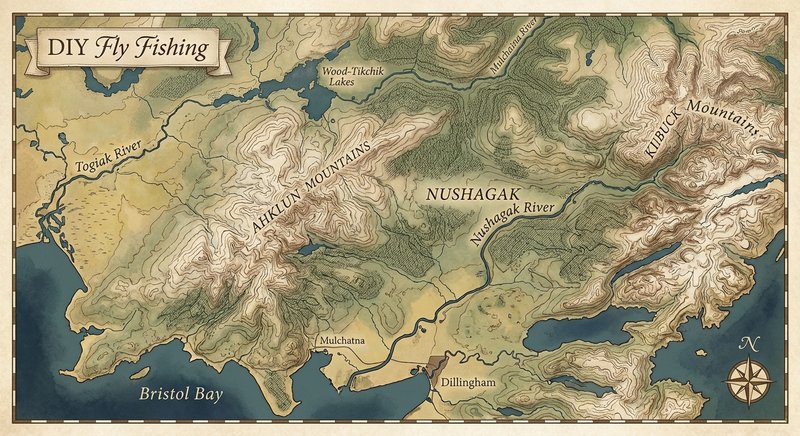
Nushagak River
Fly fishing in Alaska · Intermediate · Best seasons: Summer, Fall
Target Species
King Salmon, Silver Salmon, Rainbow Trout
About This Water
Bristol Bay river with all five Pacific salmon species. World-class king salmon fishery.
Fishing Recommendations
The Nushagak River—known simply as "The Nush" by Alaskans—is a legendary waterway located in the Bristol Bay region of Southwest Alaska. It is home to one of the largest runs of wild Chinook (King) Salmon on the planet, often seeing counts in the hundreds of thousands. For a fly angler, the Nushagak offers a raw, remote, and incredibly productive experience that defines "Alaska Dream Fishing."
🎣 Location Overview
The Nushagak is a massive, sprawling river system spanning over 270 miles. Unlike the rocky, clear-mountain streams of the Rockies, the Nush is a lowland river characterized by deep tea-colored (tannic) water, sandy banks, and expansive gravel bars.
What makes it special is the sheer volume of fish. When the "push" is on, the river vibrates with life. It is a "working" river—it’s big, powerful, and requires respect. Anglers love it because it offers the rare opportunity to hook into 30lb+ Kings on a fly rod, followed by non-stop Silver action and world-class leopard rainbows in the upper tributaries.
🐟 Target Species & Behavior
King Salmon (Chinook)
- Behavior: These are the heavyweights. They enter the river fresh from the salt, silver and chrome. They hold in the "buckets"—the deeper depressions in the river channel—and along the "seams" where fast and slow water meet.
- Feeding: Technically, they stop feeding in freshwater, but they are highly territorial and aggressive. They strike out of an instinctual "snap" response.
Silver Salmon (Coho)
- Behavior: Silvers are the acrobats. They prefer "froggy" water—sloughs, backwaters, and the edges of the main current. They are famous for chasing flies and jumping repeatedly once hooked.
- Feeding: Very aggressive. They will move several feet to intercept a fly and are highly susceptible to surface patterns (wogging).
Rainbow Trout
- Behavior: Nushagak rainbows are often "Leopard" rainbows, known for their dense spotting. In the summer, they follow the salmon. In the fall, they are "egg-fying" machines, sitting behind spawning salmon to intercept drifting roe.
- Feeding: Primarily salmon eggs and flesh (decaying salmon meat), though they will opportunisticly smash sculpins and out-migrating smolt.
📅 Best Times to Fish
- King Salmon: Mid-June through mid-July. The peak is usually the last week of June and the first week of July.
- Silver Salmon: Late July through August. The run typically peaks in mid-August.
- Rainbow Trout: June (Smolt out-migration) and August/September (The Egg Drop). September is arguably the best month for "football-shaped" trophy rainbows.
- Best Time of Day: In the land of the midnight sun, "time of day" matters less than tide and light. Lower light (cloudy days or late evening) usually makes salmon more willing to move into shallower water where they are easier to target with a fly.
🪰 Recommended Flies & Techniques
For King Salmon
- Technique: Swing fishing with heavy sink tips (T-14 or T-17) and 9-10 weight Spey or switch rods.
- Flies: Large, weighted intruders in Chartreuse/Blue, Pink/Orange, or Black/Blue. Think "obnoxious and big."
- Presentation: Cast 45 degrees downstream, mend deep to get the fly to the bottom, and swing it through the bucket.
For Silver Salmon
- Technique: Stripping streamers or "wogging" the surface.
- Flies: Pink Dolly Llama (the gold standard), Hareball Leeches, and Pink Skykomish Sunrises. For topwater, use Pink Poly Wogs.
- Presentation: A "twitchy" strip. Silvers love movement. If a fish follows but won't commit, speed up the strip.
For Rainbow Trout
- Technique: Nymphing with indicators or "beading."
- Flies: 8mm and 10mm beads in "mottled orange" or "dead egg" colors. Sculpzilla streamers in olive/white. Flesh flies (white/pink/tan) in late August.
- Presentation: Dead drift is critical. Your bead must roll along the bottom at the same speed as the natural eggs.
💡 Pro Tips & Local Knowledge
- Find the "Inside Bend": On the Nushagak, salmon often travel along the inside bends where the current is slightly slower. You don't always need to cast to the middle of the river; often, the fish are right at your feet.
- The "Nushagak Twitch": When fishing for Silvers in slow water, give your rod tip a constant 2-inch bounce while stripping. This mimics the erratic movement of a wounded baitfish or shrimp.
- Color Matters: In the tannic water of the Nushagak, Fluorescent Pink and Chartreuse offer the best contrast. If the water is unusually clear, transition to Black or Purple.
- Heavy Gear: Don't bring a knife to a gunfight. For Kings, a 10-weight is recommended. These fish use the heavy Nushagak current to their advantage and will snap a 7 or 8-weight rod easily.
⚠️ Important Information
Access
- The Nushagak is not road accessible. You must fly into Dillingham (DLG) via Anchorage. From Dillingham, you will take a floatplane or a jet boat to your camp or lodge.
- Most anglers stay at "tent camps" which range from rustic to luxury.
Regulations & Permits
- License: You need an Alaska Sport Fishing License. If targeting Kings, you must purchase a King Salmon Stamp.
- Barbless Hooks: Most areas of the Nushagak drainage require unbaited, single-hook, barbless artificial lures/flies. Always check the latest ADF&G (Alaska Dept. of Fish and Game) emergency orders before fishing, as King Salmon limits change annually based on escapement numbers.
Special Considerations
- Bears: This is Brown Bear country. Always carry bear spray, fish with a partner, and never leave fish carcasses or food near your camp.
- Bug Protection: The mosquitoes and "no-see-ums" can be legendary. Bring a head net and high-DEET repellent.
- Wading: The Nushagak has a lot of silt. Be careful of "quick-mud" pockets where you can sink deep. Use a wading staff.
Bug Hatches & Matching Flies
| Hatch | Type | Peak months | Time of day | Hook sizes | Matching flies |
|---|---|---|---|---|---|
| Chironomids Chironomidae | midge | June, July, August | All Day | #18-24 | Zebra Midge #18-22, Griffith's Gnat #18-20, Ice Cream Cone #16-18 |
| Blue Winged Olive Baetis spp. | mayfly | June, September | Mid-day/Overcast | #16-20 | RS2 #18-20, Parachute Adams #16-20, BWO Sparkle Dun #18-20 |
| American Grannom Brachycentrus occidentalis | caddis | June | Afternoon/Evening | #14-16 | Peacock Caddis #14-16, Deep Sparkle Pupa #14-16, Elk Hair Caddis #14-16 |
| Golden Stonefly Hesperoperla pacifica | stonefly | July | Morning/Evening | #6-10 | Pat's Rubber Leg #6-10, Golden Rogue Foam Stone #8-10, 20 Incher Stone #8-12 |
| March Brown Rhithrogena morrisoni | mayfly | June | Afternoon | #12-14 | March Brown Western Deceiver #12-14, Gold Ribbed Hare's Ear #12-14 |
| Spotted Sedge Hydropsyche spp. | caddis | July, August | Evening | #14-18 | LaFontaine's Emergent Sparkle Pupa #14-16, Goddard Caddis #14-16, Soft Hackle Hare's Ear #14-18 |
| Little Black Stonefly Capniidae | stonefly | May, June | Mid-day | #16-18 | Little Black Sloan #16-18, Prince Nymph #16-18 |
| Trico Tricorythodes spp. | mayfly | August | Early Morning | #20-24 | Trico Spinner #20-24, Sunken Trico Spinner #22-24 |