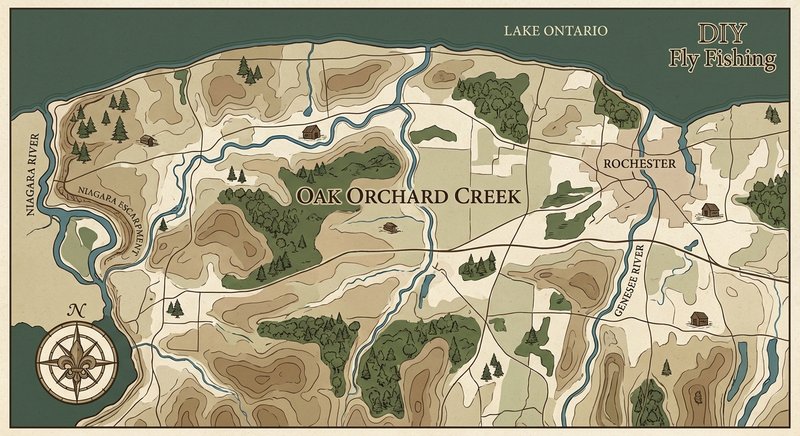
Oak Orchard Creek
Fly fishing in New York · Intermediate · Best seasons: Fall, Winter, Spring
Target Species
Steelhead, Brown Trout, Chinook Salmon
About This Water
Lake Ontario tributary famous for steelhead and brown trout. Excellent spring and fall runs.
Fishing Recommendations
Welcome to the "Oak," one of the most legendary tributaries in the Great Lakes system. As a guide, I can tell you that Oak Orchard Creek in Waterport, NY, is a bucket-list destination for anyone chasing trophy-sized Lake Ontario run salmonids. While it is a relatively short stretch of fishable water compared to the Salmon River, its concentration of fish is world-class.
🎣 Location Overview
Oak Orchard Creek is a tailwater fishery located in Orleans County, fed by the waters of Lake Ontario. What makes "The Oak" special is the Burt Dam. This impassable barrier concentrates massive runs of Lake Ontario fish into a roughly one-mile stretch of accessible water.
The water here is characterized by a mix of deep, slow-moving pools near the dam, technical pocket water, and classic riffle-run-pool sequences further downstream. The creek is generally "big water" by tributary standards, often murky with a "tannin" stain, which allows anglers to use slightly heavier tippets than they would in the gin-clear streams of the Finger Lakes. It is a place of high energy, massive fish, and, during peak runs, a very social (crowded) fishing atmosphere.
🐟 Target Species & Behavior
Chinook (King) Salmon
- Behavior: These are the "freight trains" of the creek. They enter the system to spawn and are extremely aggressive early in the run.
- Holding: Look for them in the deep "Dam Pool" or resting in the darker, deeper slots of the main channel before they move onto the gravel to spawn.
Brown Trout
- Behavior: Oak Orchard is arguably the best place in the East for trophy "Lake Run" Browns. These fish follow the salmon to feast on their eggs.
- Holding: They sit directly behind spawning salmon (the "egg line") or tucked into undercut banks and woody debris to avoid the current and the chaos of the Kings.
Steelhead
- Behavior: Known for their acrobatic fights, the Steelhead enter the creek in late fall and stay through the winter.
- Holding: They prefer faster, highly oxygenated water (the "heads" of pools) in the fall, but move to the "guts" or slower tailouts of pools as water temperatures drop in winter.
📅 Best Times to Fish
- Fall (September – November):
- September/October: Peak Chinook Salmon run. High energy, heavy crowds.
- Late October/November: The "Golden Era." Salmon are finishing up, and the trophy Brown Trout and early Steelhead are at their peak, gorging on eggs.
- Winter (December – February):
- The crowds thin out significantly. This is prime time for dedicated Steelhead anglers. Look for "thaw" events; a slight rise in water temperature can trigger a massive bite.
- Spring (March – April):
- The "Drop-back" season. Steelhead that have spawned begin moving back to the lake. They are hungry and aggressive. This is often the best time for swinging streamers.
Best Times of Day: First light is critical. The "Oak" gets a lot of pressure; the fish are most active and least wary during the 60 minutes before and after sunrise.
🪰 Recommended Flies & Techniques
The "Egg" Game (Most Effective)
Since these fish are in the river to spawn or eat eggs, egg patterns are king.
- Patterns: Estaz Eggs, Sucker Spawn, Glo-Bugs (Size 8-12).
- Colors: "Oregon Cheese," Chartreuse, and Cerise are staples.
Nymphing
When the fish get picky or the egg bite slows down:
- Patterns: Stoneflies (Size 6-10 in black or golden), Hare’s Ear, and San Juan Worms.
- Technique: High-stick nymphing or indicator nymphing. You need enough split shot to get to the "zone" (within 2-4 inches of the bottom) quickly.
Streamer Stripping & Swinging
- Patterns: Wooly Buggers (Black/Olive), Egg-Sucking Leeches, and Zonkers.
- Technique: On a sink-tip line, swing the fly through the tailouts of pools. This is particularly effective for aggressive Steelhead and fresh Browns.
💡 Pro Tips & Local Knowledge
- The "Egg Line" Strategy: Don't just cast blindly. Find a group of spawning salmon on a gravel bar and fish the deeper water 10-15 feet directly behind them. The Browns and Steelhead are sitting there like a conveyor belt, waiting for loose eggs to drift down.
- Fluorocarbon is Non-Negotiable: Despite the stained water, these fish see hundreds of flies a day. Use 8lb to 10lb fluorocarbon tippet. It’s abrasion-resistant for the rocks and nearly invisible.
- Check the Flow: Before you drive, check the Brookfield Renewable Power website or local tackle shop reports (like Orleans Outdoor). High water makes the Oak dangerous to wade; low water makes the fish extremely spooky.
- The "Staircase": The walk down to the dam is steep. Wear studded wading boots and consider a wading staff. The rocks in the Oak are notoriously "greasy."
⚠️ Important Information
Access
- Burt Dam / Fisherman’s Park: This is the primary access point. There is ample parking, but it fills up by 5:00 AM in October.
- Public vs. Private: Much of the bank downstream from the dam is private. Stick to the designated public access areas at the park to avoid trespassing issues.
Regulations
- License: A valid New York State Fishing License is required.
- Snagging: Snagging is strictly illegal. All fish must be hooked in the mouth.
- Tackle Restrictions: Ensure you are familiar with the "Great Lakes Tributary Regulations," which include specific rules on hook gap size and the distance between your fly and your weight.
Special Considerations
- Safety: The water levels can change rapidly due to dam releases. If you see the water rising or turning muddier, exit the stream immediately.
- Etiquette: It's a crowded fishery. If someone is hooked up, pull your line in to give them room to land the fish. A little kindness goes a long way on the Oak.
Guide’s Final Word: If you want the fish of a lifetime, the Oak Orchard delivers. Bring heavy gear (7-9 weight rods), a warm pair of waders, and your camera. Tight lines!
Bug Hatches & Matching Flies
| Hatch | Type | Peak months | Time of day | Hook sizes | Matching flies |
|---|---|---|---|---|---|
| Blue-Winged Olive Baetis | mayfly | April, May, September, October | Mid-day/Afternoon | #18-22 | RS2 #20-22, Parachute Adams #18-22, Pheasant Tail #18-20 |
| Grannom Caddis Brachycentrus | caddis | April, May | Morning/Afternoon | #14-16 | Grannom Pupa #14-16, Elk Hair Caddis (Olive) #14-16, LaFontaine Sparkle Pupa #14-16 |
| Sulfur Ephemerella invaria/dorothea | mayfly | June, July | Late Afternoon/Evening | #14-18 | Sulfur Parachute #16-18, CDC Sulfur Emerger #16-18, Sulfur Spinner #14-16 |
| Tan Caddis Hydropsyche | caddis | June, July, August | Evening | #14-18 | Deer Hair Caddis #14-16, Soft Hackle Hare's Ear #14-18 |
| Chironomids (Midges) Chironomidae | midge | January, February, March, December | Mid-day | #20-24 | Zebra Midge #18-22, Griffith's Gnat #20-24, Mercury Midge #20-22 |
| Slate Drake Isonychia bicolor | mayfly | August, September | Afternoon/Evening | #10-14 | Isonychia Nymph #10-12, Parachute Isonychia #12-14 |
| Trico Tricorythodes | mayfly | July, August, September | Early Morning | #22-26 | Trico Spinner #22-26, Sunken Trico #24 |
| Terrestrials (Ants/Beetles) Hymenoptera / Coleoptera | terrestrial | July, August | All Day | #12-18 | Black Foam Ant #16-18, Cinnamon Ant #14-16, Japanese Beetle #12-14 |