Octoraro Creek
Fly fishing in Maryland · Beginner · Best seasons: Spring, Fall
Target Species
Rainbow Trout, Brown Trout
About This Water
Cecil County stream with stocked trout. Scenic fishing on PA border.
Fishing Recommendations
Welcome to the banks of the Octoraro Creek in Maryland. As a guide who has spent years prowling the Mid-Atlantic’s Piedmont streams, I can tell you that the "Octy" is a bit of a hidden gem. While many anglers rush to the Gunpowder or the big rivers of Central PA, the Octoraro offers a quieter, more intimate experience for those who appreciate the nuances of a classic lowland stream.
Here is your comprehensive guide to fly fishing the Maryland stretch of the Octoraro.
🎣 Location Overview
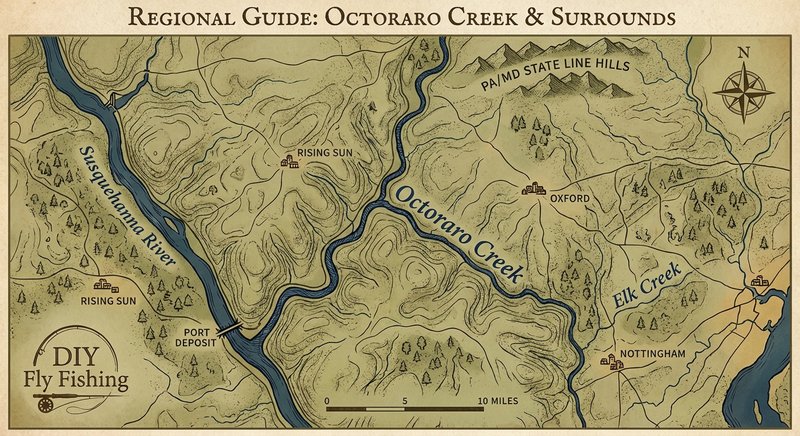
The Octoraro Creek flows out of the agricultural heartland of Lancaster and Chester Counties in Pennsylvania, crossing the Mason-Dixon line into Cecil County, Maryland, before joining the Susquehanna River.
The Maryland section is characterized by its Piedmont topography: gentle gradients, meandering bends, and a mix of deep alluvial pools and short, gravelly riffles. It is a scenic, pastoral waterway bordered by woodlands and rolling hills. What makes it special is its "sleeper" status; it doesn't get the crushing pressure of other Maryland tailwaters. It feels wilder and more secluded, offering a peaceful atmosphere where you can often have a quarter-mile of water all to yourself.
🐟 Target Species & Behavior
The Maryland Department of Natural Resources (DNR) manages this as a Stocked Trout Stream, but don't let that fool you into thinking it's easy.
- Rainbow Trout: These are the primary residents. In the spring, they are active and will often hold in the faster oxygenated water at the heads of pools. As the season progresses, they move into the deeper "buckets."
- Brown Trout: While fewer in number, the Browns in the Octoraro are the "prizes." They tend to be more wary, hugging undercut banks and submerged woody debris. There is the potential for holdover Browns that grow surprisingly large by feeding on the creek's abundant creek chubs and shiners.
- Behavior: Because the water can be slightly turbid (silty) after rain, these fish rely heavily on their lateral lines. They aren't always "matched to the hatch" purists; they are opportunistic predators looking for a high-calorie meal.
📅 Best Times to Fish
Optimal Seasons
- Spring (March – May): This is the prime window. Maryland DNR typically stocks in March and April. The water temperatures are perfect (50°F–60°F), and the aquatic insect life is most active.
- Fall (October – November): As temperatures drop, the DNR often does a secondary stocking. The fall foliage in Cecil County is stunning, and the Brown Trout become more aggressive as they prepare for their spawning window.
Best Times of Day
- Spring: Mid-morning to late afternoon. You want the sun to warm the water just a few degrees to kickstart insect activity.
- Fall: Late afternoon. The "Golden Hour" on the Octoraro can produce surprising dry fly action with small Blue Winged Olives.
🪰 Recommended Flies & Techniques
Top Fly Patterns
- Nymphs:
- Pheasant Tail (Size 14-18): The gold standard for mimicking Mayfly nymphs.
- Hare’s Ear (Size 12-16): Great for the scud and sowbug life found in the silty bottoms.
- Prince Nymph (Size 12-14): The "attractor" that works well in slightly stained water.
- Streamers:
- Woolly Bugger (Black or Olive, Size 8-10): Essential for covering water and finding holdover Browns.
- Muddler Minnow: Excellent for mimicking the various sculpins and dace in the creek.
- Dry Flies:
- Adams (Size 14-18): A generalist pattern that works during sporadic hatches.
- Elk Hair Caddis (Size 14-16): Great for the "skating" caddis action common in May.
Techniques
- Indicator Nymphing: This is the most productive method. Use a strike indicator and enough split shot to get your flies near the bottom. The Octoraro has many "dead spots" in the pools; you need to find the specific "seam" where the current moves.
- The "Swing": On the Octoraro, swinging a wet fly or small streamer through the tail-outs of pools is deadly for newly stocked fish.
- Stealth: The water can be clear in dry spells. Keep a low profile and avoid splashing.
💡 Pro Tips & Local Knowledge
- Focus on the "V": Look for where the current creates a "V" shape at the head of a pool. Fish the edges of that "V."
- Target the Wood: The Octoraro has a lot of fallen timber. While you might lose a few flies, the biggest fish are almost always tucked under submerged logs.
- Post-Rain Strategy: The Octoraro gets muddy quickly due to upstream agriculture. However, as the water begins to clear (the "tannin" or "green" stage), the fishing is world-class. Use larger, darker nymphs or streamers during this time.
- The "Secret" Spots: Focus your efforts around the Rowlandsville area and the stretches near the Octoraro Creek Road crossings. The closer you get to the Susquehanna, the more you will run into Smallmouth Bass (a fun bonus!).
⚠️ Important Information
- Access: Much of the land surrounding the creek is private. Always look for MD DNR "Public Fishing" signs. Be respectful of landowners to ensure continued access.
- Regulations: The Maryland section is typically categorized under "Special Trout Management - Wild Trout" or "Stocked Trout" regulations depending on the specific mile marker.
- Check the current Maryland DNR Freshwater Fishing Guide for the exact boundaries of "Put-and-Take" vs. "Catch and Release" areas.
- Permits: You MUST have a Maryland Non-Tidal Fishing License and a Trout Stamp. These can be purchased online via the Compass MDNR portal.
- Wading Safety: The bottom can be slippery and silty. Felt soles or studs are recommended, and a wading staff is a smart move if the water is high.
Guide’s Final Word: The Octoraro is a "moody" stream. It requires patience and a bit of exploration. But when the morning mist is rising off the water in April and you hook into a hard-fighting Rainbow in a secluded Cecil County bend, you’ll understand why we keep coming back. Tight lines!
Bug Hatches & Matching Flies
| Hatch | Type | Peak months | Time of day | Hook sizes | Matching flies |
|---|---|---|---|---|---|
| Sulphur Ephemerella invaria/dorothea | mayfly | May, June | Late Afternoon/Evening | #14-18 | Comparison Dun #14-18, Sulphur CDC Emerger #16-18, Pheasant Tail #14-18 |
| White Miller Epheron leukon | mayfly | July, August | Evening/Night | #12-14 | White Wulff #12-14, Epheron Emerger #12, White Miller Spinner #12-14 |
| Grannom Caddis Brachycentrus | caddis | April | Morning/Afternoon | #14-16 | Elk Hair Caddis (Dark) #14-16, LaFontaine's Deep Sparkle Pupa #14-16, Holy Grail #14-16 |
| Blue Winged Olive Baetis | mayfly | March, April, September, October | Afternoon | #18-22 | BWO Sparkle Dun #18-22, RS2 #20-22, Baetis Nymph #18-20 |
| Light Cahill Stenacron / Stenonema | mayfly | June, July | Evening | #12-14 | Light Cahill #12-14, Gold Ribbed Hare's Ear #12-14 |
| Trico Tricorythodes | mayfly | July, August, September | Early Morning | #20-24 | Trico Spinner #20-24, Sunken Trico Spinner #22-24 |
| Tan Caddis Hydropsyche | caddis | May, June, July | Evening | #14-18 | Tan Elk Hair Caddis #14-18, Iris Caddis #16-18, Frenchie #14-16 |
| Terrestrials Formicidae / Coleoptera | terrestrial | July, August, September | All Day | #12-18 | Black Foam Ant #16-18, Crowe Beetle #14-16, Dave's Hopper #10-12 |
| Slate Drake Isonychia bicolor | mayfly | June, September | Afternoon/Evening | #10-12 | Iso Parachute #10-12, Zug Bug #10-12, Isonychia Nymph #10-12 |