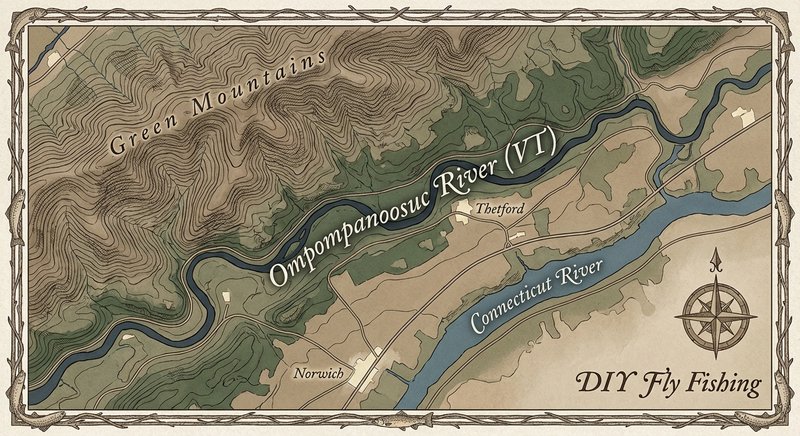
Ompompanoosuc River
Fly fishing in Vermont · Beginner · Best seasons: Spring, Summer, Fall
Target Species
Brown Trout, Rainbow Trout
About This Water
Eastern Vermont stream with good brown and rainbow trout. Flows through Norwich and Union Village.
Fishing Recommendations
The Ompompanoosuc River, affectionately known by locals as "The Ompom," is one of Vermont’s hidden gems. While the larger White River or the famous Battenkill often steal the spotlight, the Ompom offers a quintessential New England freestone experience. It winds through the scenic hills of Orange and Windsor counties before joining the Connecticut River, providing diverse water ranging from tumbling pocket water to slow, deep pools.
🎣 Location Overview
The Ompompanoosuc is characterized by its two distinct branches—the East and West—which converge at Union Village.
- The West Branch: Generally more rugged and "trouty" in its upper reaches, with boulders, plunge pools, and high-gradient sections.
- The East Branch: Slightly more pastoral, flowing through meadows and the village of Post Mills.
- The Main Stem: Below the confluence, the river widens, offering larger pools and becoming more influenced by the Union Village Dam (an Army Corps of Engineers flood control project).
Anglers love the Ompom because it offers a sense of solitude. It is rarely crowded, and the scenery—characterized by covered bridges, old farmsteads, and dense hardwood forests—is spectacular.
🐟 Target Species & Behavior
Brown Trout
The Browns in the Ompom are the "thinkers" of the river. You’ll find them tucked under overhanging banks, behind large woody debris, or in the deep, dark shadows of boulders. They are most active during low-light conditions (dawn/dusk) and are known to become highly piscivorous (fish-eating) as they grow, making them prime targets for streamers.
Rainbow Trout
The state of Vermont stocks both branches heavily. Rainbows tend to congregate in the more highly oxygenated water—look for them in the "heads" of pools, in the riffles, and in the bubbly "pocket water" behind rocks. They are generally more aggressive than the Browns and will often move further to grab a fly.
📅 Best Times to Fish
Spring (Late April – June)
This is the "Golden Era" on the Ompom. Once the spring runoff (snowmelt) subsides, usually by mid-May, the insect activity explodes.
- Key Hatch: The Hendrickson (Ephemerella subvariabilis) hatch in May is the first major event of the year.
Summer (July – August)
Water levels drop and temperatures rise.
- Pro Tip: Focus on the West Branch where the canopy is thicker and water stays cooler.
- Time of Day: Fish "crepuscular" windows—the hour before sunrise and the two hours before dark. If the water temperature hits 68°F, please stop fishing to protect the trout.
Fall (September – October)
As the leaves turn, the Brown Trout become aggressive and territorial ahead of their spawning season. This is the best time for trophy hunters to swing large streamers. The cooler nights drop water temps back into the "strike zone."
🪰 Recommended Flies & Techniques
Nymphing (The Bread & Butter)
Since trout do 90% of their feeding underwater here, nymphing is most productive.
- Patterns: Pheasant Tail (#14-18), Gold-Ribbed Hare's Ear (#12-16), and Prince Nymphs.
- Technique: Use a "tuck cast" to get your flies deep quickly in the short pocket water sections.
Dry Flies (The Excitement)
- Patterns: Elk Hair Caddis (Tan or Olive, #14-16), Parachute Adams (#14-18), and Royal Wulff.
- Terrestrials: In August, a Chernobyl Ant or a Dave’s Hopper dropped near a grassy bank can produce explosive strikes.
Streamers (The Big Fish Tactic)
- Patterns: Woolly Buggers (Black or Olive, #6-10) and the Muddler Minnow.
- Technique: Fish these "low and slow" in the deep pools below the Union Village Dam or through the undercut banks on the East Branch.
💡 Pro Tips & Local Knowledge
- The "Dam" Secret: The area around the Union Village Dam and the recreation area offers great access. The "Stilling Basin" below the dam can hold surprisingly large fish that have moved up from the Connecticut River.
- Pocket Water Mastery: Don't just fish the big, obvious pools. The Ompom is full of "pockets" the size of a bathtub. A single well-placed cast into a soft spot behind a rock often yields a fish that everyone else walked past.
- The "Post Mills" Stretch: The East Branch near Post Mills is excellent for dry fly fishing during the evening caddis hatches. The water is flatter here, requiring a longer leader (9ft - 12ft) and a more delicate presentation.
⚠️ Important Information
Access
- Route 113 and Route 132: These roads parallel much of the river. There are many informal pull-offs near bridge crossings.
- Landowner Respect: Much of the river flows through private land. Vermont law is generally angler-friendly, but always look for "Posted" signs and ask permission if an area looks like someone's backyard.
Regulations
- Season: Generally opens the second Saturday in April and runs through October 31st.
- License: A valid Vermont Fishing License is required. You can purchase these online via the Vermont Fish & Wildlife website.
- Catch & Release: While some sections allow harvest, practicing catch and release is highly encouraged on the Ompom to help maintain the population, especially for holdover fish.
Special Considerations
- Wading: The rocks in the Ompom can be incredibly slick (covered in "didymo" or rock snot in some years). Felt soles or studs are highly recommended.
- Check the Gauge: Before heading out, check the USGS gauge for the Ompompanoosuc at Union Village. If the flow is spiking due to heavy rain, the river can become turbid and dangerous to wade.
Bug Hatches & Matching Flies
| Hatch | Type | Peak months | Time of day | Hook sizes | Matching flies |
|---|---|---|---|---|---|
| Blue Winged Olive Baetis species | mayfly | April, May, September, October | Mid-day/Afternoon | #18-22 | BWO Parachute #18-22, RS2 #20-22, Pheasant Tail #18-20 |
| Hendrickson Ephemerella subvaria | mayfly | April, May | Afternoon | #12-14 | Red Quill #12-14, Hendrickson Emerger #12-14, Hendrickson Nymph #12-14 |
| Grannom Caddis Brachycentrus | caddis | May | Morning/Afternoon | #14-16 | Elk Hair Caddis (Olive) #14-16, LaFontaine's Deep Sparkle Pupa #14-16, Peacock Caddis #14-16 |
| March Brown Maccaffertium vicarium | mayfly | May, June | Afternoon | #10-14 | March Brown Dry #10-12, Hare's Ear Nymph #10-14, Grey Fox #12-14 |
| Sulphurs Ephemerella invaria/dorothea | mayfly | June, July | Evening | #14-18 | Sulphur Parachute #14-18, Sulphur Emerger #16-18, Pheasant Tail #16-18 |
| Light Cahill Stenacron interpunctatum | mayfly | June, July | Evening | #12-14 | Light Cahill Dry #12-14, Cahill Wet Fly #12-14 |
| Golden Stonefly Acroneuria | stonefly | June, July | Evening/Night | #8-12 | Pat's Rubber Legs #8-12, Stimulator (Yellow) #8-12, Golden Stone Nymph #10-12 |
| Cinnamon Caddis Hydropsyche | caddis | June, July, August | Evening | #14-18 | Elk Hair Caddis (Tan) #14-18, Soft Hackle Hare's Ear #14-16, Pupa (Tan/Cinnamon) #16-18 |
| Trico Tricorythodes | mayfly | August, September | Morning | #22-26 | Trico Spinner #22-24, Griffith's Gnat #20-24 |
| Terrestrials Various | terrestrial | July, August, September | All Day | #10-18 | Black Foam Ant #14-18, Chernobyl Ant #10-14, Crowned Beetle #14-16 |