Oswegatchie River
Fly fishing in New York · Intermediate · Best seasons: Summer, Fall
Target Species
Brook Trout, Smallmouth Bass
About This Water
Northwestern Adirondack river with brook trout. Remote wilderness fishing experience.
Fishing Recommendations
The Oswegatchie River is one of the crown jewels of the Adirondack Park. It is a wild, winding, and incredibly diverse waterway that offers two very different worlds: the remote, tannic headwaters of the Five Ponds Wilderness teeming with native Brook Trout, and the wider, rocky lower reaches where Smallmouth Bass dominate.
Here is your comprehensive guide to fly fishing the "Osweg."
🎣 Location Overview
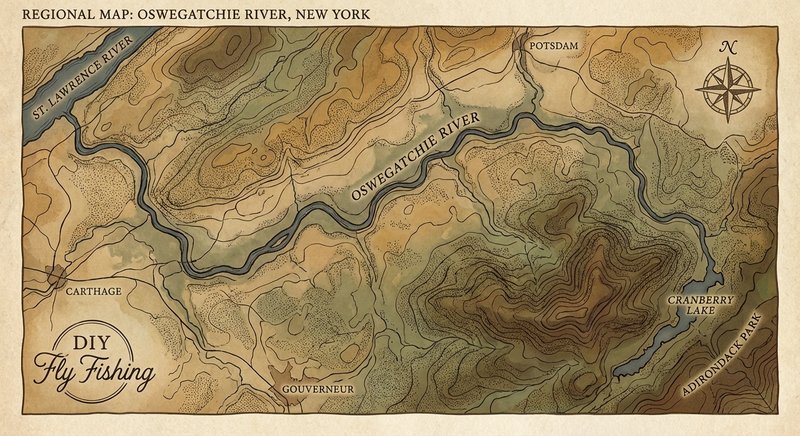
The Oswegatchie is defined by its wildness. It is often divided into the Upper (above Cranberry Lake) and the Main Stem (below the lake).
The Upper Oswegatchie is a bucket-list destination for wilderness anglers. It is a slow-moving, tea-colored (tannic) river that meanders through ancient forests. This is "High Falls" country, where the water is cold, deep, and quiet.
As the river moves toward Gouveneur and eventually the St. Lawrence, it transforms. The water warms and the gradient increases, creating "classic" smallmouth water with riffles, deep pools, and limestone ledges. What makes this river special is the lack of crowds; once you move a mile away from a road access point, you are often in total solitude.
🐟 Target Species & Behavior
Brook Trout (Upper River/High Falls)
These are primarily native or wild-strain fish. Because the water is tannic (dark), these fish often have deep, vibrant coloration.
- Behavior: They are opportunistic but cautious. In the slow-moving "stillwater" sections, they cruise for insects. In the swifter sections near High Falls, they hold behind boulders or under undercut banks.
- Diet: Terrestrials (ants/beetles), mayflies, and small leeches/baitfish.
Smallmouth Bass (Middle & Lower River)
The Oswegatchie smallies are hard-fighting and abundant.
- Behavior: They love structure. Look for them in the "pocket water" behind mid-stream boulders, at the heads of deep pools, or along the edges of weed beds. In late summer, they move into faster, oxygenated water.
- Diet: Crayfish are the primary protein source here, followed by shiners and hellgrammites.
📅 Best Times to Fish
Summer (June – August)
- Brook Trout: Focus on the early summer (June). As July and August hit, the main stem of the upper river can get too warm. Look for "spring holes" or the mouths of cold-water tributaries.
- Smallmouth: This is prime time. The water is stable, and the bass are aggressively feeding on the surface in the mornings and evenings.
Fall (September – October)
- Brook Trout: September is magic. The fish are in their spawning colors and become aggressive. Note: The season typically closes Oct 15th for trout (check current NYSDEC regs).
- Smallmouth: September into early October offers the best "big fish" potential as bass gorge themselves before winter.
Best Time of Day:
- Summer: First light until 10:00 AM, then the final two hours of daylight.
- Fall: Mid-day becomes more productive as the sun warms the water.
🪰 Recommended Flies & Techniques
For Brook Trout
- Dry Flies: Royal Wulff (Size 12-16), Elk Hair Caddis, and the Hornberg (fished as a dry or a streamer).
- Terrestrials: Black Foam Ants and Dave’s Hopper are essential in August.
- Streamers: Black Nose Dace or a small Olive Woolly Bugger (Size 8-10).
- Technique: Use a stealthy approach. In the slow water, a long leader (9ft - 12ft) is necessary to avoid spooking fish in the glassy surface.
For Smallmouth Bass
- Topwater: Boogle Bugs or small foam poppers in yellow or black.
- Sub-surface: Clouser Minnows (Chartreuse/White) and Crawfish patterns with lead eyes to bounce along the bottom.
- Technique: "Swing and Strip." Cast across the current, let the fly swing into the soft water behind a rock, and give it short, erratic strips.
💡 Pro Tips & Local Knowledge
- The "Inlet" Paddle: For the best Brook Trout fishing, put a canoe in at Inlet (near Wanakena) and paddle upstream toward High Falls. It’s a long haul, but the fishing improves with every mile you put between yourself and the car.
- Watch the Temperature: In Summer, bring a thermometer. If the water is over 68°F, stop fishing for Brook Trout to avoid mortality. Switch to the lower sections for Bass, which handle the heat fine.
- The "Adirondack Lure": Local old-timers swear by the Montreal or the Silver Doctor wet flies. Swinging these old-school patterns through riffles still catches plenty of native trout.
- Beaver Dams: On the upper river, beaver dams create deep ponds. These are hotspots for the largest Brookies, but be careful—the mud can be "bottomless" and will swallow a wader.
⚠️ Important Information
Access
- Upper River: Access via Wanakena or the Fine/Edwards area. Much of the best water requires a canoe or a significant hike.
- Lower River: Access points are plentiful near Gouveneur, Heuvelton, and various bridge crossings.
Regulations & Permits
- License: A valid New York State Fishing License is required.
- Trout Specs: Many sections of the upper river are wild-trout water with specific lure/limit restrictions. Always check the NYSDEC Freshwater Fishing Regulations guide for the "North Central Zone."
- Land Use: Respect private property in the lower sections; use designated public fishing rights (PFR) areas marked by yellow signs.
Special Considerations
- Bugs: In June and July, the black flies and deer flies are legendary. Bring high-quality repellent or a head net.
- Cell Service: Expect zero cell service in the Five Ponds Wilderness. Carry a satellite communicator (InReach/Zoleo) if heading deep.
- Water Levels: The Oswegatchie can rise rapidly after heavy Adirondack rains. Check the USGS gauge at Oswegatchie or Heuvelton before heading out.
Bug Hatches & Matching Flies
| Hatch | Type | Peak months | Time of day | Hook sizes | Matching flies |
|---|---|---|---|---|---|
| Hendrickson Ephemerella subvaria | mayfly | May | Afternoon | #12-14 | Red Quill #12-14, Hendrickson Emerger #12-14, Pheasant Tail #12-14 |
| Grannom Caddis Brachycentrus | caddis | April, May | Morning/Afternoon | #14-16 | Peacock Caddis #14-16, Holy Grail Caddis #14-16, CDC Emerger #14-16 |
| March Brown Maccaffertium vicarium | mayfly | May, June | Afternoon | #10-12 | March Brown Dry #10-12, Hare's Ear Nymph #10-14, March Brown Wet #10-12 |
| Green Drake Ephemera guttulata | mayfly | June | Evening | #8-10 | Coffin Fly #8-10, Green Drake Spinner #8-10, Grey Fox #10-12 |
| Light Cahill Stenacron / Stenonema | mayfly | June, July | Evening | #12-16 | Light Cahill Dry #12-16, Cahill Wet Fly #14-16 |
| Isonychia Isonychia bicolor | mayfly | June, July, August, September | Late Afternoon/Evening | #10-12 | Iso Parachute #10-12, Zug Bug #10-12, Prince Nymph #10-14 |
| Golden Stonefly Acroneuria | stonefly | June, July | Morning/Evening | #6-10 | Golden Stone Nymph #6-10, Stimulator #8-12, Pats Rubber Legs #8-10 |
| Blue-Winged Olive Baetis | mayfly | April, May, September, October | Afternoon | #18-22 | BWO Sparkle Dun #18-22, RS2 #20-22, Micro Mayfly #18-20 |
| Cinnamon Caddis Hydropsyche | caddis | June, July, August | Evening/Night | #14-18 | Elk Hair Caddis #14-18, LaFontaine Sparkle Pupa #14-16, Tan Soft Hackle #14-16 |
| Terrestrials (Ants/Beetles) Formicidae / Coleoptera | terrestrial | July, August, September | All Day | #12-18 | Flying Ant #14-16, Black Foam Beetle #12-16, Chernobyl Ant #8-12 |