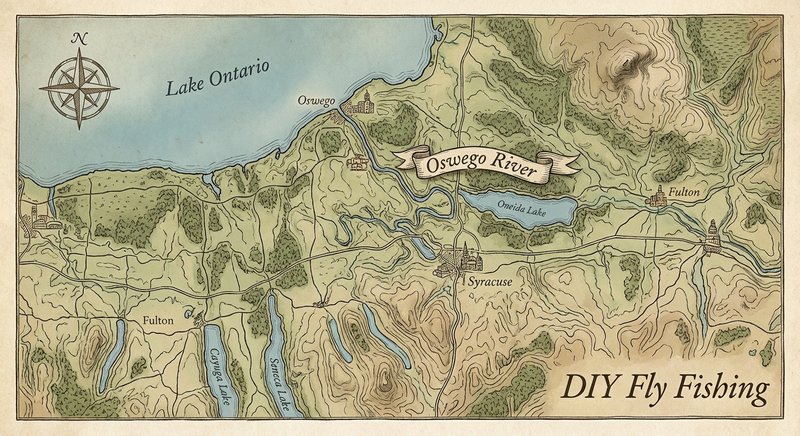
Oswego River
Fly fishing in New York · Beginner · Best seasons: Fall, Winter, Spring
Target Species
Chinook Salmon, Steelhead, Brown Trout
About This Water
Major Lake Ontario tributary with salmon and steelhead. Good urban fishing opportunity.
Fishing Recommendations
The Oswego River is one of the "Big Three" tributaries of Lake Ontario, alongside the Salmon River and the Genesee. Unlike the smaller, wadeable creeks of the region, the Oswego is a powerhouse—a massive, high-volume tailwater that drains a significant portion of Central New York. For the fly angler, it offers world-class opportunities for migratory Great Lakes salmonids right in the heart of an urban setting.
🎣 Location Overview
The Oswego River is unique because the prime fishing occurs within the city limits of Oswego, NY. The fishable section for fly anglers is relatively short—extending from the mouth at Lake Ontario up to the Varick Dam (about a mile upstream).
What makes it special is the sheer volume and concentration of fish. Because the Oswego is so large, it pulls in massive numbers of fish that aren't as affected by low-water droughts as smaller tributaries. The river is characterized by high concrete walls, deep channels, and a rocky, uneven bottom. While it lacks the "wild" feel of a mountain stream, the size and strength of the fish here are legendary.
🐟 Target Species & Behavior
Chinook (King) Salmon
- Behavior: These are the "freight trains." They enter the river to spawn and are notoriously aggressive when they first hit the fresh water.
- Holding: Look for deep holes near the "High Wall" and the faster water just below the Varick Dam. They hold in the main current seams.
Steelhead (Rainbow Trout)
- Behavior: The Oswego hosts both Washington-strain (fall/winter) and Skamania (summer/early fall) steelhead. They are acrobatic, fast, and follow the salmon to feast on their eggs.
- Holding: Steelhead sit behind spawning salmon in the "slick" to eat drifting eggs, or in the broken water of the rapids when temperatures drop.
Brown Trout
- Behavior: These are massive "lake-run" browns, often exceeding 10–15 lbs. They enter the river in the fall to spawn and stay through the winter.
- Holding: They prefer slower, deeper pocket water and the edges of the main current.
📅 Best Times to Fish
- Fall (September – October): This is King Season. The run usually peaks in late September. Large numbers of Coho Salmon also mix in.
- Late Fall/Early Winter (November – December): This is the prime window for Brown Trout and the start of the main Steelhead run. The crowds thin out, and the fishing for "chrome" steelhead is exceptional.
- Spring (March – April): The "Dropback" season. Steelhead that have spawned begin moving back to the lake. They are hungry and aggressive.
- Prime Windows: Low light is your friend. Early morning (dawn) is the "golden hour" before the fish get pressured by the heavy daytime crowds.
🪰 Recommended Flies & Techniques
Top Fly Patterns
- Egg Patterns: Estaz Eggs, Glo-Bugs, and Sucker Spawn in Oregon Cheese, Chartreuse, and Hot Pink.
- Nymphs: Stoneflies (size 6–10) in black or golden, and the "Oswego Hare's Ear."
- Streamers: Woolly Buggers (Black/Olive) and Egg-Sucking Leeches. For Steelhead, swinging large, bright Intruders can be very effective in the lower sections.
Effective Techniques
- High-Sticking/Tight-Line Nymphing: Given the depth and current, many anglers use a "chuck and duck" style (using a heavy slinky or split shot) to get the flies down to the bottom quickly.
- Indicator Fishing: Effective in the "flat" water sections. Use a large, high-buoyancy indicator to support the heavy weight required to reach the strike zone.
- Swinging: If you have space, swinging streamers with a Spey or Switch rod is a thrilling way to hook a fresh Steelhead.
💡 Pro Tips & Local Knowledge
- The "West Side" Linear Park: This is the most popular access. It features a concrete walkway with railings. While it feels "urban," it allows you to fish deep water that would be impossible to wade.
- Wading Safety: BE CAUTIOUS. The Oswego has a treacherous bottom with large, slick boulders and sudden drop-offs. Use a wading staff and felt-soled boots with studs. If the sirens sound, the dam is releasing water—get out of the river immediately.
- Heavy Gear is Mandatory: Do not bring your 5-weight. For Kings, a 9-weight or 10-weight is standard. For Steelhead and Browns, an 8-weight is the versatile choice. Use 10lb–12lb fluorocarbon leaders; these fish are not particularly leader-shy, but they are incredibly strong.
⚠️ Important Information
Access
- Leto Island: Provides access to the center of the river and the fast water below the dam.
- West Side Linear Park: Easy walking access with railings—great for those who prefer not to wade deep.
Regulations & Permits
- NY State Fishing License: A valid NYS fishing license is required.
- Great Lakes Special Regulations: The Oswego River has specific terminal tackle regulations (hook gap size, weight distance from fly). Always check the current NYSDEC Freshwater Fishing Regulations guide before hitting the water, as these are strictly enforced.
Special Considerations
- The "Oswego Elbow": Expect crowds during the peak of the Salmon run. Etiquette is key—if someone hooks a 30lb King, be prepared to pull your line in so they can land it.
- Weather: Lake Ontario creates its own weather. "Lake Effect" snow can dump inches per hour in the winter. Dress in layers and bring waterproof gear.
Bug Hatches & Matching Flies
| Hatch | Type | Peak months | Time of day | Hook sizes | Matching flies |
|---|---|---|---|---|---|
| Blue-Winged Olive Baetis | mayfly | April, May, September, October | Afternoon | #18-22 | RS2 #20-22, BWO Sparkle Dun #18-20, Pheasant Tail #18-22 |
| Grannom Caddis Brachycentrus | caddis | April, May | Afternoon/Evening | #14-16 | Peacock Caddis #14-16, Deep Sparkle Pupa #14-16, Holy Grail Caddis #14-16 |
| Sulphurs Ephemerella invaria/dorothea | mayfly | May, June | Evening | #14-18 | Sulphur Parachute #16-18, Sulphur Cripple #14-16, Hare's Ear Nymph #14-18 |
| Spotted Sedge Hydropsyche | caddis | June, July, August | Evening | #14-18 | Elk Hair Caddis #14-18, LaFontaine Sparkle Pupa #16, Z-Girdle Bug #14-16 |
| Trico Tricorythodes | mayfly | July, August, September | Morning | #20-24 | Trico Spinner #20-24, Trico Parachute #22-24 |
| March Brown Maccaffertium vicarium | mayfly | May, June | Afternoon | #10-14 | March Brown Dun #12-14, March Brown Wet Fly #12-14, Gold Ribbed Hare's Ear #10-12 |
| Midges Chironomidae | midge | March, April, October, November | All Day | #20-26 | Zebra Midge #20-24, Griffith's Gnat #20-22, Mercury Midge #20-22 |
| Terrestrials Formicidae / Coleoptera | terrestrial | July, August, September | All Day | #12-18 | Black Foam Ant #16-18, Cinnamon Ant #16-18, Japanese Beetle #12-14 |