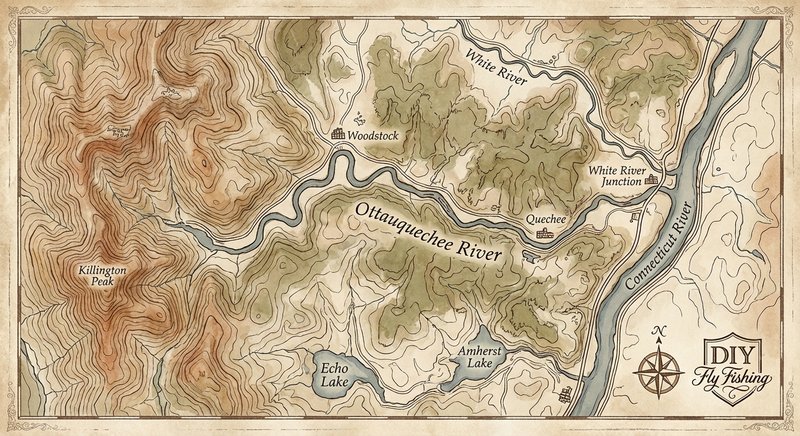
Ottauquechee River
Fly fishing in Vermont · Intermediate · Best seasons: Spring, Summer, Fall
Target Species
Rainbow Trout, Brown Trout
About This Water
Flowing through Woodstock and Quechee Gorge. Rainbow and brown trout with dramatic scenery.
Fishing Recommendations
The Ottauquechee River (often called the "Quechee" by locals) is one of Vermont’s most scenic and accessible trout streams. Flowing from the Green Mountains near Killington down to its confluence with the Connecticut River, it offers a quintessential New England fly fishing experience: pocket water, deep gorges, and classic riffle-run-pool sequences.
🎣 Location Overview
The Ottauquechee is a river of two characters. The upper reaches are cold, tumbling mountain streams, while the middle and lower sections (near Woodstock and Quechee) broaden into a medium-sized river.
What makes it special is the diversity of the water. You can find yourself high-sticking through boulder gardens in the morning and casting to rising fish in slow, glassy pools behind the historic Woodstock inns in the afternoon. The river’s crown jewel is the Quechee Gorge, Vermont's "Little Grand Canyon," which provides dramatic scenery and deep, cool pools that hold fish even during the heat of summer.
🐟 Target Species & Behavior
- Rainbow Trout: These are the river's primary residents in the swifter sections. They are often stocked by the state, but "holdovers" from previous years become quite savvy. They hold in the oxygenated "heads" of pools and in the middle of heavy riffles.
- Brown Trout: The Ottauquechee holds some surprisingly large, wild, and holdover Brown Trout. These fish are more nocturnal and cautious. They prefer the "tail-outs" of pools, undercut banks, and the deep, dark water beneath the many historic covered bridges.
- Behavior: During the spring, they are bottom-feeders. As the water warms in June, they become opportunistic surface feeders. In the fall, the Browns become aggressive as they prepare for the spawn.
📅 Best Times to Fish
Seasons
- Spring (Late April – June): This is prime time. High water from snowmelt usually recedes by mid-May. This coincides with major insect hatches (Hendricksons and Caddis).
- Summer (July – August): The river can get low and warm. Focus on the early morning (5:00 AM – 9:00 AM) or late evening. Focus on the deeper gorge areas where water stays cooler.
- Fall (September – October): Perhaps the most beautiful time. Water temperatures drop, and the trout become active again. The "October Caddis" hatch is a highlight.
Optimal Conditions
- Time of Day: Early morning for nymphs/streamers; "The Magic Hour" (sunset) for dry fly action.
- Water Levels: Look for flows between 150 and 350 CFS (measured at the North Hartland gauge) for the best wading conditions.
🪰 Recommended Flies & Techniques
Dry Flies
- Hendrickson (Size 12-14): Late May.
- Elk Hair Caddis (Size 14-18): Tan or Olive. A staple all summer long.
- Royal Wulff or Stimulator (Size 10-14): Excellent for the fast "pocket water" sections where high visibility is key.
- Terrestrials (Size 12-16): Ants and Beetles are deadly in August near overhanging banks.
Nymphs (The most consistent producers)
- Pheasant Tail (Size 14-18): Imitates almost everything.
- Pat’s Rubber Legs (Size 8-12): Great for high water or targeting larger fish.
- Zebra Midge (Size 18-22): Essential for low-water summer conditions.
Streamers
- Woolly Bugger (Black or Olive): Swing these through deep pools or under bridges for big Browns.
- Muddler Minnow: Great for imitating the sculpins found in the river’s rocky bottom.
Techniques
- Euro Nymphing: Very effective in the high-gradient sections near Sherburne and Bridgewater.
- The "Dry-Dropper": A high-floating foam fly with a small nymph 18 inches below is the "standard" rig for the Ottauquechee in June.
💡 Pro Tips & Local Knowledge
- The Bridge Strategy: Many of the best holes are directly underneath or just downstream of the covered bridges (like the Taftsville Bridge). The shade and structure provide perfect cover for trophy Browns.
- Avoid the Crowds: Most people fish the easy-access spots in Woodstock. If you are willing to hike into the Quechee Gorge (state park access), you will find deeper water and less-pressured fish.
- The "Secret" Hatch: Keep an eye out for the White Miller (Caddis) hatch in late summer. It usually happens right at dusk and can trigger a feeding frenzy.
- Stealth Matters: In the clear water around Woodstock, use long leaders (9-12 feet) and 5x or 6x tippet. The fish see a lot of people and are easily spooked.
⚠️ Important Information
Access
- Public Access: There are numerous pull-offs along Route 4.
- Key Spots: The park behind the Woodstock Union High School, the Taftsville Covered Bridge, and the Quechee State Park.
- Respect Private Property: While Vermont law allows fishing on "navigable" waters, always be respectful of lawns and posted signs near the village centers.
Regulations & Permits
- License: A valid Vermont Fishing License is required (available online or at local general stores).
- Season: Generally, trout season opens the 2nd Saturday in April and ends October 31st.
- Catch & Release: While some sections allow harvest, practicing Catch and Release is highly encouraged on the Ottauquechee to maintain the quality of the fishery, especially during low-water summer months.
Special Considerations
- Water Temps: If the water temperature hits 68°F (20°C), stop fishing for trout. They become highly stressed and often do not survive the release. Carry a stream thermometer!
- Wading: The rocks can be incredibly slick. Felt soles or studs are highly recommended.
Bug Hatches & Matching Flies
| Hatch | Type | Peak months | Time of day | Hook sizes | Matching flies |
|---|---|---|---|---|---|
| Hendrickson Ephemerella subvaria | mayfly | April, May | Afternoon | #12-14 | Red Quill #12-14, Hendrickson Emerger #14, Pheasant Tail #12-16 |
| Blue-Winged Olive (BWO) Baetis / Acerpenna | mayfly | April, May, September, October | Late Morning/Afternoon | #18-22 | RS2 #18-22, Parachute BWO #18-20, Baetis Nymph #18-22 |
| Grannom Caddis Brachycentrus | caddis | May | Late Morning/Evening | #14-16 | Peacock Caddis #14-16, Deep Sparkle Pupa #14-16, Elk Hair Caddis (Olive) #14-16 |
| Sulfur Ephemerella invaria / dorothea | mayfly | June, July | Evening | #14-18 | Sulfur Parachute #16-18, Sulfur Cripple #16-18, Pheasant Tail (Flashback) #16-18 |
| Light Cahill Stenacron / Stenonema | mayfly | June, July | Evening/Night | #12-14 | Light Cahill #12-14, Cream Usual #14, Gold Ribbed Hare's Ear #12-14 |
| Slate Drake Isonychia bicolor | mayfly | July, August, September | Afternoon/Evening | #10-12 | Iso Parachute #10-12, Isonychia Nymph #10-12, Zug Bug #10-12 |
| Cinnamon Sedge Hydropsyche | caddis | June, July, August | Evening | #14-18 | LaFontaine Sparkle Pupa #14-16, Elk Hair Caddis (Tan) #14-18, Caddis Larva #14-16 |
| Trico Tricorythodes | mayfly | July, August, September | Morning | #22-26 | Trico Spinner #22-24, Trico Parachute #22-24, Zebra Midge #20-24 |
| Black Ants & Beetles Formicidae / Coleoptera | terrestrial | July, August, September | Mid-day/Afternoon | #12-18 | Black Foam Ant #14-18, Cinnamon Ant #16-18, Black Beetle #12-16 |
| Golden Stonefly Acroneuria lycorias | stonefly | June, July | Morning/Evening | #8-12 | Golden Stone Nymph #8-12, Stimulator (Yellow) #10-12, Pat's Rubber Legs #8-12 |