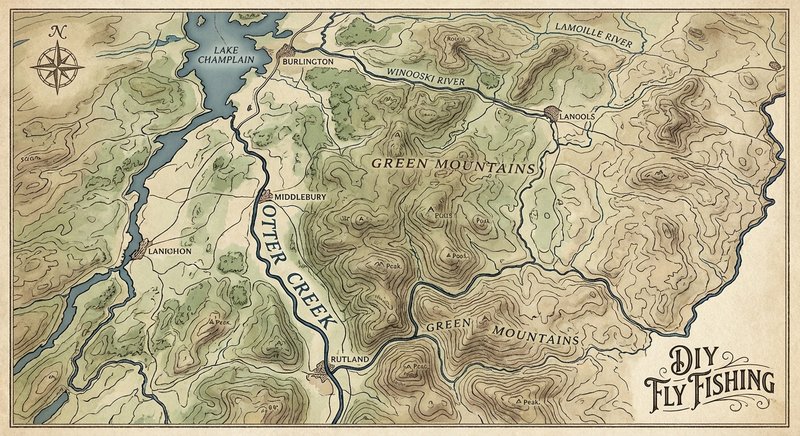
Otter Creek
Fly fishing in Vermont · Beginner · Best seasons: Spring, Summer, Fall
Target Species
Rainbow Trout, Brown Trout
About This Water
Longest river entirely in Vermont. Good populations of rainbow and brown trout with easy wading.
Fishing Recommendations
Welcome to the "Otter." As Vermont’s longest river, Otter Creek is a unique and diverse fishery. Unlike the high-gradient, tumbling mountain brooks common in the Green Mountains, the Otter behaves more like a classic limestone spring creek in some sections and a powerful valley river in others.
Here is your guide to mastering the trout water of Otter Creek.
🎣 Location Overview
Otter Creek flows north for over 100 miles from the Green Mountains to Lake Champlain. For the trout angler, the "magic" happens in the upper and middle reaches, primarily from Danby and Wallingford down through Rutland and Proctor.
What makes the Otter special is its limestone influence. The valley floor is rich in calcium carbonate, which buffers the water and creates a highly productive environment for aquatic insects. This translates to faster growth rates for fish compared to the sterile, freestone streams nearby. The river transitions from a small, intimate stream in the headwaters to a wide, powerful river with deep pools, long runs, and classic riffle-pool sequences as it moves toward Rutland.
🐟 Target Species & Behavior
The Otter is a premier destination for both Brown and Rainbow Trout.
- Brown Trout: These are the kings of the Otter. Because of the river's undercut banks and abundant woody debris (log jams), the Browns grow large and wary. They tend to hold tight to "heavy" cover during the day and move into the tailouts of pools to feed during low-light hours or hatches.
- Rainbow Trout: Found more frequently in the faster, oxygenated "pocket water" and riffles. They are opportunistic and will often hold in the "seams" where fast water meets slow water.
- Behavior: Due to the river's productivity, these fish can be "selective." During a hatch, they will lock onto a specific life stage of an insect. When no hatch is present, they are highly predatory; the larger Browns feed heavily on crayfish and sculpins.
📅 Best Times to Fish
Spring (Late April – June)
This is the "Golden Age" on the Otter.
- Why: Water levels stabilize after the snowmelt, and the legendary Hendrickson hatch begins (usually mid-May).
- Conditions: Look for overcast days for the best dry fly action.
Summer (July – August)
The Otter can get warm.
- Strategy: Focus on the early morning (6:00 AM – 10:00 AM) or the last hour of light.
- Location: Fish the upper sections (Danby/Mt. Tabor) or near the mouths of cold-water tributaries like Furnace Brook.
Fall (September – October)
The second peak of the season.
- Why: Brown trout become aggressive as they prepare for the spawn.
- Conditions: Cooling water temperatures trigger heavy feeding. This is the best time to throw large streamers for a "trophy" fish.
🪰 Recommended Flies & Techniques
Nymphing (The Consistent Producer)
The Otter is deep, and the fish do 80% of their feeding underwater.
- Patterns: Pheasant Tail (14-18), Prince Nymph (12-16), and the Walts Worm (a local favorite that mimics crane flies and scuds).
- Technique: High-sticking or Euro-nymphing through the deep slots. Use enough weight to "tick" the bottom.
Dry Flies (The Thrill)
- Spring: Hendrickson (12-14), Red Quill (14).
- Summer: Elk Hair Caddis (14-18), Light Cahill (14-16), and Terrestrials (Ants and Beetles are vital in August).
- Fall: Blue Winged Olives (18-22) on drizzly afternoons.
Streamers (The Big Fish Strategy)
- Patterns: Black or Olive Woolly Buggers (6-10), Black Ghosts, or articulated sculpin patterns.
- Technique: "Swing and strip." Cast toward the undercut banks, let it sink, and use erratic strips to mimic a wounded baitfish.
💡 Pro Tips & Local Knowledge
- The "Trophy Section": The stretch near Danby and Mt. Tabor is a federally designated "Wild Trout" area. It is rugged and beautiful, with high densities of wild fish.
- The Silt Factor: The Otter has a siltier bottom than the nearby Battenkill. Be careful when wading; the rocks can be very "greasy." Studded wading boots and a staff are highly recommended.
- Watch the Gauge: The Otter rises and falls slowly compared to mountain streams. If other rivers are "blown out" from rain, the Otter might still be fishable, or it might stay high for days after the rain stops. Check the USGS gauge at Rutland.
- Crayfish: If the fishing is slow, put on a rust-colored crayfish pattern. The Otter is crawling with them, and it’s a high-protein snack trout can’t resist.
⚠️ Important Information
Access
- Vermont has excellent "Public Waters" laws, but much of the land surrounding the Otter is private farmland. Always look for VFW (Vermont Fish & Wildlife) access signs.
- Popular access points include the bridges in Wallingford and the various pull-offs along Route 7.
Regulations
- License: A valid Vermont Fishing License is required.
- Special Rules: Some sections are "Catch and Release Only" or "Artificial Lures Only." Always consult the current Vermont Fishing Guide & Regulations booklet before hitting the water.
- Season: The traditional trout season runs from the second Saturday in April to October 31. However, some sections are open year-round for catch-and-release (check specific zone maps).
Safety
- Temperature: In July/August, if the water hits 70°F, please stop fishing for trout to prevent post-release mortality.
- Wading: As mentioned, the silt can make the bottom "slick." Take your time.
Guide’s Final Word: The Otter Creek is a thinking angler’s river. It rewards patience, good mending, and an observant eye. Tight lines!
Bug Hatches & Matching Flies
| Hatch | Type | Peak months | Time of day | Hook sizes | Matching flies |
|---|---|---|---|---|---|
| Blue-Winged Olive Baetis / Pseudocloeon | mayfly | April, May, September, October | Afternoon | #18-22 | RS2 #18-22, Parachute BWO #18-20, Pheasant Tail Nymph #18-22 |
| Hendrickson Ephemerella subvaria | mayfly | May | Afternoon | #12-14 | Red Quill #12-14, Hendrickson Emerger #12-14, Hendrickson Nymph #12-14 |
| Grannom Caddis Brachycentrus | caddis | May | Mid-day to Afternoon | #14-16 | Peacock Caddis #14-16, Deep Sparkle Pupa #14-16, Elk Hair Caddis (Olive) #14-16 |
| Light Cahill Stenacron interpunctatum | mayfly | June, July | Evening | #12-14 | Light Cahill Dry #12-14, Cahill Wet Fly #12-14 |
| Giant Michigan Mayfly (Hex) Hexagenia limbata | mayfly | June, July | Dusk and Night | #6-8 | Hexagenia Spinner #6-8, Hexagenia Nymph #6-8 |
| Trico Tricorythodes | mayfly | July, August, September | Morning | #22-26 | Trico Spinner #22-26, Sunken Trico Spinner #24 |
| Golden Stonefly Acroneuria | stonefly | June, July | Evening/Night | #8-12 | Golden Stone Nymph #8-12, Stimulator (Yellow) #8-12 |
| Cinnamon Sedge Hydropsyche | caddis | June, July, August | Evening | #14-18 | Tan Elk Hair Caddis #14-18, LaFontaine's Emergent Pupa #16 |
| Terrestrials Formicidae / Coleoptera | terrestrial | July, August, September | All Day | #12-18 | Chernobyl Ant #10-14, Black Foam Ant #16-18, Beetle Bailey #14-16 |