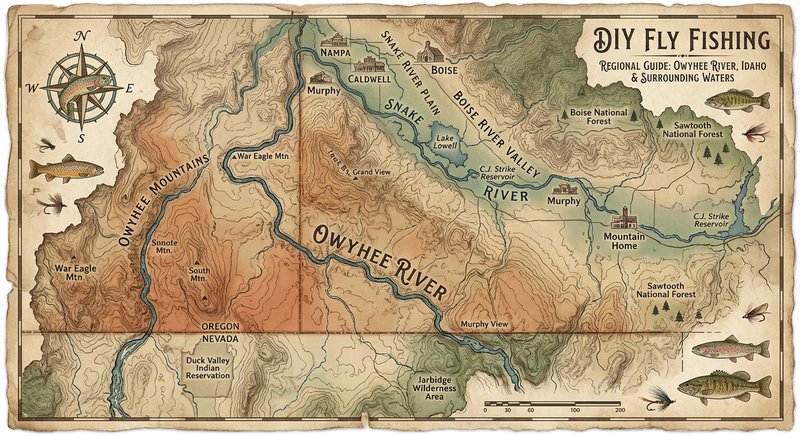
Owyhee River
Fly fishing in Idaho · Intermediate · Best seasons: Spring, Fall
Target Species
Brown Trout, Rainbow Trout
About This Water
Remote desert canyon river with brown trout. Stunning redrock scenery in southwestern Idaho.
Fishing Recommendations
The Owyhee River, specifically the tailwater section below the Owyhee Dam in Eastern Oregon (frequently accessed via Boise, Idaho), is a world-class "spring creek in a desert." It is a technical, rewarding, and stunningly beautiful fishery known for producing some of the largest Brown Trout in the lower 48.
🎣 Location Overview
The Owyhee is a high-desert tailwater that winds through a dramatic, red-rock canyon. Unlike many Western rivers that are fast and brawling, the Owyhee is slow-moving, crystalline, and deep.
What makes it special is the consistent water temperature provided by the dam, which creates a rich biomass of midges, mayflies, and crustaceans. It is a "technical" river; the water is glassy and the fish are highly educated. Anglers love it because it offers the rare chance to sight-fish for 20-plus-inch Brown Trout in water that rarely freezes, even in the dead of winter.
🐟 Target Species & Behavior
- Brown Trout: The Owyhee is a Brown Trout factory. These fish are notorious for their size and wariness. They often hold in very shallow water near the banks or in the "soft" seams where the current barely moves. They are "sippers," often rising to tiny bugs with minimal disturbance.
- Rainbow Trout: While less numerous than the Browns, the Rainbows here are incredibly hard-fighting and often inhabit the slightly faster riffles and oxygenated water near the base of the dam.
- Feeding Behavior: Because the water is so clear, these fish see everything. They are extremely leader-shy and often focus on specific life stages of insects (emergers vs. duns).
📅 Best Times to Fish
While fishable year-round, the "Prime Windows" are Spring and Fall.
- Spring (March – May):
- The Draw: This is Skwala Stonefly and Blue Winged Olive (BWO) season.
- Conditions: Overcast, drizzly days in April produce some of the best dry-fly fishing of the year.
- Time of Day: 11:00 AM to 4:00 PM is the primary hatch window.
- Fall (September – November):
- The Draw: The Brown Trout Spawn occurs in late fall (November). Note: Avoid fishing for fish on active redds (spawning beds) to protect the future of the fishery.
- Conditions: September and October offer incredible terrestrial fishing (ants/hoppers) and the return of the Fall BWOs.
- Time of Day: Cool mornings for nymphing, mid-afternoon for hatches.
🪰 Recommended Flies & Techniques
Top Fly Patterns
- Dry Flies:
- BWO Sparkle Dun (#18–22)
- Griffith’s Gnat (#18–22) for midge clusters.
- CDC RS2 (Grey or Olive, #20–22).
- Skwala Stonefly (#10–12) in early Spring.
- Nymphs:
- Zebra Midge (Red, Black, or Olive #18–22).
- Pheasant Tail (Tactical/Jig versions, #18–20).
- Scuds (Olive or Pink, #16–18)—the Owyhee is full of them.
- Streamers:
- Sculpzilla or Junior Mint (Olive/White). Use a "slow-strip" or "swing and hang" technique.
Effective Techniques
- Technical Dry Fly: Use a long leader (12–15 feet) tapering down to 6X or 7X fluorocarbon. You must land your fly softly and ensure a drag-free drift.
- Sight Nymphing: Instead of using a bulky indicator, use a "dry-dropper" rig or a tiny piece of yarn. Because the water is clear, you can often watch the fish take the nymph.
- The "Owyhee Slide": Slowly swinging small streamers through deep undercut banks where big Browns hide.
💡 Pro Tips & Local Knowledge
- The "Slow Mo" Approach: Move slowly. These fish have a 360-degree view in that glassy water. If you see a fish, don't cast immediately. Watch it. Observe its feeding rhythm.
- Go Small: If you think your fly is small enough, go one size smaller. A size 22 midge is often the difference between a refusal and a hookup.
- High Bank Advantage: Use the canyon’s elevation. Have a partner stand on the high bank to spot fish and "guide" your cast into the zone.
- Avoid the "Glow": Wear earth tones (greens, browns, greys). Bright colored shirts will spook fish before you even get a fly in the water.
⚠️ Important Information
- The Border Factor: Although commonly fished by Idaho residents, the Owyhee River tailwater is in Oregon. You must have a valid Oregon Fishing License.
- Access: Access is excellent via the Owyhee Lake Road, which parallels the river for several miles below the dam. There are numerous pull-outs and primitive campsites.
- Cell Service: Expect zero cell service once you enter the canyon. Download your maps and let someone know your return time.
- Regulations: The river is generally Catch and Release for all trout. Always check the current Oregon Department of Fish and Wildlife (ODFW) regulations for seasonal changes or emergency closures.
- Rattlesnakes: This is high desert. In Spring and Summer, be very cautious when walking through tall grass or near rock piles.
Bug Hatches & Matching Flies
| Hatch | Type | Peak months | Time of day | Hook sizes | Matching flies |
|---|---|---|---|---|---|
| Blue-Winged Olive (BWO) Baetis spp. | mayfly | March, April, September, October, November | Late Morning/Afternoon | #18-22 | RS2 #18-22, Parachute Adams #18-22, Pheasant Tail Nymph #18-20 |
| Midges Chironomidae | midge | January, February, March, December | All Day | #20-26 | Zebra Midge #20-24, Griffith's Gnat #20-22, Morgan's Midge #22-24 |
| Pale Morning Dun (PMD) Ephemerella excrucians | mayfly | June, July, August | Late Morning/Early Afternoon | #16-18 | PMD Sparkle Dun #16-18, Split Case PMD #16-18, Trigger Finger PMD #16-18 |
| Trico Tricorythodes spp. | mayfly | August, September | Early Morning | #22-26 | Trico Spinner #22-24, Sunken Trico Spinner #22-26 |
| Spotted Sedge Hydropsyche | caddis | May, June, July, August | Evening | #14-18 | Elk Hair Caddis #14-18, LaFontaine's Deep Sparkle Pupa #14-16, Godzilla Caddis #14-16 |
| Skwala Skwala americana | stonefly | March, April | Afternoon | #8-12 | Skwala Stone #10-12, Pat's Rubber Legs #8-12 |
| Terrestrials Formicidae/Gryllidae | terrestrial | July, August, September | Afternoon | #10-18 | Morrish Hopper #10-14, Cinnamon Ant #16-18, Black Foam Beetle #14-16 |
| Crane Fly Tipulidae | other | August, September | Morning/Evening | #8-12 | Daddy Long Legs #8-10, Crane Fly Larva #10-12 |