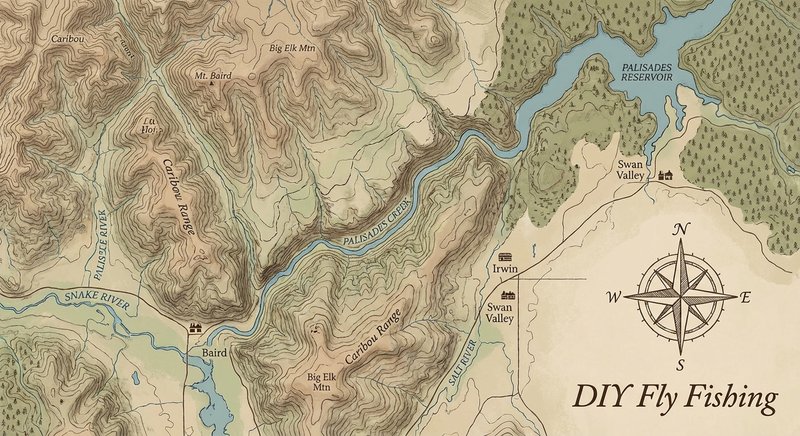
Palisades Creek
Fly fishing in Idaho · Beginner · Best seasons: Summer, Fall
Target Species
Cutthroat Trout
About This Water
Near Palisades Reservoir with cutthroat trout. Scenic canyon fishing near Wyoming border.
Fishing Recommendations
Palisades Creek is a quintessential Rocky Mountain freestone stream. Tucked away in the Caribou-Targhee National Forest near the South Fork of the Snake River, it offers an intimate, small-water experience that serves as a perfect contrast to the big-water drift boat fishing found nearby.
Here is your comprehensive guide to fly fishing Palisades Creek.
🎣 Location Overview
Palisades Creek is a stunning tributary of the South Fork of the Snake River. It flows through a dramatic canyon characterized by towering limestone cliffs, lush riparian zones, and a series of crystal-clear pools and riffles.
What makes this water special is the Palisades Creek Trail. Because the creek is located within a roadless canyon, it requires hiking to access the best water. The further you hike, the less pressure the fish see. The creek is divided into three distinct sections: the Lower Creek (below the Lower Lake), the Middle Creek (between the lakes), and the Upper Creek (above Upper Palisades Lake). It is a classic "pocket water" fishery where the scenery is as breathtaking as the fishing is rewarding.
🐟 Target Species & Behavior
The primary inhabitant is the Snake River Fine-Spotted Cutthroat Trout. You may also encounter the occasional Rainbow or a hybrid "Cuttbow," but the wild Cutthroat are the stars here.
- Behavior: These fish are opportunistic and famously "looking up." Because the growing season is short and the water is nutrient-poor compared to the main stem Snake, they cannot afford to be overly selective.
- Where they hold: Look for them in the "tail-outs" of pools, behind large boulders (pocket water), and tucked tightly against the undercut banks. In the faster riffles, they will sit in the softer cushions of water just in front of or behind rocks.
- Feeding: Their diet consists mainly of aquatic insects (mayflies, caddis, stoneflies) and a significant amount of terrestrials (ants, beetles, grasshoppers) during the summer months.
📅 Best Times to Fish
- Optimal Seasons: July through September is the prime window.
- July: Post-runoff. The water clears, and the first major hatches (Golden Stones and PMDs) begin.
- August: The "Dog Days" are actually the best here. Terrestrial fishing is at its peak.
- September: Fall colors arrive, and the fish become aggressive before the winter lean times.
- Best Times of Day: Unlike the big rivers, you don't need to be there at the crack of dawn. The canyon is deep, and the sun hits the water later. 10:00 AM to 4:00 PM is usually the most productive window when insects are active.
- Conditions: Clear water is essential. After a heavy mountain rain, the creek can blow out quickly due to the steep canyon walls.
🪰 Recommended Flies & Techniques
Top Fly Patterns
- Dry Flies (The Main Event):
- Chubby Chernobyl (Size 10-14) in Gold, Tan, or Purple.
- Parachute Adams (Size 14-18) – the ultimate searcher.
- Royal Wulff or Royal Trude – high visibility in broken water.
- Amy’s Ant (Size 12-14) – a fantastic terrestrial/attractor.
- Nymphs (For the deep holes):
- Bead-head Pheasant Tail (Size 16-18).
- Pat’s Rubber Legs (Size 10-12) in Coffee/Black.
- Zebra Midge (Size 18-20) in Red or Black.
- Streamers:
- Woolly Bugger (Size 8-10) in Olive or Black for the deeper pools in the lakes.
Effective Techniques
- Dry-Dropper: This is the "bread and butter" on Palisades Creek. Use a buoyant dry (like a Chubby) and hang a small nymph 18–24 inches below it.
- High-Sticking: Because the current is complex, use a short line and keep as much fly line off the water as possible to avoid drag.
- Short Casts: Accuracy is more important than distance. Most fish are caught within 15–20 feet of the angler.
💡 Pro Tips & Local Knowledge
- Hike for Quality: The first mile of the creek near the trailhead gets pounded. If you hike 3 to 4 miles in—past the first steep switchbacks—you will find fish that have rarely seen a fly.
- The "Shadow" Factor: Because of the high canyon walls, parts of the creek fall into shadow early. When the sun leaves the water, the temperature drops and the dry fly action can actually intensify for a brief moment before cooling off.
- Don't Overlook the Lakes: Lower and Upper Palisades Lakes hold larger fish than the creek. If you make it to the Upper Lake (roughly 7 miles in), bring a small streamer and fish the drop-offs where the creek enters the lake.
- Stealth Matters: The water is gin-clear. Wear natural colors (earth tones) and avoid "lining" the fish (casting your fly line directly over their heads).
⚠️ Important Information
- Access: The trailhead is located at the end of Palisades Creek Road, off Highway 26. There is a large parking area and a Forest Service campground.
- Regulations: Idaho fishing regulations apply. Ensure you have a valid Idaho Fishing License. As of the current season, it is generally open to bait, but Catch and Release is strongly encouraged to preserve the wild Cutthroat population in this fragile ecosystem. Always check the current IDFG seasons and rules.
- Bear Safety: This is Grizzly and Black Bear country. Always carry bear spray, make noise while hiking, and never fish alone if possible.
- Physicality: The trail to the Upper Lake is a 14-mile round trip with significant elevation gain. Wear sturdy wading boots with felt or studs (the rocks are slippery) and bring plenty of water and sun protection.
Guide’s Final Word: Palisades Creek is where you go to "recharge." It isn't about trophy sizes; it's about the beauty of a wild trout rising to a dry fly in one of the most scenic canyons in Idaho. Tight lines!
Bug Hatches & Matching Flies
| Hatch | Type | Peak months | Time of day | Hook sizes | Matching flies |
|---|---|---|---|---|---|
| Salmonfly Pteronarcys californica | stonefly | June, July | Afternoon | #2-6 | Sofa Pillow #4-6, Pats Rubber Legs #4-8, Chubby Chernobyl #6-10 |
| Pale Morning Dun Ephemerella excrucians | mayfly | July, August | Late Morning/Afternoon | #14-18 | Sparkle Dun #16-18, Pheasant Tail Nymph #14-18, PMD Emerger #16 |
| Golden Stonefly Hesperoperla pacifica | stonefly | July | Morning/Evening | #8-12 | Golden Chubby #8-12, 20 Incher #8-12 |
| Blue Winged Olive Baetis | mayfly | April, May, September, October | Mid-day | #18-22 | Parachute Adams #18-22, RS2 #20-22, JujuBaetis #18-22 |
| Yellow Sally Isoperla | stonefly | July, August | Afternoon/Evening | #14-16 | Yellow Sally Stimulator #14-16, Iron Sally #14-16 |
| Spotted Sedge Hydropsyche | caddis | July, August | Evening | #14-16 | Elk Hair Caddis #14-16, LaFontaine's Deep Sparkle Pupa #14-16 |
| Terrestrials (Grasshoppers) Melanoplus | terrestrial | August, September | Afternoon | #8-12 | Morrish Hopper #8-12, Amy's Ant #10-14 |
| October Caddis Dicosmoecus | caddis | September, October | Afternoon | #8-12 | Orange Stimulator #8-10, October Caddis Pupa #8-12 |
| Midges Chironomidae | midge | March, April, October, November | Anytime | #18-24 | Zebra Midge #18-22, Griffith's Gnat #20-24 |