Palouse River
Fly fishing in Idaho · Beginner · Best seasons: Spring, Summer, Fall
Target Species
Rainbow Trout, Smallmouth Bass
About This Water
Eastern Idaho stream with rainbow trout and smallmouth bass. Scenic Palouse Falls area.
Fishing Recommendations
The Palouse River in Idaho is a unique and somewhat underrated fishery that transitions from a cold-water mountain stream to a warm-water canyon river. Flowing through the scenic "Palouse" country—characterized by rolling hills and basalt canyons—this river offers a distinct "two-story" fishery that caters to both trout enthusiasts and bass anglers.
🎣 Location Overview
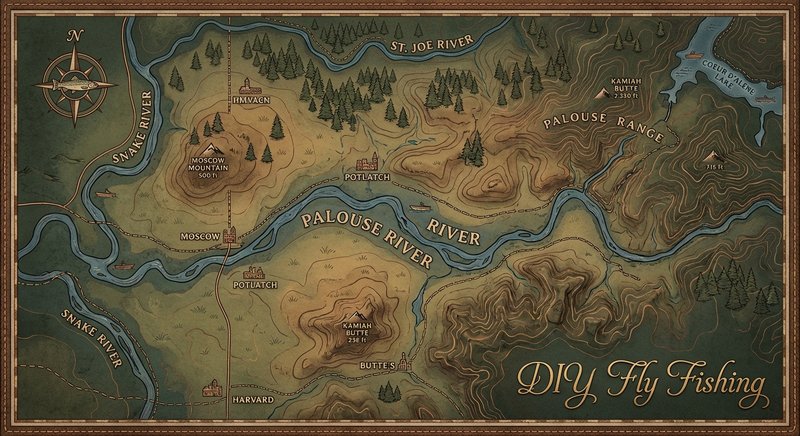
The Palouse River begins in the high-elevation forests of the Hoodoo Mountains within the St. Joe National Forest. In its upper reaches, it is a classic freestone stream with plunge pools, riffles, and cold, oxygenated water. As it moves toward the town of Laird Park and eventually toward the Washington border, the river slows, warms, and enters deep basalt canyons.
What makes this water special is the solitude. While the nearby St. Joe and Clearwater Rivers draw international crowds, the Palouse remains a local gem. It offers a rugged, intimate fishing experience where you are more likely to see a moose or an osprey than another angler.
🐟 Target Species & Behavior
Rainbow Trout
- Behavior: Found primarily in the upper sections (above Laird Park). These are often wild, resilient fish. They hold in the "textbook" spots: behind large boulders, in the foam lines of plunge pools, and at the heads of riffles.
- Feeding: They are opportunistic. Because the nutrient load in the upper freestone section isn't as high as a spring creek, these trout aren't usually picky but require a stealthy approach in the crystal-clear summer water.
Smallmouth Bass
- Behavior: As the river drops in elevation and warms, the Smallmouth take over. They love the basalt ledges and deep, slow-moving pools. Look for them in the "shadow" of rocks or where current seams meet slow water.
- Feeding: They are aggressive predators. They focus heavily on crayfish and various minnow species (dace and sculpin). During summer evenings, they will look upward for large terrestrial insects or dragonflies.
📅 Best Times to Fish
- Spring (Late May - June): This is prime time for Rainbow Trout. As the runoff recedes and the water clears, the fish are hungry. Be mindful of high water levels; wait for the "green drop" (when the water transitions from muddy brown to a clear emerald tint).
- Summer (July - August): The best window for Smallmouth Bass. The water temperature hits the "sweet spot" (65-75°F). For trout, focus on the very early morning or late evening to avoid stressing the fish in warmer water.
- Fall (September - October): Perhaps the most beautiful time on the river. The water cools, and both species become active again before winter. Trout will feed heavily on terrestrials (hoppers/ants), and Smallmouth will aggressively chase streamers to bulk up for winter.
Prime Window: Low light conditions (dawn and dusk) are consistently the most productive, especially for Smallmouth in the canyon sections.
🪰 Recommended Flies & Techniques
For Rainbow Trout (Upper River)
- Technique: Dry-Dropper is the gold standard here.
- Dry Flies: Parachute Adams (#14-16), Elk Hair Caddis (#12-14), and Stimulators (#10-12) in orange or yellow.
- Nymphs: Bead-head Prince Nymphs (#14), Pheasant Tails (#16), and Copper Johns.
For Smallmouth Bass (Lower River/Canyons)
- Technique: "Swing and Strip" streamers or popping on the surface.
- Streamers: Woolly Buggers (Black, Olive, or Brown to mimic crayfish) #4-8, Sculpzilla, and Clouser Minnows.
- Topwater: Small Boogle Bugs or foam poppers in yellow or white.
- Crayfish Patterns: Near-Nuff Crayfish or any weighted pattern that bounces along the bottom.
💡 Pro Tips & Local Knowledge
- The Laird Park Transition: The area around Laird Park is the "liminal space" of the river. You can literally catch a Rainbow Trout and a Smallmouth Bass in the same 100-yard stretch.
- Think Small for Bass: Unlike lake Smallmouth, river Smallmouth in the Palouse often respond better to slightly smaller streamers (#6 or #8) rather than massive 4-inch articulated patterns.
- Stealth in the Upper Sections: The upper Palouse is quite narrow. If you wade mid-stream, you’ll spook every trout in the pool. Stay on the bank, keep a low profile, and cast "upstream and across."
- The "Hoppy" Season: In late August, the fields surrounding the river are thick with grasshoppers. A large foam hopper pattern dropped tight against the undercut banks can trigger violent strikes from both species.
⚠️ Important Information
- Access:
- Upper River: Excellent access via Highway 6 and the Giant White Pine Campground/Laird Park areas. There are many pull-offs within the St. Joe National Forest.
- Canyon Sections: Access becomes more difficult as the river moves toward the Washington border. Much of the land is private; always look for public fishing access signs or ask permission.
- Regulations: Idaho fishing regulations apply. Always check the Idaho Fish and Game (IDFG) website for current seasons, bag limits, and gear restrictions (e.g., barbless hook requirements or bait bans).
- Wading Safety: The basalt rocks in the canyon sections can be incredibly slick (like greased bowling balls). Felt-soled boots or studs are highly recommended.
- Supplies: The nearby town of Potlatch, ID is your best bet for last-minute snacks and fuel, but for specialized fly gear, you'll want to stop in Moscow, ID or Lewiston, ID before heading out.
Bug Hatches & Matching Flies
| Hatch | Type | Peak months | Time of day | Hook sizes | Matching flies |
|---|---|---|---|---|---|
| Blue Winged Olive (BWO) Baetis | mayfly | March, April, October, November | Late Morning/Afternoon | #18-22 | Parachute Adams #18-22, RS2 #20-22, BWO Emerger #18-20 |
| Pale Morning Dun (PMD) Ephemerella excrucians | mayfly | June, July | Morning/Early Afternoon | #16-18 | Sparkle Dun #16-18, Pheasant Tail #16-18, PMD Cripple #16-18 |
| Spotted Sedge Hydropsyche | caddis | June, July, August | Evening | #14-18 | Elk Hair Caddis #14-16, LaFontaine's Deep Sparkle Pupa #14-16, Peacock Caddis #16-18 |
| Golden Stonefly Hesperoperla pacifica | stonefly | June, July | Daytime | #8-12 | Pat's Rubber Legs #8-12, Chubby Chernobyl (Gold) #10-12, Golden Stone Nymph #10-12 |
| Trico Tricorythodes | mayfly | August, September | Early Morning | #20-24 | Trico Spinner #20-24, Zebra Midge #20-22 |
| Grasshoppers Acrididae | terrestrial | July, August, September | Late Morning/Afternoon | #8-12 | Morrish Hopper #10-12, Dave's Hopper #8-12 |
| Black Ant Formicidae | terrestrial | July, August | Daytime | #14-18 | Cinnamon Ant #16, Black Foam Ant #14-18 |
| October Caddis Dicosmoecus gilvipes | caddis | September, October | Afternoon/Evening | #8-12 | Orange Stimulator #8-10, October Caddis Pupa #10-12 |
| Midges Chironomidae | midge | February, March, November | All Day | #18-24 | Griffith's Gnat #18-22, Zebra Midge (Red/Black) #18-22 |