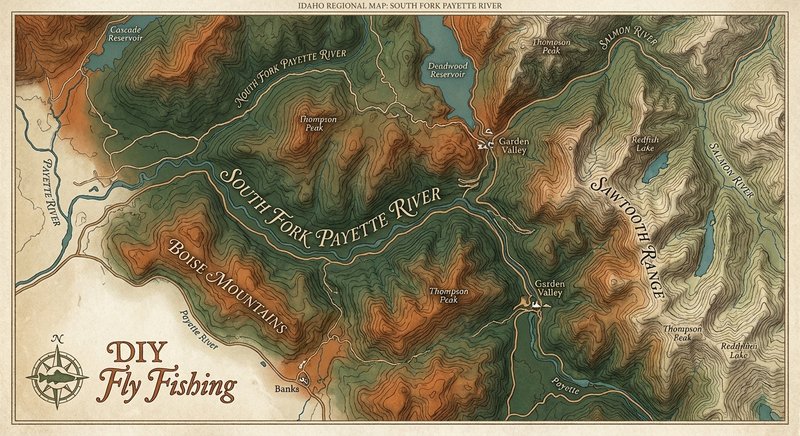
Payette River (South Fork)
Fly fishing in Idaho · Intermediate · Best seasons: Summer, Fall
Target Species
Rainbow Trout, Bull Trout
About This Water
Below Deadwood Reservoir with rainbow and bull trout. Popular whitewater and fishing destination.
Fishing Recommendations
The South Fork of the Payette is one of Idaho’s most dramatic and rewarding fly fishing destinations. Carving through steep granite canyons and lush pine forests, it offers a classic "mountain river" experience characterized by crystal-clear water, plunging pools, and aggressive wild trout.
Here is your comprehensive guide to fishing the South Fork Payette.
🎣 Location Overview
The South Fork of the Payette River is a high-gradient mountain stream located about 1.5 to 2 hours northeast of Boise. It is famous globally for its world-class whitewater, but for the angler, it offers miles of pocket water, deep emerald pools, and riffles.
What makes this river special is its rugged beauty and accessibility. While much of the river parallels the Banks-Lowman Road (Hwy 17) and Highway 21, the steep canyon walls and massive granite boulders provide a sense of wilderness even when you are just a few hundred yards from your truck. The water remains cold throughout the summer thanks to high-elevation snowmelt, making it a reliable refuge for trout when lower-elevation rivers get too warm.
🐟 Target Species & Behavior
Rainbow Trout
The South Fork is home to a healthy population of wild, hard-fighting Rainbows. In the upper reaches near Lowman, they are opportunistic feeders.
- Behavior: They hold in the "cushion" in front of large boulders, in the seams between fast and slow water, and in the tail-outs of deep pools.
- Diet: They rely heavily on stoneflies, caddis, and terrestrial insects (grasshoppers/ants) during the summer.
Bull Trout
The "Ghosts of the Payette." These native char are the apex predators of the river.
- Behavior: They are highly migratory. In the summer, they seek deep, cold holes. In the fall, they move toward headwater tributaries to spawn. They are often found in the darkest, deepest shadows of the river or at the very base of large waterfalls and plunge pools.
- Diet: Once they reach a certain size, they are almost exclusively piscivorous (fish-eaters), targeting mountain whitefish and smaller trout.
📅 Best Times to Fish
Summer (July – August)
This is the prime window for dry fly fishing. Once the spring runoff subsides (usually late June), the river clears and the "Big Bug" hatches begin.
- Best Time: Early morning and late evening. The "canyon effect" provides shade in the late afternoon, which can trigger massive evening rises.
Fall (September – October)
This is arguably the best time for seasoned anglers. The crowds thin out, the water levels drop (making wading easier), and the fish become very active before winter.
- Best Time: Mid-morning to late afternoon as the water warms slightly.
- Special Window: October is prime for targeting larger Rainbows on streamers and spotting migratory Bull Trout.
🪰 Recommended Flies & Techniques
Dry Fly Fishing (The Main Event)
The South Fork fish are not typically "leader shy," but they are fast. You need a fly that floats high and is easy to see in turbulent water.
- Patterns: Chubby Chernobyl (Size 6-10) in orange, gold, or purple; Stimulators (Size 8-12); Parachute Adams (Size 14-16) for evening hatches.
- Technique: "Hopper-Dropper." Hang a weighted nymph 2–3 feet below a large foam dry fly.
Nymphing
When the fish aren't rising, go deep into the pocket water.
- Patterns: Pat’s Rubber Legs (Coffee/Black), Prince Nymphs, and Jig-head Pheasant Tails.
- Technique: European/Tight-line nymphing is incredibly effective here because the complex currents often create "drag" on traditional indicator rigs.
Streamer Fishing (For Bull Trout)
If you want the "big ones," you have to throw big meat.
- Patterns: Sex Dungeon (White or Olive), Sparkle Minnows, or Galloup’s Bottom Feeder.
- Technique: Use a sink-tip line and cast into the deepest, slowest pools. Strip the fly aggressively but allow it to "swing" deep into the shadows.
💡 Pro Tips & Local Knowledge
- The "Pocket Water" Secret: Most anglers fish the big, obvious pools. The biggest South Fork Rainbows often hide in tiny "pockets" of soft water no bigger than a hula hoop behind large rocks in the middle of heavy rapids. Short, accurate casts win the day.
- Watch the Raft Traffic: The South Fork is a highway for whitewater kayakers and rafters. Don't let them frustrate you. Fish actually stay active; use the "lull" between rafting groups to hit the prime spots.
- The "Lowman Reach": If you want easier wading and more traditional "trout water," head upstream of the town of Lowman toward the confluence with the Deadwood River.
- Stealth: The water is gin-clear. Even though the current is fast, if you stand on top of a rock overlooking a pool, the fish will see your silhouette and lock down. Stay low.
⚠️ Important Information
- Access: Much of the river is bordered by Boise National Forest land. Use pull-outs along Hwy 17 (Banks-Lowman Rd). Be careful—the banks are steep and the granite can be slick.
- Regulations:
- Bull Trout: It is illegal to intentionally target Bull Trout in some areas, and mandatory to release them immediately if caught. They are a protected species. Check the latest Idaho Fish & Game Seasons and Rules before you head out.
- Barbless Hooks: Highly recommended to ensure the survival of wild fish.
- Wading Safety: This is a powerful river. A wading staff is not optional here—it is a necessity. The "bowling ball" rocks are covered in slick algae.
- Cell Service: Virtually non-existent once you leave Garden Valley or Lowman. Download your maps for offline use and let someone know your return time.
Guide’s Final Word: The South Fork Payette isn't a place where you'll find "easy" fish, but it is a place where you will find wild fish in one of the most beautiful canyons in the Lower 48. Pack a 5-weight for the dries and a 7-weight for the streamers, and prepare for a workout!
Bug Hatches & Matching Flies
| Hatch | Type | Peak months | Time of day | Hook sizes | Matching flies |
|---|---|---|---|---|---|
| Salmonfly Pteronarcys californica | stonefly | June | All Day | #4-8 | Rogue River Stone #4-6, Pat's Rubber Legs #6-8, Chubby Chernobyl #6-10 |
| Golden Stonefly Hesperoperla pacifica | stonefly | June, July | Morning/Afternoon | #8-12 | Norm Wood Special #8-10, Golden 20-Incher #10-12, Water Walker #10 |
| Pale Morning Dun (PMD) Ephemerella excrucians | mayfly | June, July, August | Late Morning/Afternoon | #14-18 | Sparkle Dun #16-18, Pheasant Tail #14-18, PMD Emerger #16 |
| Blue Winged Olive (BWO) Baetis tricaudatus | mayfly | March, April, September, October | Mid-day/Overcast | #18-22 | Parachute Adams #18-22, RS2 #20-22, JujuBaetis #18-20 |
| Yellow Sally Isoperla | stonefly | July, August | Afternoon/Evening | #14-16 | Yellow Stimulator #14-16, Little Yellow Sloan #14-16, Iron Lotus #16 |
| Spotted Sedge / Caddis Hydropsyche | caddis | July, August, September | Evening | #12-16 | Elk Hair Caddis #14-16, LaFontaine's Deep Sparkle Pupa #14-16, X-Caddis #14-16 |
| October Caddis Dicosmoecus gilvipes | caddis | September, October | Afternoon | #8-12 | Orange Stimulator #8-10, October Caddis Pupa #10-12, Morrish October Caddis #10 |
| Grasshoppers Acrididae | terrestrial | August, September | Mid-day/Afternoon | #8-12 | Dave's Hopper #10-12, Morrish Hopper #8-12, Pantone Hopper #10 |
| Midges Chironomidae | midge | January, February, March, November, December | Late Morning | #20-24 | Zebra Midge #18-22, Griffith's Gnat #20-22, Top Secret Midge #20-24 |