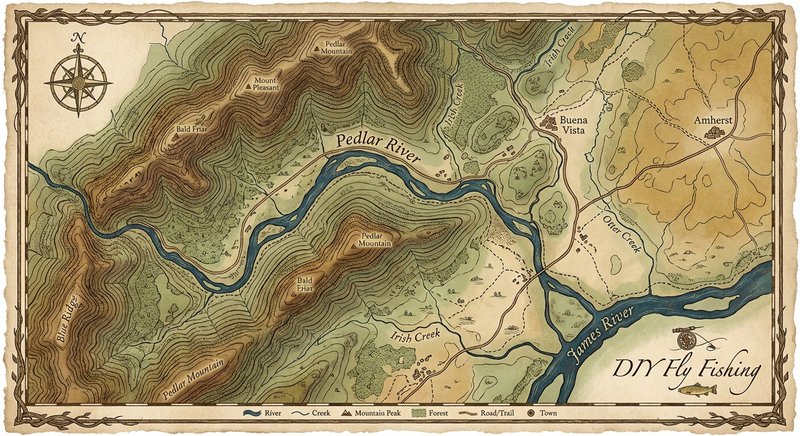
Pedlar River
Fly fishing in Virginia · Beginner · Best seasons: Spring, Summer, Fall
Target Species
Brown Trout, Rainbow Trout
About This Water
Amherst County stream with wild trout. Blue Ridge Parkway area.
Fishing Recommendations
The Pedlar River, tucked away in the Blue Ridge Mountains of Amherst County, is one of Virginia’s most cherished fly fishing secrets. While many anglers flock to the larger James River or the famous Shenandoah streams, the Pedlar offers a quintessential Appalachian freestone experience with a unique twist: the Lynchburg Reservoir.
As your guide, I’m here to break down how to fish this rugged and beautiful water.
🎣 Location Overview
The Pedlar River is a high-gradient freestone stream flowing through the George Washington National Forest. It is defined by its dramatic boulders, plunging pools, and tight "pocket water."
What makes the Pedlar special is the Lynchburg Reservoir (Pedlar Lake). The section below the dam acts as a semi-tailwater. While it isn’t a deep-bottom release like the Smith River, the dam helps stabilize water temperatures and provides a consistent flow that supports a robust trout population. It offers a mix of "Special Regulation" water (Delayed Harvest or Wild/Managed sections) and "Put-and-Take" areas, providing variety for every skill level.
🐟 Target Species & Behavior
The Pedlar is primarily home to Rainbow and Brown Trout.
- Rainbow Trout: These are your primary targets in the faster water. They tend to hold in the "heavy" water—the heads of pools, bubbly riffles, and right in the middle of current seams. They are opportunistic feeders and will often rise to a well-placed dry fly even when no hatch is visible.
- Brown Trout: The Pedlar holds some surprisingly large, "educated" Browns. These fish are more secretive, preferring the shadows of undercut banks, deep woody debris, or the dark recesses behind massive boulders. They are most active during low-light conditions or after a light rain.
- Behavior: Because the water is exceptionally clear, these fish are "spooky." If they see your silhouette or a splashy line, the pool is finished for the next hour.
📅 Best Times to Fish
- Spring (March – May): The Prime Window. This is when the best hatches occur. The water levels are usually perfect, and the fish are hungry after winter. March Browns and Quill Gordons dominate the early spring.
- Summer (June – August): Focus on the early morning (6 AM – 10 AM) and late evening. The tree canopy provides good shade, but water temperatures can rise in the lower sections. Focus on the oxygenated "white water" or the cooler reaches immediately below the dam.
- Fall (September – November): A spectacular time to be on the river. The Brown trout become aggressive as they prepare to spawn. Blue-Winged Olives (BWO) hatch on overcast days, and terrestrial fishing (hoppers/ants) remains excellent until the first hard frost.
🪰 Recommended Flies & Techniques
Top Fly Patterns
- Dry Flies: Parachute Adams (#14-18), Elk Hair Caddis (Tan or Olive, #14-16), Royal Wulff (#14), and Yellow Stimulators (#12-14) for high-water visibility.
- Nymphs: Bead-head Pheasant Tails (#14-18), Prince Nymphs (#12-16), and Pat’s Rubber Legs (Stonefly imitation) for the deeper pools.
- Streamers: Woolly Buggers (Olive or Black, #8-12) and small sculpin patterns.
- Terrestrials: Black Ants and Foam Beetles are deadly in late summer.
Effective Techniques
- High-Sticking / Tight-Line Nymphing: The Pedlar is full of complex currents. By keeping as much fly line off the water as possible, you avoid "drag" and keep your nymph in the strike zone longer.
- Dry-Dropper Rig: This is the "bread and butter" on the Pedlar. Use a buoyant Stimulator or Foam Caddis as your "indicator" and hang a small Pheasant Tail nymph 18–24 inches below it.
- Stealth Casting: Stay low. Kneel if you have to. Cast from downstream to upstream so you are approaching the fish from their blind spot (behind them).
💡 Pro Tips & Local Knowledge
- The "Special Reg" Stretch: Focus on the section below the Lynchburg Reservoir dam down to the NW Boundary of the George Washington National Forest. This area is managed for better fish holdover and higher quality angling.
- Watch the Gauge: The Pedlar can rise and fall quickly. If the USGS gauge (near Buena Vista or below the dam) shows a sharp spike after rain, the water may be "stained." In these conditions, switch to large, dark streamers.
- The "Pocket Water" Secret: Many anglers walk right past the small pockets of water between big rocks, looking for the big "glory pools." Don't do that. Some of the biggest trout on the Pedlar live in a pocket no bigger than a bathtub. One accurate cast is all you need.
⚠️ Important Information
- Access: Much of the best fishing is accessed via Route 607 (Pedlar River Road). There are several pull-offs within the National Forest. Be prepared for some light hiking/scrambling; the banks can be steep and rocky.
- Regulations:
- A Virginia Freshwater Fishing License is required.
- A Trout License is required between October 1 and June 15.
- A National Forest Permit (Stamp) is required to fish on GWNF land.
- Check the current VA Department of Wildlife Resources (DWR) map, as regulations (creel limits vs. catch-and-release) can change at specific boundary markers.
- Safety: Cell service is non-existent in the Pedlar canyon. Tell someone where you are going. Also, watch your step—the rocks here are famously "greasy" and slick. Studded wading boots and a wading staff are highly recommended.
Bug Hatches & Matching Flies
| Hatch | Type | Peak months | Time of day | Hook sizes | Matching flies |
|---|---|---|---|---|---|
| Blue-Winged Olive (BWO) Baetis / Pseudocloeon | mayfly | March, April, October, November | Mid-day | #18-22 | RS2 #18-22, Parachute Adams #18-22, Pheasant Tail #18-20 |
| Quill Gordon Epeorus pleuralis | mayfly | March, April | Early Afternoon | #12-14 | Quill Gordon #12-14, Gold Ribbed Hare's Ear #12-14 |
| Blue Quill Paraleptophlebia | mayfly | April | Mid-day to Afternoon | #16-18 | Blue Quill #16-18, Pheasant Tail #16-18 |
| Hendrickson Ephemerella subvaria | mayfly | April, May | Afternoon | #12-14 | Red Quill #12-14, Hendrickson Spinner #12-14, Hendrickson Emerger #12-14 |
| March Brown Maccaffertium vicarium | mayfly | May | Afternoon | #10-12 | March Brown American #10-12, Hare's Ear #10-12 |
| Green Sedge Rhyacophila | caddis | April, May, June | All day / Evening | #14-16 | Green Weenie #14-16, Elk Hair Caddis (Olive) #14-16, LaFontaine Sparkle Pupa #14-16 |
| Yellow Sally Isoperla | stonefly | May, June, July | Late Afternoon / Evening | #14-16 | Yellow Sally #14-16, Little Yellow Sloan #14-16 |
| Light Cahill Stenacron / Stenonema | mayfly | June, July | Evening | #14-16 | Light Cahill #14-16, Cahill Nymph #14-16 |
| Terrestrials Formicidae / Coleoptera | terrestrial | July, August, September | All day | #12-18 | Cinnamon Ant #14-18, Black Foam Beetle #12-16, Dave's Hopper #10-12 |
| Golden Stonefly Acroneuria | stonefly | May, June | Evening / Night | #8-12 | Pat's Rubber Legs #8-12, Golden Stone #8-10 |