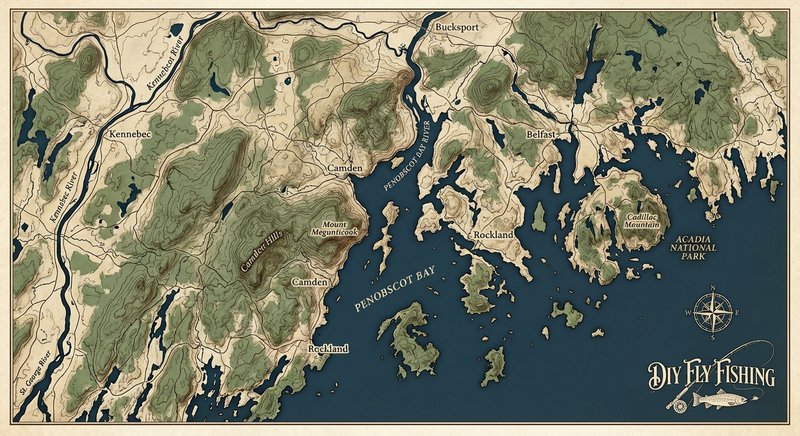
Penobscot Bay
Fly fishing in Maine · Intermediate · Best seasons: Summer, Fall
Target Species
Striped Bass, Mackerel, Pollock
About This Water
Mid-coast bay with striped bass and mackerel. Scenic island fishing.
Fishing Recommendations
Welcome to Penobscot Bay, one of the most majestic and rugged fly fishing destinations on the Atlantic coast. As an expert guide in these waters, I can tell you that "The Bay" offers a quintessential Maine experience: granite-bound shores, spruce-lined islands, and some of the hardest-fighting stripers in the Northeast.
Here is your comprehensive guide to fly fishing Penobscot Bay.
🎣 Location Overview
Penobscot Bay is the largest bay on the Maine coast, serving as the mouth of the mighty Penobscot River. It is a labyrinth of over 200 islands (including North Haven, Vinalhaven, and Islesboro), rocky ledges, deep channels, and sprawling salt marshes.
What makes this area special is the structure. Unlike the sandy beaches of Southern Maine or Cape Cod, Penobscot Bay is defined by granite. The water is cold, gin-clear, and nutrient-rich, supported by a massive 10-to-12-foot tidal range. Anglers love it because it offers true "sight fishing" opportunities on the flats and heart-pounding "white water" fishing along the rocky surf. It feels wild, remote, and rewards those who understand the rhythm of the tides.
🐟 Target Species & Behavior
Striped Bass (The Primary Target)
These are migratory fish that arrive from the south. In Penobscot Bay, they are "structure oriented."
- Behavior: They use the heavy kelp beds and granite boulders to ambush prey. You will find them in "wash" (where waves hit rocks), in the current seams of island "guts," and on shallow mud flats at high tide.
- Feeding: They focus on Atlantic Herring, Mackerel, Sand Eels, and green crabs.
Atlantic Mackerel
- Behavior: Fast-moving schools that frequent the outer islands and deep harbors.
- Feeding: They chase tiny baitfish (silversides) to the surface, creating "boils." They are incredibly fun on a 5-weight or 6-weight rod.
Pollock
- Behavior: Often found in the deeper, colder "runs" between islands or near harbor docks.
- Feeding: Aggressive predators that hit small streamers with abandon. While smaller than the bass, they provide consistent action when the tide is slack.
📅 Best Times to Fish
- Optimal Months:
- June: The "Fresh" arrival. Fish are hungry and aggressive.
- July & August: Peak season for the flats and night fishing.
- September: The "Fall Run." Fish begin schooling up to head south; this is when you find the biggest "cows" feeding heavily for the journey.
- Best Time of Day: Low light is king. Dawn and dusk provide the best surface action. However, because Maine water stays cool, "mid-day" fishing on the flats can be productive if the tide is right.
- The Window: The "Middle Tides" (the two hours before and after high or low tide) are most productive. Moving water is mandatory; dead low or dead high slack water usually sees a drop in activity.
🪰 Recommended Flies & Techniques
Top Fly Patterns
- Bob’s Banger / Gurgler (White or Chartreuse): Essential for topwater action. There is nothing like a Striper exploding on a Gurgler in a rocky cove.
- Chartreuse & White Clouser Minnow: The "Gold Standard." It gets down deep where the fish hold in the current.
- Hollow Fleyes: Best for mimicking larger Atlantic Herring. Use these when targeting trophy fish near ledges.
- Juana’s Crab or EP Crustacean: For "stalking" fish on the shallow flats of the Bagaduce River or the upper bay marshes.
- Mushmouth / Sand Eel Patterns: Vital when the fish are keyed into the slender baitfish found on sandy patches.
Techniques & Presentation
- The "Strip-Set": Never trout-set (lifting the rod). When a striper hits, pull the line hard with your stripping hand to set the hook in their leathery mouths.
- Beating the Kelp: When fishing the rocks, use a weed-guard on your flies. Stripers love to bury themselves in the "brown gold" (kelp) once hooked.
- Swing the Current: In the island "guts" (narrow channels), cast across the current and let your fly swing like a wet fly for trout. Stripers sit behind boulders waiting for food to be swept to them.
💡 Pro Tips & Local Knowledge
- Focus on the "Whitewater": Look for where the swells are hitting submerged ledges. Stripers sit in the oxygenated, turbulent water to daze baitfish. Cast your fly right into the foam.
- The "Bagaduce" Secret: The Bagaduce River (which feeds into the bay near Castine) is a "reversing falls" system. It warms up faster than the ocean, making it a hotspot for early-season bass and sight-fishing on the flats.
- Follow the Birds: If you see Common Terns or Gulls diving, get there immediately. They are feeding on the leftovers of a Mackerel or Striper blitz.
- Vary Your Retrieve: If you aren't getting hits, change your strip speed. Sometimes they want a "fleeing" fast strip; other times they want a "dying" slow twitch.
⚠️ Important Information
Access
- By Boat: This is the best way to see the Bay. Launch from Rockland, Camden, or Castine.
- Wade Fishing: Public access can be tricky due to private property. Good public wading spots include Sears Island (Searsport) and the Fort Point State Park area.
Regulations & Permits
- Saltwater Registry: You must register with the Maine Saltwater Recreational Fishing Registry (it is free or very low cost depending on residency).
- Limits: Striped Bass regulations change annually (currently a "slot limit" usually between 28" and less than 31"). Check the Maine Department of Marine Resources for the most current rules.
Special Considerations
- Safety: The Maine coast is unforgiving. Watch for "sneaker waves" on the rocks and be aware of the 10-foot tide—it can cut you off from the shore quickly if you are wading on a bar.
- Gear: An 8-weight or 9-weight rod with a cold-water intermediate sinking line is the "all-around" setup for this region. Bring a floating line for the flats.
Tight lines, and enjoy the salt air of Penobscot Bay!
Bug Hatches & Matching Flies
| Hatch | Type | Peak months | Time of day | Hook sizes | Matching flies |
|---|---|---|---|---|---|
| Hendrickson Ephemerella subvaria | mayfly | May | Afternoon | #12-14 | Red Quill #12-14, Hendrickson Emerger #12-14, Pheasant Tail #12-16 |
| Mother's Day Caddis Brachycentrus | caddis | May | All Day | #14-16 | Elk Hair Caddis (Olive) #14-16, LaFontaine's Deep Sparkle Pupa #14-16, Peacock Caddis #14-16 |
| Blue-Winged Olive Baetis | mayfly | May, September, October | Overcast Afternoons | #18-22 | BWO Parachute #18-22, RS2 #20-22, Barr's BWO Emerger #18-20 |
| Eastern Green Drake Ephemera guttulata | mayfly | June | Evening | #8-10 | Green Drake Paradox #8-10, Coffin Fly #8-10, Green Drake Nymph #8-12 |
| Light Cahill Stenacron canadense | mayfly | June, July | Evening | #12-14 | Light Cahill #12-14, Cahill Wet Fly #12-14 |
| Hexagenia Hexagenia limbata | mayfly | July | Dusk/Night | #6-8 | Hexagenia Spinner #6-8, Hexagenia Nymph #6-10, Michigan Wigglers #6-8 |
| White Miller Epheron leukon | mayfly | August | Late Evening | #12-14 | White Wulff #10-12, White Miller Dry #12-14 |
| Cinnamon Caddis Hydropsyche | caddis | June, July, August | Evening | #14-18 | Cinnamon Ant #16, Tan Elk Hair Caddis #14-18, Soft Hackle Hare's Ear #14-16 |
| Terrestrials (Ants and Beetles) Formicidae / Coleoptera | terrestrial | July, August, September | Midday | #12-18 | Black Foam Ant #14-18, Chernobyl Ant #8-12, Crowe Beetle #12-16 |
| Common Midge Chironomidae | midge | April, May, September, October | Morning/Evening | #20-24 | Griffith's Gnat #20-24, Zebra Midge #18-22 |