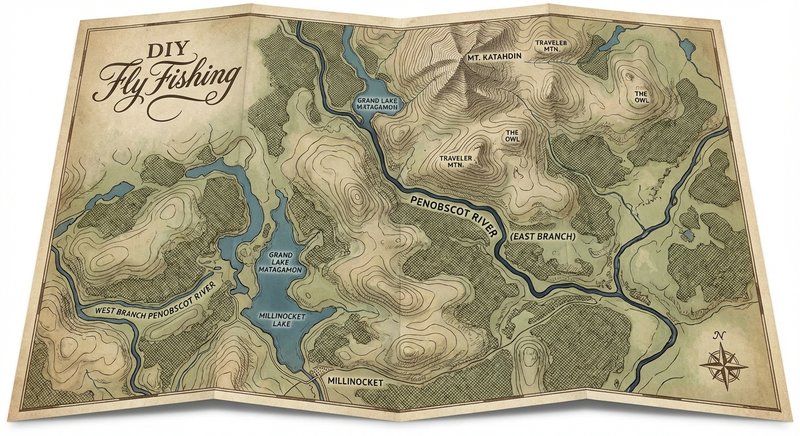
Penobscot River (East Branch)
Fly fishing in Maine · Advanced · Best seasons: Summer, Fall
Target Species
Brook Trout
About This Water
Remote Piscataquis County river with brook trout. Wilderness canoeing and fishing.
Fishing Recommendations
The East Branch of the Penobscot is a crown jewel of the North Maine Woods. Flowing through the heart of the Katahdin Woods and Waters National Monument, it is a wild, rugged, and remote river that offers some of the finest pursuit of wild brook trout in the Eastern United States.
Here are my professional recommendations for fishing the "East Branch."
🎣 Location Overview
The East Branch of the Penobscot is distinct from the West Branch (which is famous for Landlocked Salmon). The East Branch is a boulder-strewn, high-gradient river characterized by classic "pocket water," deep pools, and treacherous rapids.
What makes it special is the wildness. Unlike many rivers in the East, this is a truly remote experience. You are fishing in the shadow of Mt. Katahdin, surrounded by moose, bald eagles, and ancient forests. The water is cold, well-oxygenated, and chemically ideal for salmonids. It feels prehistoric, and the brook trout here—purely wild and native—reflect that untamed spirit with their vibrant halos and aggressive strikes.
🐟 Target Species & Behavior
Wild Brook Trout (Salvelinus fontinalis)
The stars of the show here are the wild Brookies. These aren't your typical small-stream fish; in the East Branch, they can reach impressive sizes (14–18 inches), though the average is 8–12 inches.
- Behavior: They are opportunistic but wary. In the summer heat, they seek "thermal refuge"—areas where cold springs enter the river or deep, oxygenated bubbles at the base of falls.
- Holding Water: Look for "seams" where fast water meets slow water, and don't ignore the "bucket" behind large boulders. In the fall, they move toward spawning tributaries and become highly territorial.
- Diet: Their diet consists of stoneflies, caddis, mayflies, and small baitfish (sculpins and dace).
(Note: You may also encounter Landlocked Salmon and Smallmouth Bass in the lower reaches, but the upper stretches are Brook Trout heaven.)
📅 Best Times to Fish
While the season technically opens in early spring, your requested focus on Summer and Fall is when this river truly shines.
- Summer (Late June – August):
- The Window: Early morning and "the magic hour" (last 90 minutes of light).
- Conditions: Focus on the faster, broken water where oxygen levels are highest. This is the prime time for dry-fly action and terrestrial fishing.
- Fall (September – early October):
- The Window: Mid-day becomes more productive as the water cools.
- Conditions: This is the "Pre-spawn" period. Brook trout turn vibrant orange and become very aggressive. Streamer fishing is peak during this window as fish defend their territory.
🪰 Recommended Flies & Techniques
Dry Flies (Summer Peak)
- Stimulators (Size 8-12): Orange or Royal. These mimic the large stoneflies and serve as great "searcher" patterns.
- Elk Hair Caddis (Size 14-18): Tan or Olive. The river has prolific caddis hatches.
- Hornbergs (Size 10-14): A Maine classic. Fish it as a dry, then let it sink and swing it at the end of the drift.
- Terrestrials: Foam Ants and Beetles are deadly in August when the trout are looking at the banks.
Nymphs & Streamers
- Pheasant Tail & Prince Nymphs (Size 12-16): Effective year-round.
- Black Ghost or Grey Ghost: Traditional Maine streamers. They mimic the small smelt and dace.
- Wooly Buggers (Black or Olive): Drag these through deep pools in the fall to trigger aggressive strikes.
Techniques
- High-Sticking/Euro Nymphing: Because the river is so rocky, traditional long-line nymphing often results in snags. Short-line nymphing in the pockets is highly effective.
- The "Maine Twitch": When fishing a dry fly, don't be afraid to give it a tiny skitter across the surface. Brookies often respond to the movement.
💡 Pro Tips & Local Knowledge
- Focus on the "Grand Pitch" and "Hulling Machine": These are famous rapids. The pools below these heavy drops hold the largest fish that are waiting for food to be washed down.
- Wading Safety: The East Branch is notorious for "greasy" rocks. Felt boots (where legal) or studs are mandatory. A wading staff is not a luxury here; it’s a necessity.
- The "Cold Water Search": If the main stem feels warm in August (above 68°F), find the mouth of any small incoming tributary. Brook trout will stack up in those cold-water plumes.
- The Stealth Factor: Because the water is often crystal clear, keep a low profile. If you can see the fish, they have likely already seen you.
⚠️ Important Information
- Access: Access is primarily via the Grindstone Road (Route 11) or the Lunksoos Boat Launch within the National Monument. Many areas require driving on unpaved logging roads—ensure you have a spare tire and a full tank of gas.
- Regulations: Maine fishing laws can be complex. The East Branch has sections that are Fly Fishing Only (FFO) and many areas are Catch and Release for wild brook trout. Always check the current Maine MDIFW Open Water Regulations before casting.
- The "North Woods Greeting": Black flies and mosquitoes are the "tax" you pay to fish here. Bring heavy-duty repellent and a head net, especially in early summer.
- Wildlife: This is bear and moose country. Keep a clean camp and give moose a wide berth—they can be more dangerous than bears if startled in the water.
Guide’s Final Word: The East Branch isn't about high fish counts; it’s about the quality of the experience. Take a moment to look up at the mountains, breathe the balsam-scented air, and appreciate the fact that you are fishing one of the last truly wild places in the East.
Bug Hatches & Matching Flies
| Hatch | Type | Peak months | Time of day | Hook sizes | Matching flies |
|---|---|---|---|---|---|
| Hendrickson Ephemerella subvaria | mayfly | May | Afternoon | #12-14 | Red Quill #12-14, Hendrickson Emerger #14, Pheasant Tail #12-14 |
| Blue Winged Olive Baetis / Pseudocloeon | mayfly | May, September, October | Mid-day/Afternoon | #18-22 | BWO Sparkle Dun #18-20, RS2 #20-22, WD-40 #18-22 |
| Green Drake Ephemera guttulata | mayfly | June | Evening | #8-10 | Coffin Fly #8-10, Green Drake Spinner #8-10, Hare's Ear (Large) #8-10 |
| Grannom Caddis Brachycentrus | caddis | May | Morning/Afternoon | #14-16 | Elk Hair Caddis (Olive) #14-16, Deep Sparkle Pupa #14-16, Peacock Caddis #16 |
| March Brown Maccaffertium vicarium | mayfly | June | Afternoon | #10-12 | March Brown Dry #10-12, Gold Ribbed Hare's Ear #10-12, March Brown Wet #12 |
| Isonychia / Slate Drake Isonychia bicolor | mayfly | July, August, September | Evening | #10-12 | Isonychia Parachute #10-12, Zug Bug #10-12, Prince Nymph #10-14 |
| Golden Stonefly Acroneuria | stonefly | June, July | Evening/Night | #6-10 | Golden Stone Nymph #6-10, Stimulator (Yellow) #8-12, Pats Rubber Legs #8-10 |
| Light Cahill Stenacron / Stenonema | mayfly | June, July | Evening | #12-14 | Light Cahill Dry #12-14, Cream Usual #14, Light Cahill Wet Fly #12-14 |
| Black Carpenter Ant Camponotus | terrestrial | July, August | All Day | #12-16 | Black Foam Ant #14-16, Chernobyl Ant #12, Fur Ant #16 |