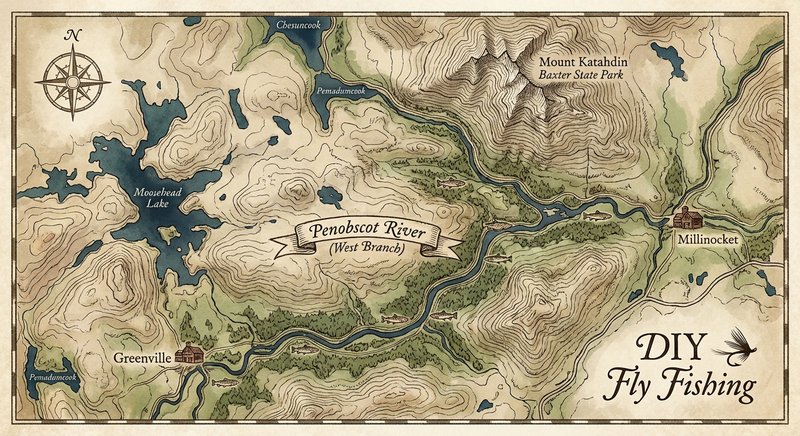
Penobscot River (West Branch)
Fly fishing in Maine · Intermediate · Best seasons: Spring, Summer, Fall
Target Species
Landlocked Salmon, Brook Trout
About This Water
Maine's legendary landlocked salmon river below Ripogenus Dam. Trophy fish in wilderness setting.
Fishing Recommendations
The West Branch of the Penobscot River is, without exaggeration, the crown jewel of fly fishing in the Northeast. Located in the shadow of Mount Katahdin, it is a rugged, high-gradient river that offers world-class opportunities for wild Landlocked Salmon and native Brook Trout. This is a powerful, "big" water experience that demands respect but rewards anglers with some of the hardest-fighting freshwater fish in North America.
🎣 Location Overview
The West Branch is a tailwater, but not in the gentle, meadow-stream sense. Flowing out of the Ripogenus Dam, the river plunges through a deep canyon (The Cribworks) and settles into a series of legendary pools and "deadwaters."
What makes it special is the combination of sheer power and productivity. The river is boulder-strewn and fast-moving, creating oxygen-rich "pocket water" that Landlocked Salmon love. Unlike many Maine rivers that can get too warm in mid-summer, the deep-water release from Ripogenus Lake keeps the West Branch cold and the fish active even in the heat of August. It is a true wilderness experience, accessed primarily via the Golden Road, a private logging road that reminds you exactly how remote you are.
🐟 Target Species & Behavior
Landlocked Salmon (Salmo salar sebago)
These are the stars of the show. Unlike their landlocked cousins in lakes, West Branch salmon behave like their Atlantic ancestors. They are incredibly athletic, known for screaming runs and multiple acrobatic leaps.
- Behavior: They hold in fast, highly oxygenated water—think "walking speed" current or faster. They love the heads of pools, heavy riffles, and the "seams" next to main currents.
- Feeding: Their primary protein source is the Rainbow Smelt. However, they are also prolific insect feeders, especially on caddis and stoneflies.
Native Brook Trout
The West Branch holds "trophy" brookies that can reach 18–20 inches, though the average is closer to 10–14.
- Behavior: They are more light-sensitive and cautious than the salmon. Look for them in the "softer" water—behind large boulders, in the tail-outs of pools, or in the calmer "deadwater" stretches like Nesowadnehunk.
- Feeding: They are opportunistic, feeding on everything from tiny midges to large terrestrial patterns and small baitfish.
📅 Best Times to Fish
- Late May – June (The Smelt Run & Caddis): This is the high-energy window. As the ice leaves the lakes, smelt get pushed through the dam. Salmon go into a feeding frenzy. This coincides with the first major caddis hatches.
- July – August (Dry Fly Season): While other rivers are low and warm, the West Branch is prime. The "match the hatch" game is on. Blue Winged Olives (BWOs) and various Caddis species dominate.
- September – October (The Pre-Spawn): The fish are in their most beautiful spawning colors. Salmon become aggressive and territorial. The nights get crisp, the bugs get smaller (tiny BWOs), but the fish become very active before the season closes.
🪰 Recommended Flies & Techniques
Streamer Fishing (The "Maine Way")
This is most effective in spring and fall or when the water is high.
- Patterns: Gray Ghost, Black Ghost, Mickey Finn (Classic Maine); Mudler Minnows; and Black or Olive Wooly Buggers.
- Technique: "Swing" the streamer. Cast quartering downstream, let the current tension swing the fly across the face of the fish, and add small twitches to imitate a wounded smelt.
Dry Fly Fishing
The West Branch is famous for its evening caddis hatches.
- Patterns: Elk Hair Caddis (Tan/Olive, sizes 12-16), X-Caddis, Stimulators (Orange/Yellow), and Klinkhammers. For late season, use Blue Winged Olives (sizes 18-22).
- Technique: Focus on "pocket water." You only need a 3-second drift in a small pocket to induce a strike. High-visibility dries are essential in the heavy whitewater.
Nymphing
When nothing is rising, nymphing the deep slots is the most productive way to find fish.
- Patterns: Pheasant Tail Nymphs (size 14-18), Prince Nymphs, Copper Johns, and Stonefly Creepers.
- Pro Secret: The Sucker Spawn. In the late spring, suckers spawn in the river, and salmon gorging on eggs is a poorly kept local secret.
💡 Pro Tips & Local Knowledge
- The Big Eddy: This is the most famous pool on the river. It’s a massive swirling pool where the current reverses. Salmon cruise the edges of the eddy. It is "technical" water—long leaders and light tippets (5X/6X) are often needed here.
- Studs are Mandatory: The rocks in the Penobscot are notoriously slippery (often called "greased bowling balls"). Do not attempt to wade this river without high-quality felt or rubber soles with aggressive aluminum studs and a wading staff.
- The "Salmon Pull": When a Landlocked Salmon hooks up, they almost always head downstream into the rapids. Be prepared to chase them or risk getting "spooled."
- The Hatch Clock: During the summer, the best dry fly action often happens in the final 45 minutes of daylight. Don't leave the water early!
⚠️ Important Information
- Access: Access is via the Golden Road. It is a privately owned road used by massive logging trucks. They have the right of way. If you see a dust cloud, pull over completely. There is usually a fee/toll to enter the North Maine Woods at the gatehouse.
- Water Levels: This is a dam-controlled river. However, the dam is also used for whitewater rafting releases. Water levels can rise quickly and significantly in the late morning/early afternoon. Always keep an eye on a "marker rock" near the bank.
- Regulations: Maine fishing laws are specific. The West Branch has various sections with "Fly Fishing Only" or "Catch and Release" regulations. Always check the Maine IF&W Open Water Regulations before casting.
- Safety: This is a remote area with little to no cell service. Bring a spare tire, extra water, and a first-aid kit. Tell someone where you are going.
Guide’s Final Thought: "The West Branch doesn't give up its secrets easily. You'll lose flies to the rocks and your pride to the salmon's jumps, but once you hook a 20-inch 'silver bullet' in the shadow of Katahdin, you'll be coming back for the rest of your life."
Bug Hatches & Matching Flies
| Hatch | Type | Peak months | Time of day | Hook sizes | Matching flies |
|---|---|---|---|---|---|
| Blue-Winged Olive (BWO) Baetis / Acerpenna | mayfly | May, September, October | Mid-day/Afternoon | #18-22 | BWO Sparkle Dun #18-20, Pheasant Tail Nymph #18-22, RS2 #20-22 |
| Hendrickson Ephemerella subvaria | mayfly | May, June | Afternoon | #12-14 | Red Quill #12-14, Hendrickson Emerger #12-14, Gold Ribbed Hare's Ear #12-14 |
| Grannom Caddis Brachycentrus | caddis | May | All day | #14-16 | Elk Hair Caddis (Olive) #14-16, LaFontaine's Deep Sparkle Pupa #14-16, Peacock Caddis #16 |
| March Brown Maccaffertium vicarium | mayfly | June | Afternoon/Evening | #10-12 | March Brown Western Lady #10-12, Spaced-Out March Brown #12, March Brown Nymph #10-12 |
| Eastern Green Drake Ephemera guttulata | mayfly | June, July | Evening | #8-10 | Green Drake Paradrake #8-10, Coffin Fly (Spinner) #8-10, Green Drake Nymph #8-10 |
| Golden Stonefly Acroneuria | stonefly | June, July | Afternoon/Evening | #8-12 | Stimulator (Yellow) #8-12, Golden Stone Nymph #8-10, Pat's Rubber Leg #8-12 |
| Spotted Sedge Hydropsyche | caddis | July, August | Evening | #14-18 | Tan Elk Hair Caddis #14-16, Hydropsyche Larva #14-18, Iris Caddis #16 |
| Slate Drake Isonychia bicolor | mayfly | July, August, September | Afternoon | #10-12 | Isonychia Parachute #10-12, Zug Bug #10-12, Iso Nymph (Prince-style) #10-12 |
| Terrestrials (Ants and Beetles) Formicidae / Coleoptera | terrestrial | July, August, September | All day | #12-18 | Black Foam Ant #14-18, Chernobyl Ant #10-12, Crowe Beetle #14-16 |