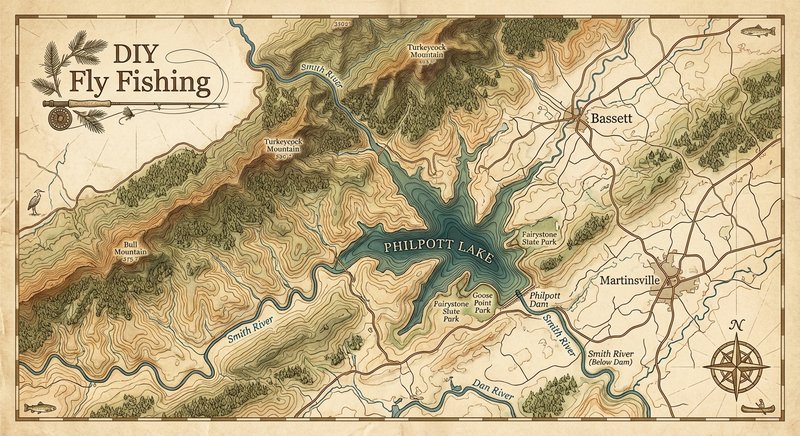
Philpott Lake
Fly fishing in Virginia · Intermediate · Best seasons: Spring, Summer, Fall
Target Species
Largemouth Bass, Crappie, Striped Bass
About This Water
Henry County reservoir and source of Smith River tailwater. Bass and crappie.
Fishing Recommendations
Welcome to Philpott Lake, one of Virginia’s "hidden gems" nestled in the rugged foothills of the Blue Ridge Mountains. As a guide, I consider Philpott to be one of the most scenic and rewarding fly fishing destinations in the Southeast, though its crystal-clear water and steep topography require a tactical approach.
Here is your comprehensive guide to fly fishing Philpott Lake.
🎣 Location Overview
Philpott Lake is a 2,900-acre reservoir managed by the U.S. Army Corps of Engineers. Unlike many Virginia lakes, Philpott has virtually no residential development on its shores, offering 100 miles of pristine, forest-lined coastline.
The water is remarkably clear—often with 10–15 feet of visibility—which makes it look more like a mountain lake than a typical lowland reservoir. It is deep, rocky, and fed by the cold waters of the Smith River. For the fly angler, this means you are fishing "highland reservoir" style: focusing on steep drop-offs, underwater ledges, and flooded timber rather than shallow weed beds.
🐟 Target Species & Behavior
Largemouth Bass
Philpott’s largemouths are sleek and healthy. Because of the water clarity, they are often more "light sensitive" than bass in murky water.
- Behavior: They hold tight to the abundant "downed timber" (fallen trees) and rocky points.
- Feeding: Their diet consists primarily of gizzard shad, threadfin shad, and crayfish.
Crappie
Philpott holds an impressive population of "slabs."
- Behavior: They are highly structure-dependent. You will find them suspended in standing timber or tucked into brush piles.
- Feeding: They focus almost exclusively on small minnows and young-of-the-year shad.
Striped Bass
This is the "big game" of Philpott. These fish are nomadic and follow the bait.
- Behavior: In Spring and Fall, they move toward the mouths of creeks and onto shallower points. In Summer, they retreat to the deep "thermocline" near the dam.
- Feeding: Alewives and gizzard shad.
📅 Best Times to Fish
Spring (Late March – May)
- The Window: This is the prime time for fly anglers. As the water hits 55–65°F, bass and crappie move into the shallows to spawn.
- Conditions: Overcast days are gold. The fish lose their wariness in the clear water and will smash flies in 2–8 feet of water.
Summer (June – August)
- The Window: Low light is mandatory. Fish from 5:00 AM to 9:00 AM and the last two hours of daylight.
- Conditions: Look for the "topwater bite" at dawn. During midday, fish retreat to 20+ feet, making them difficult to reach with a fly rod unless using heavy sinking lines.
Fall (September – November)
- The Window: As the water cools, shad move into the creek arms (like Bowens Creek). The predators follow.
- Conditions: Mid-day fishing becomes productive again. Look for "surface busts" where Stripers or Bass are corralling bait.
🪰 Recommended Flies & Techniques
For Largemouth Bass
- Patterns:
- Topwater: BoogleBugs (size 4), Frog patterns, and Deer Hair Poppers.
- Subsurface: Gamechangers (white/chartreuse), Clouser Minnows, and Crawfish patterns with lead eyes.
- Technique: Focus on "vertical" structure. Cast your fly as tight to a fallen log as possible. Let it sink—often the strike happens on the initial drop.
For Crappie
- Patterns:
- Small Woolly Buggers (size 8-10) in white, pink, or chartreuse.
- "Crappie Candy" (synthetic minnow patterns).
- Technique: Use a 4-weight rod with a slow-sinking tip. Fish vertically over brush piles or use a "count down" method to reach the depth where fish are suspended.
For Striped Bass
- Patterns:
- Large Hollow Fleyes or EP-style baitfish (4–6 inches long) in white/grey or "sexy shad" colors.
- Technique: You need an 8-weight or 9-weight rod with an intermediate or Type 3 sinking line. Target the points near the main channel. Strip the fly fast and erratically.
💡 Pro Tips & Local Knowledge
- The "Smith River Mouth" Advantage: The area where the Smith River flows into the lake stays cooler and more oxygenated. This is a magnet for all species during the summer heat.
- Long Leaders are Key: Because the water is so clear, I recommend using fluorocarbon leaders. For bass, run 9–12 feet of leader tapering to 10lb or 12lb test. If you use a short, heavy leader, the fish will see it and turn away.
- Deer Island: The area around Deer Island features some of the best underwater topography. Focus on the "saddle" between the island and the mainland for Stripers.
- Stealth Matters: Avoid using your trolling motor on high settings. In Philpott’s clear water, vibrations and shadows spook fish much faster than in stained lakes.
⚠️ Important Information
- Access: The best boat ramps for fly anglers are Salthouse Branch (central lake access) and Bowens Creek (good for reaching the creek arms).
- Regulations: A valid Virginia Fishing License is required. There are specific size limits for Striped Bass and Largemouth; check the Virginia DWR website for the most current "Creel Limits."
- Safety: Philpott is deep and the banks are steep. If you are fishing from a kayak or SUP, be aware that wind can kick up quickly, and there are very few places to "beach" a boat due to the rocky shoreline. Always wear your PFD.
- The Tailrace: If the lake fishing is slow, the Philpott Tailrace (below the dam) is a world-class trout fishery. It’s worth bringing a 5-weight rod just in case!
Guide’s Final Word: Philpott is a thinking-man’s lake. Don’t be intimidated by the depth; find the wood, watch your electronics for baitfish, and keep your fly in the "strike zone" as it falls. Tight lines!
Bug Hatches & Matching Flies
| Hatch | Type | Peak months | Time of day | Hook sizes | Matching flies |
|---|---|---|---|---|---|
| Blue Winged Olive (BWO) Baetis | mayfly | March, April, October, November | Midday/Afternoon | #18-22 | Parachute Adams #18-22, Pheasant Tail #18-20, RS2 #20 |
| Sulphurs Ephemerella invaria/dorothea | mayfly | May, June | Late Afternoon/Evening | #14-18 | Sulphur Parachute #16-18, Split Case Sulphur #14-16, Sulphur CDC Emerger #16 |
| Tan Caddis Hydropsyche | caddis | April, May, June | Morning/Evening | #14-16 | Elk Hair Caddis #14-16, Holy Grail #14-16, Frenchie #14-16 |
| Chironomids (Midges) Chironomidae | midge | January, February, March, December | All Day | #20-24 | Zebra Midge #20-22, Griffith's Gnat #20-24, Top Secret Midge #22 |
| Light Cahill Stenacron | mayfly | June, July | Evening | #12-14 | Light Cahill #12-14, Hare's Ear #12-14 |
| Terrestrials (Ants & Beetles) Formicidae/Coleoptera | terrestrial | July, August, September | All Day | #12-18 | Black Foam Ant #16-18, Chocolate Foam Beetle #12-14, Chernobyl Ant #8-12 |
| Tricos Tricorythodes | mayfly | July, August, September | Morning | #22-26 | Trico Spinner #22-24, Trico Parachute #22 |
| October Caddis Pycnopsyche | caddis | September, October | Afternoon/Evening | #8-12 | Orange Stimulator #8-12, October Caddis Pupa #10-12 |